Best Puppy Puzzle Toys 2026: Nina Ottosson Dog Brick Guide
Discover the best mental enrichment for puppies in 2026. Learn how to use the Nina Ottosson Dog Brick to boost cognitive development and ease teething.
The Science of Puppy Brain Games in 2026
When we think of tiring out a new puppy, our minds immediately jump to long walks, endless games of fetch, or marathon playdates at the local dog park. However, as veterinary behaviorists have increasingly emphasized throughout 2026, physical exercise is only half the equation for a developing canine brain. Mental enrichment and puzzle games are critical for early cognitive development, impulse control, and preventing destructive behaviors before they take root.
According to the American Kennel Club, just 15 minutes of focused mental enrichment—such as sniffing, foraging, and solving puzzles—can burn as much energy as an hour of physical walking. For an 8-to-16-week-old puppy whose joints are still developing and who cannot safely endure long physical exertion, brain games are not just a luxury; they are a developmental necessity. Engaging their natural foraging instincts helps build neural pathways, reduces separation anxiety, and provides a healthy outlet for the intense chewing urges associated with teething.
Why the Nina Ottosson Dog Brick is the 2026 Gold Standard
While the market is flooded with new interactive toys every year, the Nina Ottosson Dog Brick (Level 2) remains the undisputed champion for puppy cognitive training in 2026. Priced affordably at around $16.99 to $19.99 in most major pet retailers this year, it offers an adjustable difficulty curve that perfectly matches a puppy's rapidly expanding problem-solving skills.
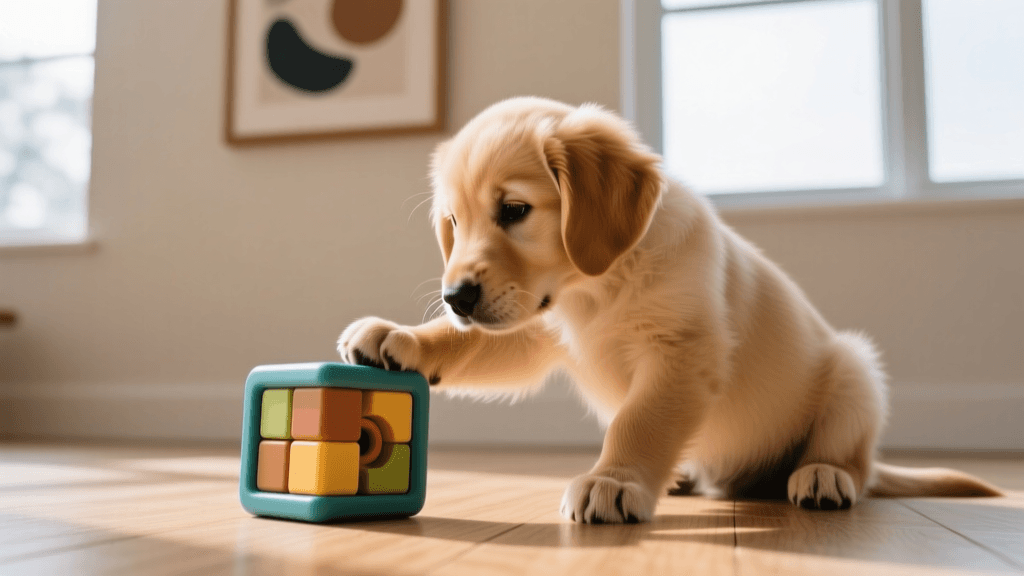
The Dog Brick features three distinct types of mechanisms: sliding compartments, flipping bones, and removable bone covers. The 2026 manufacturing standards ensure that these puzzles are made from BPA-free, phthalate-free, and PVC-free composite materials, which is crucial when your teething puppy is inevitably going to chew on the edges. Unlike cheap plastic alternatives that can splinter and cause intestinal blockages, the Dog Brick is engineered to withstand the sharp incisors of a teething Labrador or German Shepherd puppy.
Step-by-Step Puppy Puzzle Training Protocol
Handing a complex puzzle to an 8-week-old puppy is a recipe for frustration. Puppies do not inherently understand that sliding a plastic block reveals a piece of kibble. You must scaffold their learning. Here is the definitive protocol for introducing the Dog Brick during your puppy's first four months.
Phase 1: The Open Buffet (Weeks 8-10)
During the earliest weeks, your goal is simply to build confidence and associate the puzzle with high-value rewards.
- Setup: Slide all the compartments completely open. Leave the white bone covers off entirely.
- Bait: Use highly aromatic, soft training treats (like freeze-dried minnows or small bits of boiled chicken) rather than dry kibble.
- Action: Place the puzzle on a non-slip mat. Encourage your puppy to eat directly from the open compartments.
- Goal: The puppy learns that this specific plastic board is a reliable source of delicious food.
Phase 2: The Slide Reveal (Weeks 10-12)
Once your puppy eagerly approaches the board, it is time to introduce the first mechanical obstacle.
- Setup: Place treats in the sliding compartments, but only close them halfway. The treat should still be partially visible.
- Action: When the puppy sniffs and paws at the treat, use a marker word like "Yes!" the moment the block slides and the treat is fully exposed.
- Progression: Over several days, gradually close the compartments further until the puppy must deliberately use their nose or paw to slide the block fully open.
Phase 3: The Bone Flip (Weeks 12-16)
This is the most cognitively demanding phase, requiring fine motor skills and sustained focus.
- Setup: Place treats in the circular recesses and cover them with the white plastic bones.
- Action: Puppies will naturally try to chew or paw the bones. Reward them heavily the moment they figure out how to grip the edge of the bone and flip it out of the recess.
- Teething Hack: For puppies in the peak teething window (around 14 weeks), you can smear a thin layer of plain, xylitol-free Greek yogurt or puppy-safe peanut butter under the bones to encourage licking and soothe inflamed gums.
2026 Puppy Puzzle Toy Comparison Chart
While the Dog Brick is excellent for structured training, a well-rounded enrichment routine requires variety. Below is a comparison of the top three mental enrichment tools recommended by veterinary professionals in 2026.
| Toy Name | Primary Enrichment Type | Best Puppy Age | 2026 Avg. Price | Teething Friendly? |
|---|---|---|---|---|
| Nina Ottosson Dog Brick | Cognitive Problem Solving | 8 - 24 Weeks | $17.99 | Moderate (Hard Plastic) |
| Kong Classic (Red/Black) | Foraging & Licking | 8 Weeks+ | $18.50 | Excellent (Soothing Rubber) |
| Outward Hound Snuffle Mat | Olfactory Scent Work | 10 Weeks+ | $22.00 | Poor (Fabric Chewing Risk) |
Tracking Cognitive Milestones in the First Year
Just as you track physical milestones like weight gain and adult tooth eruption, you should monitor your puppy's cognitive progression. The American Veterinary Medical Association (AVMA) notes that early socialization and environmental enrichment are vital for preventing behavioral issues later in life. By month four, a well-enriched puppy should be able to solve a Level 2 puzzle in under two minutes without exhibiting signs of stress, such as excessive whining, pawing frantically, or walking away. If your puppy shows frustration, always revert to the previous, easier phase of the protocol.
DIY Mental Enrichment for Puppies on a Budget
If you are waiting for your puzzle toys to ship or want to supplement your puppy's daily routine, you can create highly effective DIY enrichment games using household items.
- The Muffin Tin Shuffle: Take a standard metal muffin tin, place a piece of kibble in a few of the cups, and cover all the cups with tennis balls. Your puppy must use their nose and paws to knock the balls aside to find the food. This is an excellent, free precursor to the Nina Ottosson Dog Brick.
- The Towel Burrito: Lay a clean, fleece blanket flat on the floor. Sprinkle your puppy's daily kibble ration evenly across it. Roll the blanket up tightly into a "burrito." Your puppy will have to use their paws and snout to unroll the blanket and forage for the kibble. This mimics natural scavenging behaviors and is highly tiring.
- Frozen Goat's Milk Kong: For intense teething relief, plug the small hole of a Kong Classic with a dab of pumpkin puree. Fill it with a mixture of puppy kibble and plain goat's milk, then freeze it solid for 4 hours. The cold soothes the gums, while the licking action releases endorphins that naturally calm the puppy's nervous system.
Safety, Teething, and Supervision Rules
Mental enrichment should never come at the cost of your puppy's safety. Puppies explore the world with their mouths, and their sharp teeth can break off pieces of toys that are meant for adult dogs.
The Golden Rule of Puppy Puzzles: Never leave a puppy unattended with any puzzle toy, snuffle mat, or chewable enrichment item until they are at least 12 months old and have proven they will not attempt to ingest the non-edible components.
Always inspect the Nina Ottosson Dog Brick before and after every use. Look for deep gouges in the sliding tracks or loosened white bone covers. If a piece becomes small enough to be swallowed, discard the toy immediately. Furthermore, account for the calories used in puzzle games. If you are using your puppy's daily kibble ration for training and puzzles, you may need to slightly reduce their bowl meals to prevent rapid, unhealthy weight gain during their critical growth phases. By combining structured puzzle training with safe, supervised play, you will lay the foundation for a confident, focused, and well-adjusted adult dog.
jonas-cole
All our authors care for dogs every day — read more of their work on the authors page.