Managing Mealtime Resource Guarding in Multi-Dog Homes
Learn how to prevent mealtime resource guarding in multi-dog homes with practical feeding routines, spatial management, and expert training tips.
Creating Harmony in the Multi-Dog Household
Sharing your life with multiple dogs brings immense joy, doubled (or tripled) companionship, and a lively home environment. However, it also introduces complex social dynamics that require careful management. One of the most common and stressful challenges in multi-dog households is resource guarding, particularly around mealtime. When dogs feel the need to protect their food, bowls, or high-value chews from their housemates, it can lead to tension, anxiety, and potentially dangerous fights.
Resource guarding is a natural, evolutionary survival instinct. In the wild, protecting calories was essential for survival. In our modern living rooms, however, this behavior is unnecessary and hazardous. The good news is that with structured routines, spatial management, and proactive training, you can create a peaceful dining environment for your entire pack. This comprehensive guide will walk you through actionable strategies to manage and prevent mealtime resource guarding in your multi-dog home.
Understanding Resource Guarding and Canine Body Language
Before you can manage resource guarding, you must be able to identify it. Many pet parents only recognize guarding when it escalates to growling, snapping, or biting. However, dogs communicate their discomfort long before a physical altercation occurs. According to the Humane Society of the United States, understanding subtle canine body language is the first line of defense in preventing behavioral escalations.
Early Warning Signs of Guarding
- Whale Eye: The dog turns its head away from the bowl but keeps its eyes fixed on the approaching dog or human, showing the whites of its eyes.
- Freezing and Stiffening: The dog stops chewing and becomes completely rigid when another pet enters the room.
- Accelerated Eating: Gulping food down frantically or attempting to cover the bowl with their paws or body.
- Lip Licking and Yawning: Displacement behaviors that indicate internal stress and anxiety regarding the proximity of a perceived competitor.
- Low Growling or Hard Staring: Late-stage warnings that indicate the dog is prepared to escalate to a bite if the boundary is crossed.
By recognizing these early signals, you can intervene by managing the environment before the dog feels forced to react aggressively.
The Foundation: Spatial Management and Setup
The most effective way to prevent resource guarding is to remove the opportunity for it to occur. Spatial management ensures that dogs do not feel pressured to defend their resources because their housemates are physically prevented from encroaching on their space.
Strategic Barrier Placement
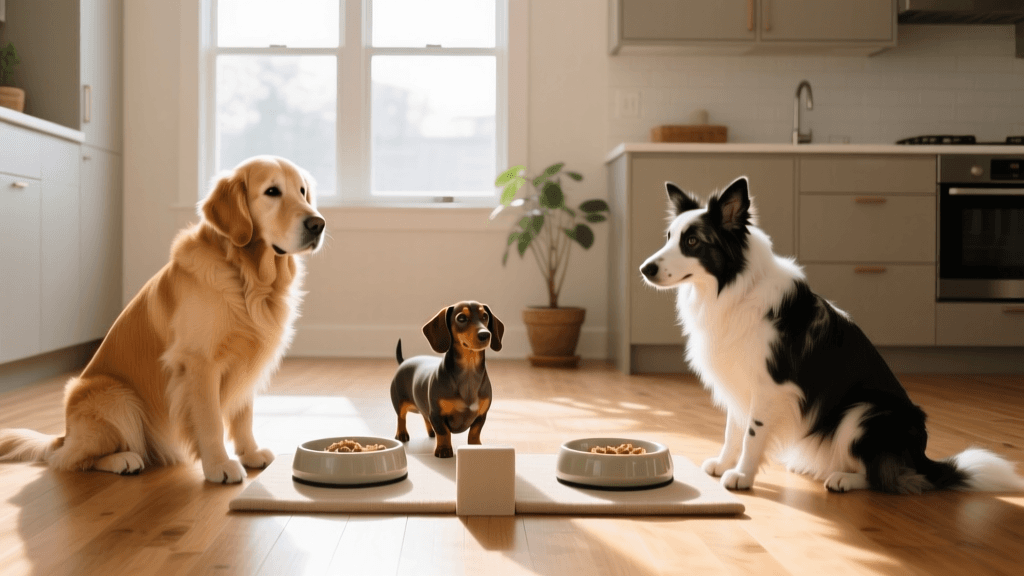
Investing in high-quality baby gates is non-negotiable for multi-dog homes. You should create designated 'dining zones' where dogs can eat without visual or physical access to one another.
- Hardware-Mounted Gates: For doorways and high-traffic areas, use hardware-mounted gates like the Cardinal Gates Stairway Special (approx. $70-$90). These screw into the studs and cannot be knocked over by large, excited dogs.
- Pressure-Mounted Gates: For temporary hallway divisions, pressure-mounted gates like the Regalo Easy Step Walk Thru (approx. $40) work well, provided your dogs are not prone to jumping on or pushing against them.
- Freestanding Pet Pens: If you have an open-concept home, a freestanding pen like the IRIS USA Exercise Pen (approx. $60) can create an instant, movable dining room for the dog who needs the most space.
Crate Training as a Safe Haven
Crates should never be used as punishment, but rather as a personal sanctuary. A heavy-duty wire crate, such as the MidWest Homes for Pets Ultima Pro ($80-$130 depending on size), provides a secure, den-like environment. Feeding a resource-guarding dog inside their crate with the door closed eliminates all anxiety about approaching housemates, allowing their nervous system to relax during meals.
Implementing a Structured Feeding Routine
Dogs thrive on predictability. A structured feeding routine removes the chaos and competition that often trigger guarding behaviors. Here is a step-by-step protocol for mealtime success:
- Separate the Pack: Before bringing out any food, guide each dog to their designated dining station (crate, separate room, or gated area).
- Prepare Meals Out of Sight: The sound of kibble hitting bowls can cause excitement and barrier frustration. Prepare the meals in a closed kitchen or pantry.
- Distribute Calmly: Ask each dog for a 'sit' or 'down' before placing the bowl down. This reinforces impulse control and establishes you as the provider of resources.
- Enforce the 15-Minute Rule: Leave the food down for exactly 15 minutes. If a dog does not finish, pick the bowl up and put it away until the next scheduled meal. This prevents 'grazing,' which leads to perpetual, low-level guarding anxiety throughout the day.
- Simultaneous Pickup: Once all dogs are finished, or the 15 minutes are up, leash the dogs or put them in another room before picking up the bowls to prevent squabbles over the last few kibbles.
Comparison Chart: Management Tools for Multi-Dog Homes
Choosing the right equipment depends on your home layout and your dogs' sizes. Below is a comparison of common management tools.
| Management Tool | Estimated Cost | Pros | Cons | Best Use Case |
|---|---|---|---|---|
| Hardware-Mounted Gate | $70 - $100 | Extremely sturdy; tall options available | Requires drilling into walls/trim | Main doorways, kitchen entrances |
| Heavy-Duty Wire Crate | $80 - $150 | Secure, portable, doubles as a safe space | Takes up significant floor space | High-value chews, severe guarders |
| Snuffle Mat / Slow Feeder | $15 - $35 | Slows eating, provides mental enrichment | Difficult to clean; not for wet food | Dry kibble, reducing mealtime anxiety |
| Tether / Tie-Down | $15 - $25 | Keeps dog in place without full confinement | Requires supervision; chew risk if unattended | Training 'place' command near bowls |
Managing Water Stations and Toy Bins
While food is the most common trigger, dogs can also guard water bowls and communal toy bins. In a multi-dog home, you should never have just one water bowl. Follow the 'N+1' rule: provide one more water station than the number of dogs you have. If you have three dogs, place four water bowls in different, low-traffic areas of the house to prevent bottlenecking and guarding.
Similarly, avoid leaving high-value toys (like squeakers or tug ropes) in a communal bin. Store toys in a closed cabinet and only bring them out for supervised, structured play sessions. Rotate the toys weekly to maintain novelty and reduce the perceived 'scarcity' that drives guarding behavior.
High-Value Chews and the 'Trade-Up' Game
Mealtime is only half the battle. High-value chews like bully sticks, yak cheese chews, and frozen Kongs are notorious triggers for resource guarding. These items should never be given to dogs in the same room, even if they have never fought over them before. The ASPCA emphasizes that managing the environment to prevent rehearsal of aggressive behaviors is critical, as every time a dog successfully guards an item, the behavior is reinforced.
Teaching the 'Trade-Up' Protocol
If you need to take an item away from your dog, never pry it from their mouth or pin them down, as this will only increase their defensiveness. Instead, teach the 'Trade-Up' game:
- Wait until your dog has a medium-value item (e.g., a standard rubber toy).
- Approach calmly and toss a high-value treat (like boiled chicken or freeze-dried liver) right next to their nose.
- When they drop the toy to eat the treat, calmly pick up the toy.
- Give them the treat, and then immediately give the toy back.
This teaches the dog that a human approaching their resource results in something even better, and that giving up an item doesn't mean losing it forever. Over time, this changes their emotional response from anxiety to anticipation when you approach them while they are chewing.
Desensitization to Housemate Proximity
If your dogs are comfortable eating in separate rooms but you eventually want them in the same space, you must use desensitization and counter-conditioning. Start by feeding them on opposite sides of a closed, solid door. Over several weeks, move the bowls closer to the door. If both dogs remain relaxed, switch to a baby gate or a door cracked open just enough to see through. If either dog exhibits stiffness, whale eye, or growling, you have moved too fast. Increase the distance and proceed at a slower pace. Patience is vital; rushing this process can result in a severe setback.
When to Call a Certified Professional
While spatial management and routine adjustments can resolve mild to moderate guarding, severe cases require professional intervention. You should immediately seek help from a qualified behaviorist if:
- A dog has bitten a human or another pet, breaking the skin.
- Fights break out over resources and are difficult to interrupt.
- A dog exhibits extreme anxiety, pacing, or vocalization when separated from their resources.
- Your management strategies are failing due to the layout of your home or the unpredictable nature of the dogs.
Look for professionals who utilize fear-free, force-free methodologies. The International Association of Animal Behavior Consultants (IAABC) and the Certification Council for Professional Dog Trainers (CCPDT) maintain directories of certified experts who specialize in multi-dog aggression and resource guarding. Avoid trainers who recommend alpha rolls, shock collars, or 'showing the dog who is boss,' as these aversive techniques routinely escalate resource guarding and destroy the trust between you and your dog.
Conclusion
Managing mealtime resource guarding in a multi-dog household is not about dominating your dogs; it is about advocating for their emotional well-being. By implementing strict spatial management, adhering to a predictable feeding routine, and utilizing positive reinforcement techniques like the Trade-Up game, you can eliminate the anxiety that drives guarding behavior. Remember that management is a lifelong commitment. Even dogs who have been successfully counter-conditioned can regress if placed in highly stressful, unmanaged environments. Protect your pack's peace by setting them up for success, ensuring that every meal and chew session is a relaxing, enjoyable experience for everyone in your home.
beth-carrasco
All our authors care for dogs every day — read more of their work on the authors page.