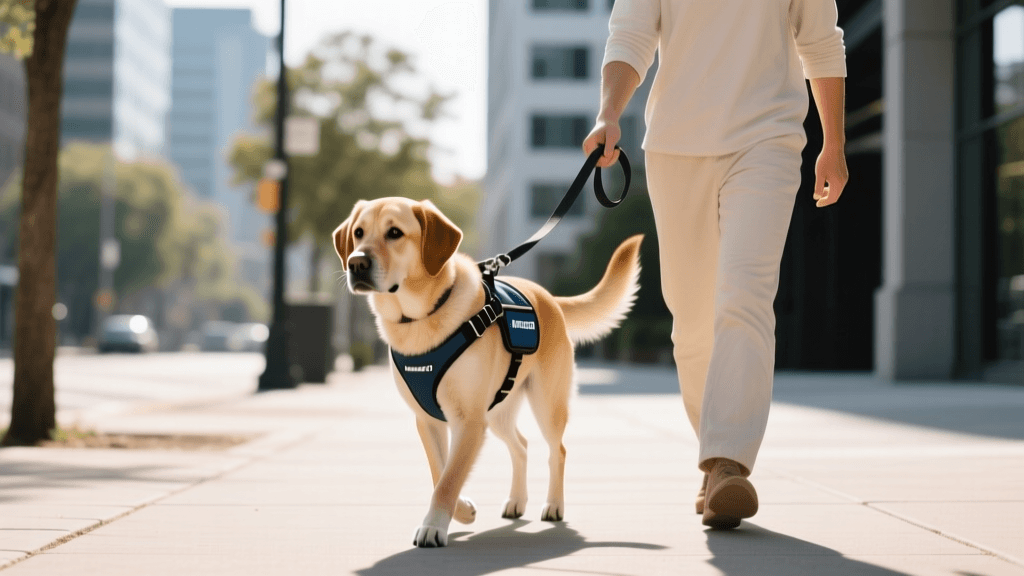
Decoding Mobility Service Dog Stress Signals in 2026
Learn to decode subtle stress and focus body language in mobility service dogs. Essential 2026 guide for handlers and the public on canine welfare.
The Unique Psychological Burden of Mobility Work
When we think of service dogs, we often picture guide dogs navigating busy streets or medical alert dogs detecting blood sugar drops. However, mobility service dogs perform a uniquely demanding role that bridges intense physical labor with deep psychological restraint. These canine partners assist individuals with physical disabilities by performing tasks such as counterbalance, wheelchair pulling, bracing for stability, and retrieving heavy objects. In 2026, the understanding of canine ergonomics and working dog psychology has evolved significantly, revealing the immense cognitive load these dogs carry every day.
Unlike pets, a mobility dog must suppress natural instincts—such as the urge to chase a squirrel, greet a stranger, or investigate a novel scent—while simultaneously bearing physical weight or maintaining precise spatial awareness. This requires an extraordinary level of 'biddability' and impulse control. Understanding the body language of a working mobility dog is not just about recognizing when they are happy; it is about identifying the micro-signals of fatigue, stress, and cognitive overload before they lead to burnout or injury.
The 'Switch': On-Duty Focus vs. Off-Duty Relaxation
One of the most fascinating aspects of working dog psychology is the psychological 'switch' triggered by their working gear. Through rigorous operant conditioning, mobility dogs learn that the donning of a specialized harness or vest signals the beginning of their workday. In 2026, top-tier training facilities utilize ergonomic Y-front mobility harnesses that distribute weight evenly across the dog's sternum and shoulders, preventing the joint strain associated with older, rigid designs.
When the vest goes on, the dog's demeanor shifts. You will notice a change in their ear carriage, a tightening of their core muscles, and a softening of their gaze toward the handler. This is 'task-trained focus.' However, handlers must be vigilant. A dog that remains in a state of hyper-vigilance long after the vest is removed is exhibiting signs of chronic stress. True welfare means ensuring the dog can completely decompress, exhibiting loose, wiggly body language, relaxed facial muscles, and deep, restorative sleep during off-hours.
Decoding Micro-Stress Signals in the Field
Because mobility dogs are specifically selected and trained for their stoicism and willingness to please, they often mask overt signs of distress. A Golden Retriever or Labrador Retriever may continue to brace for a handler's weight even if they are experiencing muscle fatigue or environmental anxiety. It is crucial for handlers and the public to recognize the subtle 'calming signals' and displacement behaviors that indicate a dog is reaching its cognitive or physical limit.
| Signal | Physical Description | Psychological Meaning in Mobility Work | Handler Action Required |
|---|---|---|---|
| Whale Eye | Showing the whites of the eyes while keeping the head pointed forward. | Anxiety or conflict; the dog is focused on a task but distracted by an environmental stressor. | Remove the stressor or grant the dog a brief 'shake-off' break. |
| Displacement Yawning | Exaggerated, repetitive yawning when not tired. | A self-soothing mechanism indicating rising cortisol levels or frustration. | Shorten the outing; provide a low-stress decompression walk. |
| Lip Licking | Rapid flicking of the tongue over the nose or lips. | Nervousness or anticipation of a physically demanding task (e.g., bracing). | Check harness fit; offer verbal reassurance and a high-value reward. |
| Muscle Tremors | Fine shaking in the hindquarters or shoulders while stationary. | Physical exhaustion from sustained counterbalance or pulling tasks. | Immediately cease the physical task; allow the dog to rest and hydrate. |
| Piloerection | Hair standing up along the spine or neck. | Arousal, overstimulation, or feeling threatened by an approaching stranger. | Advocate for the dog's space; enforce public access boundaries. |
2026 Welfare Standards and Public Interference
The intersection of public access laws and canine psychology is a critical area of focus in 2026. According to the Americans with Disabilities Act (ADA) Service Animal Guidelines, a service dog must be under the handler's control and trained to perform specific tasks. However, the ADA also notes that the public must not interfere with a working service animal. From a psychological perspective, when a stranger approaches, speaks to, or attempts to pet a mobility dog, it forces the dog to break its task-trained focus loop.
This interruption spikes the dog's dopamine and cortisol levels, creating a state of cognitive dissonance. The dog wants to engage socially (as dogs are naturally social creatures) but knows it must remain focused on the handler's physical safety. Repeated interruptions throughout a day can lead to 'compassion fatigue' and task-refusal. Organizations like Assistance Dogs International (ADI) continuously update their accreditation standards to emphasize handler advocacy, teaching handlers how to politely but firmly shut down public interference to protect their dog's mental well-being.
Breed Instincts: Biddability and Physical Resilience
The psychology of a mobility dog is deeply rooted in breed genetics. While Labrador Retrievers and Golden Retrievers remain the gold standard due to their high 'retrieve drive' and innate desire to work in tandem with humans, 2026 has seen a notable rise in the use of Bernese Mountain Dogs and Leonbergers for heavy mobility work. These giant breeds possess a natural 'drafting' instinct—the genetic predisposition to pull carts and bear weight.
Understanding these breed-specific instincts is vital. A Retriever approaches mobility work with an eager, high-energy enthusiasm that requires careful impulse control training. In contrast, a drafting breed approaches the work with a calm, methodical steadiness. However, giant breeds also have different stress indicators; they may not exhibit the hyper-vigilance of a smaller breed, but they are highly susceptible to heat stress and joint fatigue. Handlers must tailor their reading of the dog's body language to the specific genetic makeup of their partner.
Actionable Advice for Handlers and the Public
To ensure the psychological and physical longevity of mobility service dogs, both handlers and the general public must adopt a welfare-first mindset. Here are the core principles for 2026:
- For Handlers: Implement the '10-minute rule.' After every 10 minutes of sustained physical bracing or pulling, give your dog a 2-minute decompression break where they can sniff, shake off, and relax their muscles.
- For Handlers: Conduct weekly 'harness-free' body scans. Check for asymmetrical muscle development or sensitivity along the spine that might indicate your dog is compensating for a poorly fitted mobility harness.
- For the Public: Practice the 'Ignore, Don't Interact' rule. Treat a mobility dog in a vest like a medical device. Do not make eye contact, do not speak to the dog, and do not offer treats. Your respect is the greatest gift you can give a working dog.
- For the Public: If you see a mobility dog exhibiting severe stress signals (panting heavily in a cool room, hiding behind the handler, or refusing to move), politely ask the handler if they or their dog need assistance, rather than assuming the dog is misbehaving.
Conclusion
Mobility service dogs are extraordinary partners who give their physical strength and mental focus to enhance human independence. As our understanding of canine psychology deepens in 2026, the responsibility falls on all of us to recognize the silent language of these working dogs. By learning to decode their micro-stress signals, respecting their on-duty focus, and advocating for their off-duty rest, we ensure that these dedicated animals remain healthy, happy, and willing partners for years to come.
beth-carrasco
All our authors care for dogs every day — read more of their work on the authors page.