Preparing Your Home for a Mobility Service Dog: 2026
Discover essential 2026 home modifications, smart tech, and layout tips to prepare your living space for a new mobility assistance service dog.
Welcoming a Mobility Assistance Dog in 2026
Bringing a mobility service dog into your home is a life-changing milestone. These highly trained working animals assist with critical tasks such as bracing for stability, pulling wheelchairs, retrieving dropped items, and opening doors. However, as we navigate 2026, the standards for working dog welfare have evolved significantly. It is no longer enough to simply make your home accessible for yourself; you must also optimize your environment to protect the physical and mental well-being of your canine partner. Mobility work places immense biomechanical stress on a dog's joints, spine, and paw pads. According to Assistance Dogs International (ADI), preserving the long-term health of a working dog requires proactive environmental management and ergonomic home design. This comprehensive guide will walk you through the essential home modifications, smart technology integrations, and spatial planning required to prepare your living space for a mobility service dog in 2026.
The Critical Role of Flooring and Traction
When a mobility dog performs a brace or a pull, they generate significant horizontal and vertical force. Slippery surfaces like polished hardwood, smooth ceramic tile, or laminate are incredibly dangerous for working dogs. A slip during a bracing task can lead to severe orthopedic injuries, including cruciate ligament tears or hip dysplasia exacerbations. In 2026, veterinary orthopedic specialists strongly recommend installing flooring with a high Dynamic Coefficient of Friction (DCOF).
For high-traffic areas and primary working zones, textured Luxury Vinyl Plank (LVP) with a DCOF rating of 0.50 or higher is the gold standard. LVP provides the necessary grip for the dog's paw pads while remaining easy to clean and comfortable for wheelchair tires or walkers. If replacing your flooring is not immediately feasible, you must invest in commercial-grade, low-pile rubber runner mats or interlocking foam gym tiles for the specific areas where your dog will perform mobility tasks. Never rely on standard decorative area rugs, as they can bunch up, slide, and create tripping hazards for both the handler and the dog.
Spatial Planning: Creating Park and Settle Zones
A mobility service dog must be able to work efficiently without navigating a cluttered obstacle course. Furthermore, when the dog is not actively working, they need a designated "Park and Settle" zone where they can rest while remaining close to their handler.
- Clearance Requirements: Ensure there is a minimum clearance of 36 inches in all primary hallways and doorways to accommodate both a wheelchair and a large-breed service dog walking side-by-side.
- The 4x6 Rule: Designate a 4-foot by 6-foot footprint next to your bed, your primary seating area, and your workspace. This space must be entirely free of coffee tables, floor lamps, or decorative poufs.
- Furniture Height: If your dog is trained to retrieve items from beds or sofas, ensure your furniture height is appropriate. Low-profile modular sofas are trending in 2026 for service dog homes, as they allow the dog to safely place their front paws on the cushion without overextending their shoulders.
Smart Home Integration for Reduced Canine Strain
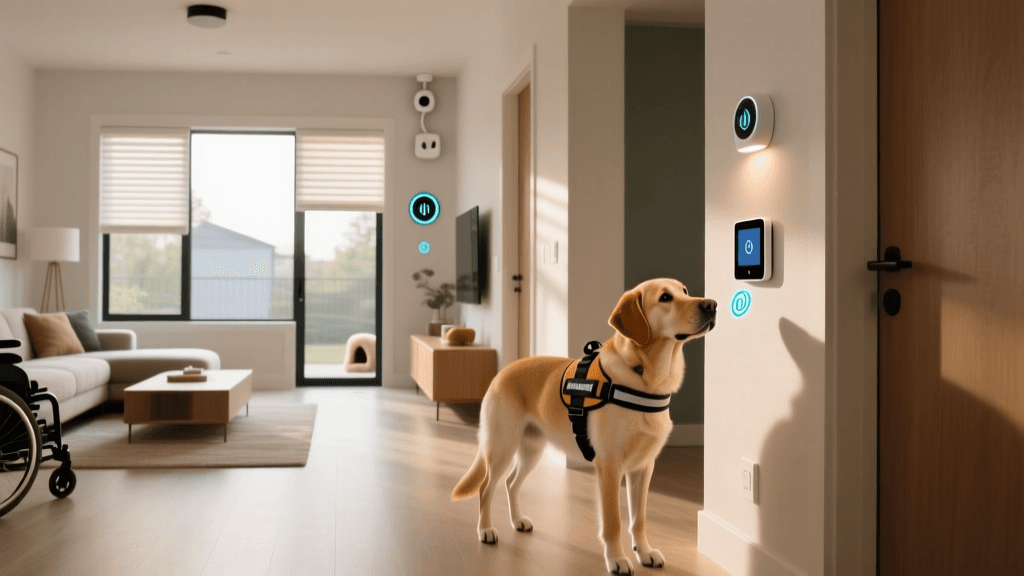
The explosion of the Matter smart home protocol in 2026 has revolutionized how handlers interact with their environment, significantly reducing the physical burden on mobility dogs. While your dog is trained to turn on lights or open doors, relying on the dog for every environmental interaction accelerates joint wear and tear. By integrating smart home technology, you can reserve your dog's physical energy for tasks that truly require their unique capabilities, such as bracing or deep pressure therapy.
Consider installing smart locks, such as the latest Schlage or Yale models equipped with Matter support, which allow you to unlock doors via voice command or a smartphone widget. Similarly, automated window blinds and voice-activated lighting ecosystems (like Philips Hue or Lutron) allow you to manage your environment without prompting your dog to pull cords or flip switches. The U.S. Department of Justice ADA guidelines note that while service dogs are trained for specific tasks, handlers are encouraged to use assistive technology in tandem with their dogs to promote the animal's longevity and welfare.
Navigating Thresholds: Ramps and Doorways
Mobility dogs often pull wheelchairs or assist handlers up inclines. Standard concrete or wooden thresholds can be jarring and difficult to navigate. According to the National Resource Center on Supportive Housing and Home Modification, maintaining a smooth transition between different floor heights is critical for fall prevention and mobility assistance.
For any interior or exterior threshold with a height difference greater than half an inch, install a beveled rubber or aluminum transition ramp. For exterior entryways, modular aluminum ramp systems are highly preferred over custom-built wooden ramps in 2026. Aluminum ramps offer superior weather resistance, require zero maintenance, and feature built-in grit surfaces for maximum paw traction. Ensure that any exterior ramp adheres to the ADA-recommended 1:12 slope ratio (one inch of rise for every twelve inches of ramp length) to ensure your dog can safely pull a wheelchair up the incline without risking spinal injury.
2026 Cost Estimates for Home Modifications
Budgeting for home modifications is a crucial step in the getting-a-dog process. Below is a comparative table outlining the estimated costs for essential home prep modifications in 2026.
| Modification Category | Specific 2026 Recommendation | Estimated Cost Range (USD) | Priority Level |
|---|---|---|---|
| High-Traction Flooring | Textured LVP (DCOF > 0.50) per sq ft | $4.50 - $8.00 | Critical |
| Threshold Ramps | Rubber beveled indoor transitions | $40 - $120 each | High |
| Exterior Wheelchair Ramp | Modular Aluminum (1:12 slope) | $1,200 - $3,500 | Critical |
| Smart Lock Integration | Matter-compatible deadbolt | $180 - $280 | Medium |
| Custom 3D-Printed Harness | Ergonomic mobility pulling harness | $450 - $700 | High |
Advanced Gear: 3D-Printed Custom Harnesses
One of the most significant advancements in working dog equipment by 2026 is the widespread availability of 3D-scanned, custom-molded mobility harnesses. Traditional nylon webbing harnesses, even the high-quality ones, can create pressure points on a dog's sternum and shoulders during repetitive pulling or bracing tasks. Today, specialized canine orthotics labs use LiDAR scanning on smartphones to map the exact contours of your dog's chest and back. The resulting harness is printed using flexible, impact-absorbing TPU (Thermoplastic Polyurethane) materials that distribute weight evenly across the dog's muscular structure. Investing in a custom-fitted harness is not a luxury; it is a medical necessity for any dog performing mobility work to prevent early-onset arthritis and soft tissue damage.
Final Preparations and Ongoing Welfare
Preparing your home for a mobility service dog extends far beyond buying a bed and a leash. It requires a fundamental shift in how you view your living space—transforming it into an ergonomic, safe, and efficient environment that supports both your independence and your dog's physical health. As you finalize your preparations, remember to consult with your service dog trainer or a certified veterinary rehabilitation therapist to assess your specific floor plan. They can provide personalized recommendations based on your dog's breed, size, and the specific mobility tasks they will perform. By investing the time and resources into these 2026 home modifications, you are ensuring that your dedicated canine partner remains healthy, happy, and capable of assisting you for many years to come.
tom-renshaw
All our authors care for dogs every day — read more of their work on the authors page.