Preventing Early-Onset Canine OA: Puppy Joint Guide 2026
Discover how to prevent early-onset canine OA in puppies. Learn 2026 veterinary guidelines for managing dysplasia, joint supplements, and developmental care.
When most dog owners hear the term "canine osteoarthritis" (OA), they immediately picture senior dogs struggling to rise from their beds or navigate stairs. However, veterinary orthopedic specialists emphasize a critical, often overlooked fact: the foundation for early-onset osteoarthritis is frequently laid during the first twelve months of a puppy's life. While OA is a degenerative joint disease that worsens with age, its root causes in many large and giant breed dogs stem from Developmental Orthopedic Diseases (DOD) such as hip dysplasia, elbow dysplasia, and osteochondritis dissecans (OCD). As we navigate the updated veterinary protocols of 2026, understanding how to protect your puppy's developing cartilage and joints is essential for ensuring a lifetime of pain-free mobility.
The Hidden Puppyhood Origins of Canine Osteoarthritis
Osteoarthritis is characterized by the progressive breakdown of articular cartilage, leading to bone-on-bone friction, inflammation, and chronic pain. In puppies predisposed to joint laxity (looseness), the abnormal movement of the femoral head within the acetabulum (hip socket) causes microtrauma to the delicate cartilage. Over the first few months of life, this repetitive microtrauma triggers an inflammatory cascade. According to the Orthopedic Foundation for Animals (OFA), the structural changes that occur before a puppy reaches one year of age directly dictate the severity of the osteoarthritis they will experience in adulthood. Therefore, OA treatment in the context of puppy care is actually about early intervention, joint preservation, and prevention.
Early Diagnostics: PennHIP and OFA Screening
You cannot treat or prevent what you do not measure. In 2026, the gold standard for early detection of hip joint laxity is the PennHIP evaluation. Unlike traditional hip x-rays that require the dog to be mature, PennHIP can be performed on puppies as young as 16 weeks old. By measuring the "Distraction Index" (DI), veterinarians can predict with high accuracy whether a puppy will develop hip dysplasia and subsequent early-onset OA. If your puppy is a high-risk breed (such as a German Shepherd, Golden Retriever, or Rottweiler), scheduling a PennHIP evaluation at 16 weeks is a crucial step in your puppy care timeline. Early identification opens the door to joint-sparing surgical options that are only viable during the rapid growth phases of puppyhood.
Nutritional Management and Joint Supplements
Proper nutrition is the cornerstone of developmental joint health. Overfeeding and rapid growth are primary catalysts for DOD and early OA. The 2026 AAHA (American Animal Hospital Association) weight management guidelines stress that large breed puppies must be kept in a lean, almost "skinny" body condition score (BCS of 4/9) during their first year to minimize mechanical stress on developing growth plates.
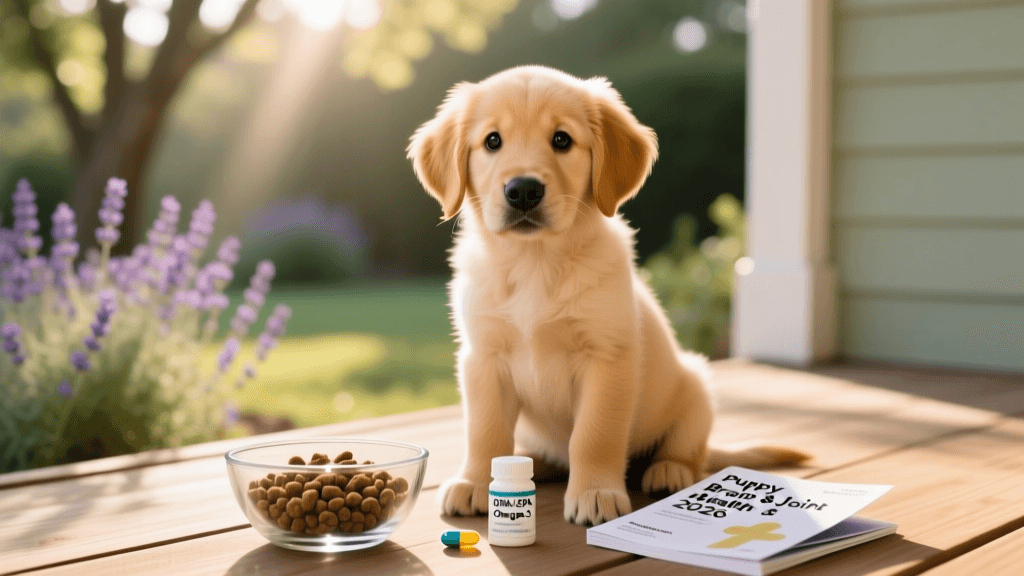
Beyond caloric restriction, targeted supplementation can alter the biochemical environment of the puppy's joints. Here is a comparison of the most effective nutritional strategies for early OA prevention:
| Strategy | Mechanism of Action | 2026 Recommended Products / Actions |
|---|---|---|
| Large Breed Puppy Diet | Controls calcium/phosphorus ratios and slows growth rate to prevent skeletal mismatches. | Royal Canin Giant Puppy, Purina Pro Plan Large Breed Puppy |
| Omega-3 Fatty Acids (EPA/DHA) | Downregulates inflammatory enzymes (COX-2) that degrade cartilage matrix. | Nordic Naturals Omega-3 Pet, Welactin Canine (High EPA/DHA concentration) |
| Chondroprotectives | Provides building blocks for glycosaminoglycans and inhibits cartilage-degrading enzymes. | Dasuquin Advanced with EPI, Nutramax GlycoFlex Max (Chewables) |
| Strict Weight Management | Reduces mechanical load and adipokine-induced joint inflammation. | Daily weigh-ins, precise gram-measured feeding (no free-feeding) |
The 2026 Consensus on Sterilization Timing and Joint Health
One of the most significant shifts in modern puppy care involves the timing of spay and neuter procedures. Historically, puppies were sterilized at six months of age. However, extensive research has proven that early removal of sex hormones prematurely closes growth plates, altering the biomechanical angles of the limbs and drastically increasing the risk of cranial cruciate ligament (CCL) tears and early-onset OA. A landmark longitudinal study from the UC Davis School of Veterinary Medicine demonstrated that delaying sterilization until after skeletal maturity (often 12 to 18 months for large breeds) significantly reduces the incidence of joint disorders. In 2026, responsible breeders and progressive veterinarians strongly advocate for hormone-sparing procedures or delayed sterilization to protect the orthopedic health of at-risk puppies.
Exercise Modification: Protecting Developing Cartilage
Puppies are naturally energetic, but uncontrolled, high-impact exercise is a major contributor to early joint degradation. The cartilage in a puppy's joint is softer and more susceptible to shear forces than that of an adult dog. The American Kennel Club (AKC) and veterinary orthopedic surgeons recommend strict exercise modification during the first year of life to prevent early-onset OA.
The 5-Minute Rule: A widely accepted guideline for structured leash walking is five minutes of exercise per month of age, up to twice a day. For example, a four-month-old puppy should have no more than 20 minutes of continuous, structured walking per session.
Surface Matters: Avoid playing fetch on concrete, asphalt, or slippery hardwood floors. The repetitive slamming of paws on hard surfaces sends shockwaves directly into the elbow and shoulder joints. Instead, encourage low-impact activities like swimming, which builds supportive muscle mass without loading the joints, or off-leash play on soft, uneven grass where the puppy can self-regulate their activity level and rest when tired.
Early Surgical and Medical Interventions
If early diagnostics reveal severe joint laxity or developmental anomalies, 2026 veterinary medicine offers remarkable preventative interventions that can stop OA before it ever begins. Juvenile Pubic Symphysiodesis (JPS) is a minimally invasive procedure performed between 16 and 20 weeks of age. By prematurely fusing a specific growth plate in the pelvis, the hip socket is forced to grow deeper, capturing the femoral head and eliminating the laxity that causes OA. Similarly, a Triple Pelvic Osteotomy (TPO) can be performed on puppies under 10 months of age who show dysplasia but have not yet developed osteoarthritic changes on x-rays. TPO rotates the socket to provide better coverage, effectively preserving the joint for life.
On the medical front, veterinarians may recommend early courses of Adequan Canine (polysulfated glycosaminoglycan) injections. While traditionally used for adult dogs with active OA, off-label early use in high-risk puppies with confirmed microtrauma can help inhibit the enzymatic breakdown of cartilage and stimulate the synthesis of new joint fluid, acting as a powerful shield against early degeneration.
Conclusion: A Proactive Approach to Puppy Joint Care
Preventing early-onset canine osteoarthritis requires a paradigm shift from reactive treatment to proactive preservation. By utilizing early PennHIP diagnostics, adhering to strict large-breed nutritional protocols, delaying sterilization until skeletal maturity, and modifying exercise surfaces, you can drastically alter your puppy's orthopedic trajectory. The decisions you make during your puppy's first twelve months will echo throughout their entire life. Partner closely with your veterinarian to implement these 2026 joint-preservation strategies, ensuring your puppy grows into an active, agile, and pain-free adult dog.
hannah-wickes
All our authors care for dogs every day — read more of their work on the authors page.