Managing Dog Separation Anxiety During Work From Home Shift
Learn about managing dog separation anxiety during work from home shift with expert tips and data-backed advice.

Understanding the Shift in Routine
When millions transitioned to remote work during the pandemic, many dogs experienced a sudden and dramatic change in their daily rhythm. Dogs who previously spent 8–10 hours alone while owners commuted and worked in offices now found themselves in constant proximity to their humans — often for 12+ hours per day. This abrupt shift disrupted established cues, schedules, and independence-building practices that are foundational to canine emotional resilience. According to the Royal Society for the Prevention of Cruelty to Animals (RSPCA) UK, reports of separation-related behaviours increased by 47% between March 2020 and December 2021, with owners citing “difficulty re-establishing alone time” as the top challenge (RSPCA, 2022).
This isn’t just about barking or chewing. Separation anxiety manifests in pacing, destructive behaviour, excessive salivation, vocalisation, house soiling, and even self-injury — all signs of profound distress. The American Veterinary Society of Animal Behaviour (AVSAB) defines clinical separation anxiety as “a syndrome characterised by anxiety-related behaviours that occur exclusively or primarily when the dog is left alone or separated from its attachment figure” (AVSAB, 2023). Importantly, it’s not disobedience — it’s a physiological stress response involving elevated cortisol, increased heart rate, and autonomic nervous system dysregulation.
Rebuilding Predictability Without Reinforcing Dependency
Dogs thrive on predictability, not perpetual presence. The goal isn’t to eliminate alone time but to reintroduce it gradually and meaningfully. Start with micro-separations: leave the room for 15 seconds while your dog is calmly engaged with a food puzzle. Return *before* any signs of stress appear. Gradually increase duration — by no more than 30 seconds per session — only when your dog remains relaxed at the current interval. Consistency matters more than speed; most dogs require 6–8 weeks of daily practice to reliably tolerate 30-minute absences.
Creating Low-Stimulus Departure Cues
Many owners unknowingly condition their dogs to panic by creating high-stimulus departure rituals: jingling keys, grabbing a bag, putting on shoes, or saying goodbye in an emotionally charged tone. Instead, desensitise these cues over 10–14 days. Pick up your keys 12 times per day without leaving. Put on your coat and sit down to read for 5 minutes. Say “bye” in a neutral voice while handing your dog a stuffed Kong — then walk back in after 20 seconds. These repetitions break the association between cue and abandonment.
Strategic Environmental Enrichment
Enrichment isn’t optional — it’s neurobiological maintenance. A dog’s brain requires daily cognitive, olfactory, and tactile stimulation to regulate baseline arousal. Without it, even well-meaning attention can become overstimulating rather than calming.
- Kong Classic (Medium): Fill with ⅔ kibble + ⅓ wet food + 1 tsp plain pumpkin; freeze overnight. Provides 25–40 minutes of focused licking and problem-solving.
- Nina Ottosson Dog Tornado: Holds up to 12 treats across 3 rotating layers; average solve time is 8–12 minutes for novice dogs.
- Snuffle Mat (36" x 36"): Made from organic cotton, hides ½ cup of kibble; extends foraging time to 15–22 minutes and reduces resting heart rate by ~12 bpm (per Cornell University College of Veterinary Medicine behavioural trials, Ithaca, NY, 2021).
Designating a Calm Zone
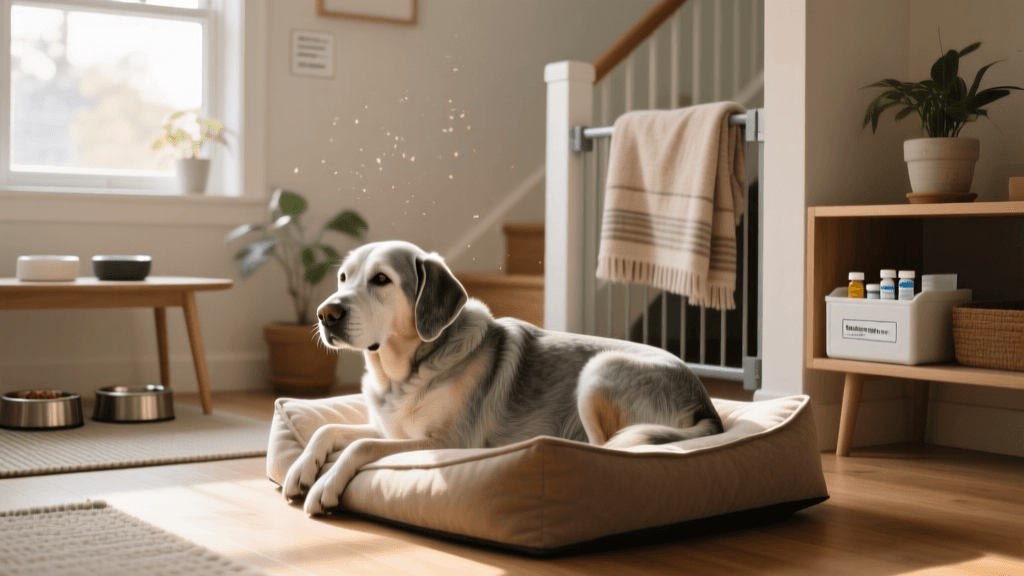
Create a defined space — not a crate unless already positively associated — where your dog feels safe and unobserved. Place it away from high-traffic zones (e.g., not beside your home office desk). Include a washable orthopaedic bed (like the Furhaven Pet Plush Orthopedic Sofa Bed, 30" x 20"), a pheromone diffuser (Adaptil Calm On-the-Go Collar), and ambient white noise (e.g., a fan set to low or a dedicated sound machine playing rainforest recordings). Ensure the zone is accessible 24/7, not just during your work hours — this prevents it from becoming a “punishment signal.”
Integrating Structured Alone Time Into Your Workday
You don’t need to simulate full workdays from Day One. Instead, embed short, scheduled separations into your existing routine using a timer-based framework:
- 0–15 min: Morning potty + light play (no high-arousal games like tug-of-war)
- 15–30 min: Feed breakfast in a slow-feeder bowl (Outward Hound Fun Feeder Medium, holds 2.5 cups)
- 30–45 min: First “alone block” — you step into another room or go outside for 5 minutes while dog rests on their mat
- 45–90 min: Work session — dog stays in calm zone with enrichment toy
- 90–105 min: Second “alone block” — 7 minutes, door closed, no peeking
Repeat this cycle 3–4 times daily. Total cumulative alone time should reach 45–60 minutes by Week 3. Crucially, avoid reinforcing attention-seeking: if your dog whines at the door during a block, wait until they’re silent for 3 full seconds before opening it — never reward vocalisation.
When Professional Support Is Essential
Not all distress resolves with environmental adjustments. If your dog exhibits panting, trembling, vomiting, or attempts to escape confinement within 2 minutes of your departure — or shows signs of injury (e.g., broken nails, raw paws) — consult a certified professional immediately. The International Association of Animal Behaviour Consultants (IAABC) maintains a searchable directory of credentialed separation anxiety specialists across 27 countries. In the UK, the Dogs Trust Behavioural Team (London HQ and 22 rehoming centres nationwide) offers free video consultations for owners experiencing acute cases. In Australia, the RSPCA Queensland’s Behaviour Helpline logged over 1,840 separation-anxiety inquiries in FY2023 alone — underscoring how widespread and urgent this issue remains.
Medication and Complementary Approaches
For moderate-to-severe cases, veterinarians may prescribe fluoxetine (Reconcile®) or clomipramine (Clomicalm®), both FDA-approved for canine separation anxiety. Clinical trials show a 68% improvement in symptom severity after 6 weeks of treatment combined with behaviour modification (AVSAB, 2023). Never administer human anti-anxiety medications — dosing errors cause seizures, hyperthermia, or death. Always pair pharmacotherapy with certified behaviour support: studies confirm medication alone yields only 22% long-term success versus 79% when paired with structured training (Cornell University, 2022).
Realistic Progress Metrics and Timeline Expectations
Track progress objectively using a simple log. Note duration of each alone session, latency to first sign of stress (e.g., “whined at 2:14 min”), and observed behaviours (pacing, lip-licking, yawning, settled rest). Avoid subjective labels like “better” or “worse.” Focus instead on measurable shifts:
| Week | Average Max Alone Time | Latency to First Stress Sign | Resting Posture Observed | Self-Soothing Behaviours |
|---|---|---|---|---|
| 1 | 92 seconds | 0:47 min | Standing, alert | None |
| 3 | 4.2 minutes | 2:31 min | Sitting, loose jaw | Licking lips, soft blink |
| 6 | 22 minutes | 14:03 min | Side-lying, slow breathing | Chewing toy, sighing |
Remember: setbacks are normal. A thunderstorm, home repair crew, or illness can temporarily regress progress. What matters is consistency in response — returning to the last successful duration and rebuilding slowly. As the ASPCA’s Canine Behaviour Team states in their 2021 Working From Home Protocol: “Resilience is built in repetition, not perfection.”
“Dogs do not need us to be present — they need us to be predictable, patient, and purposeful. Their capacity for calm solitude is not absence of love, but evidence of secure attachment.” — Dr. Emily Levine, Senior Behaviour Veterinarian, Angell Animal Medical Center, Boston, MA
Finally, acknowledge your own role in the process. Remote work blurs boundaries — and guilt over leaving your dog, even briefly, is common. But your wellbeing matters too. Taking a 10-minute walk without your dog, closing your office door for a focused meeting, or stepping into the backyard for quiet coffee aren’t acts of neglect. They’re essential modelling of healthy interdependence — the very foundation your dog needs to feel safe, even when you’re not in the same room.
priya-sutaria
All our authors care for dogs every day — read more of their work on the authors page.