Best Dog Breeds for Remote Workers in 2026: Behavior Guide
Discover the best dog breeds for remote workers in 2026. Learn how canine arousal levels and breed instincts impact home office harmony and hybrid schedules.
The Evolution of the Home Office Dog in 2026
As we navigate the professional landscape of 2026, remote and hybrid work models have permanently altered our daily routines. The home office is no longer a temporary setup; it is a dedicated environment where deep work, virtual collaborations, and asynchronous tasks occur. For dog owners, this means our canine companions are permanent fixtures in our workspaces. However, not all dogs are psychologically or instinctively suited for the quiet hum of a Zoom call or the prolonged stillness required for deep focus. Understanding the intersection of canine ethology, breed instincts, and workspace demands is critical for maintaining harmony between your career and your dog's behavioral health.
Understanding Canine Arousal in a Workspace
In canine psychology, 'arousal' refers to a dog's baseline state of alertness, reactivity, and readiness to respond to environmental stimuli. When selecting a dog for a home office environment, evaluating a breed's typical arousal spectrum is far more important than simply looking at their physical energy levels. A dog might be physically exhausted after a morning run but still possess high mental arousal, meaning they remain hyper-vigilant to the sound of the doorbell, the movement of delivery drivers, or your pacing during a phone call.
Remote workers require dogs with low environmental reactivity and a strong capacity for habituation—the ability to tune out repetitive, non-threatening stimuli like keyboard clatter, ringing phones, and shifting desk chairs. Breeds that were historically selected for high vigilance or rapid response to visual and auditory cues often struggle to settle in a dynamic home office, leading to chronic stress and disruptive behaviors.
Top Low-Arousal Breeds for Deep Work
The ideal home office dog possesses a high threshold for stimulation and an instinctual drive for proximity without the need for constant interaction. Here are the top behavioral profiles for remote workers:
1. The Greyhound: The 45-MPH Couch Potato
Despite their reputation as elite athletes, retired racing Greyhounds are among the best breeds for remote workers. Behaviorally, Greyhounds are sprinters, not endurance workers. Their instinct is to expend a short burst of energy and then conserve calories through prolonged rest. They possess incredibly low visual reactivity to indoor movements and are highly prone to 'learned helplessness' in a positive way when placed on a comfortable bed in your office. They will happily sleep through a four-hour strategy meeting, requiring only a brief morning sprint and a decompression walk to remain behaviorally balanced.
2. The Basset Hound: Scent-Driven Serenity
Basset Hounds were bred to track small game at a slow, deliberate pace, allowing hunters to follow them on foot. This history has resulted in a breed with remarkably low physical arousal and a high tolerance for environmental noise. Unlike terriers, which are bred to react explosively to sudden movements and sounds, Bassets process the world primarily through olfaction. As long as they are provided with mental enrichment (such as a snuffle mat under your desk), their low visual reactivity makes them exceptional, quiet companions for focused work blocks.
3. The Cavalier King Charles Spaniel: Affiliative Lap Warmers
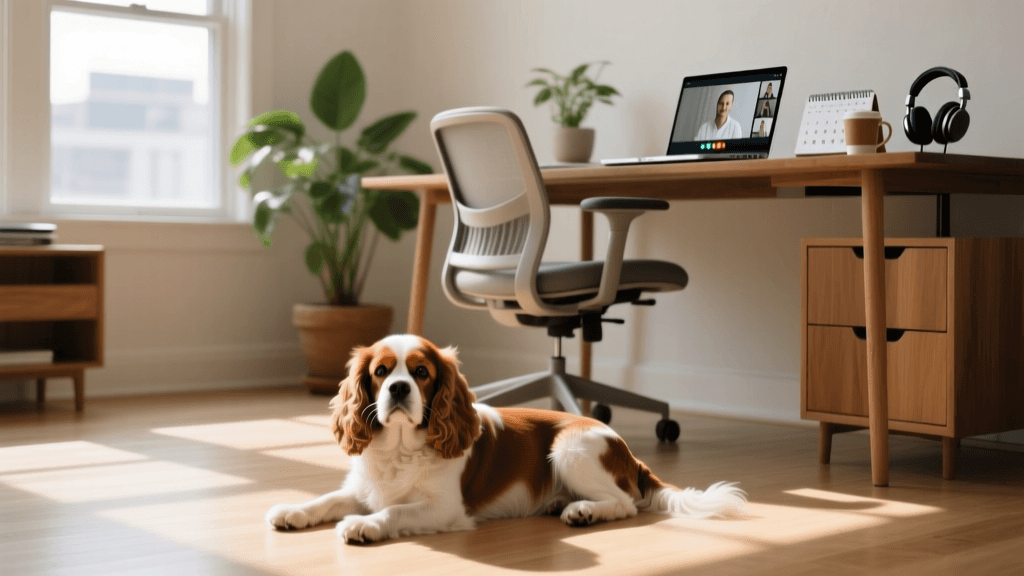
The Cavalier's primary historical function was to serve as a comforting companion and lap warmer for royalty. Their behavioral profile is defined by high affiliative behaviors and a profound desire for physical proximity. They are 'velcro dogs' in the truest sense, but unlike high-drive velcro breeds, Cavaliers lack the working drive that turns proximity-seeking into demanding behavior. They are content to simply rest their chin on your foot while you code or write, providing a calming, oxytocin-boosting presence without demanding active engagement.
The High-Drive Mismatch: Why Herding Breeds Struggle
It is a common misconception that simply tiring out a high-drive working breed will make them a good office dog. Breeds like the Border Collie, Australian Shepherd, and Belgian Malinois possess deeply ingrained herding and guarding instincts. In a home office, these instincts can manifest in highly problematic ways.
Herding breeds are hyper-sensitive to movement and spatial pressure. When you stand up to pace during a brainstorming session, or use expressive hand gestures on a webcam, you may inadvertently trigger their herding sequence. This can result in the dog nipping at your heels, staring intensely, or vocalizing in frustration because they feel compelled to control the 'flock' (you) but are being ignored. Furthermore, their high auditory reactivity means the sudden, overlapping voices of a virtual meeting can cause severe sensory overload, leading to anxiety-driven barking that disrupts your professional life.
The 2026 Hybrid Trap: Velcro Dogs and Separation Anxiety
One of the most significant behavioral challenges for remote workers in 2026 is the transition to hybrid schedules. Many companies now mandate two to three days of in-office work per week. If you have spent the last two years with a highly affiliative 'velcro' dog by your side 24/7, suddenly leaving them alone for eight hours can trigger acute separation anxiety.
According to the ASPCA, separation anxiety is often triggered by a sudden change in routine or a loss of constant companionship. Dogs that have never learned the behavioral skill of independent settling will panic when the home office empties. To prevent this, remote workers must proactively practice 'departures' and utilize confinement training, ensuring the dog views a crate or a separate room as a safe den rather than a punishment zone, long before the hybrid schedule begins.
Breed Instincts vs. Remote Work Demands
| Breed Profile | Instinctual Drive | Home Office Suitability | Hybrid Transition Risk |
|---|---|---|---|
| Greyhound | Sprint and conserve energy | Excellent (Low reactivity) | Moderate (Needs routine) |
| Basset Hound | Slow scent tracking | Excellent (High habituation) | Low (Highly adaptable) |
| Cavalier King Charles | Affiliative companionship | Very Good (Quiet proximity) | High (Prone to separation distress) |
| Border Collie | Movement control / Herding | Poor (Triggers on pacing/gestures) | High (Requires intense mental work) |
| Jack Russell Terrier | High prey drive / Alertness | Poor (Reactive to window/noises) | Moderate (If heavily exercised) |
Actionable Behavioral Protocols for the Remote Worker
Regardless of the breed you choose, maintaining a dog's behavioral health in a home office requires structured protocols. The American Veterinary Medical Association (AVMA) emphasizes that dogs thrive on predictable routines and appropriate mental enrichment. Here are three essential protocols for the 2026 remote worker:
1. The 'Place' Command and Mat Training
Teach your dog a rock-solid 'Place' command using a specific raised cot or mat in your office. This creates a clear spatial boundary. When you are in deep work mode, the mat signals that it is time for passive resting. Reward calm, settled behavior on the mat with low-value treats delivered quietly, reinforcing the concept that doing nothing is a highly rewarded job.
2. Scheduled Decompression Walks
Do not rely solely on physical exercise to tire your dog out. Mental fatigue is far more effective for promoting sleep during your work hours. Utilize 'sniffaris'—long-line walks in natural environments where the dog is allowed to dictate the pace and engage in continuous olfactory processing. A 30-minute decompression walk before you log on will lower your dog's cortisol levels and promote hours of restful sleep.
3. Asynchronous Enrichment
When you must take a long phone call or engage in a high-focus task, provide asynchronous enrichment that keeps the dog occupied without requiring your input. Frozen lick mats, puzzle feeders, and safe, long-lasting chews engage the dog's natural foraging instincts and release endorphins, keeping them quietly anchored to their spot while you manage your professional responsibilities.
By aligning your dog's innate behavioral instincts with the realities of your remote work environment, you create a sustainable, stress-free ecosystem where both your career and your canine companion can thrive.
tom-renshaw
All our authors care for dogs every day — read more of their work on the authors page.