Leash Reactivity Training: A Behaviorist's Guide to Calm Walks
Discover expert behavior analysis techniques for leash reactivity. Learn counter-conditioning, threshold management, and actionable training protocols.

Understanding Leash Reactivity Through Behavior Analysis
Leash reactivity is frequently mislabeled as aggression or dominance, but from a certified behavior analysis perspective, it is primarily an emotional response rooted in fear, anxiety, or barrier frustration. When a dog barks, lunges, or growls at the end of a leash, they are not attempting to assert dominance over their environment. Instead, they are exhibiting a maladaptive coping mechanism designed to increase the distance between themselves and a perceived threat. To successfully modify this behavior, we must shift our focus from suppressing the outward symptoms to altering the underlying emotional state through classical and operant conditioning protocols.
According to the American Veterinary Society of Animal Behavior (AVSAB), the use of punishment-based tools—such as prong collars, choke chains, or electronic shock collars—to suppress reactivity is contraindicated. These aversive methods do not change the dog's underlying emotional response; they merely suppress the warning signs, often leading to a phenomenon known as 'learned helplessness' or sudden, unprovoked biting without prior warning signals. True behavioral modification requires a foundation of trust, predictability, and positive reinforcement.
The Neurobiology of the Reactive Dog
To train a reactive dog effectively, you must understand the canine autonomic nervous system. When a dog spots a trigger (e.g., an unfamiliar dog, a skateboarder, a loud truck), the amygdala—the brain's threat-detection center—activates the sympathetic nervous system. This triggers a massive release of adrenaline and cortisol, preparing the dog for a 'fight or flight' response.
During this neurological hijack, the prefrontal cortex, which is responsible for higher-level learning and decision-making, essentially shuts down. This is why asking a reactive dog to 'sit' or 'look at me' while they are actively barking at a trigger is neurologically futile. The dog is not being stubborn; they are biologically incapable of processing complex operant cues. Therefore, the core tenet of behavior analysis for reactivity is that all training must occur before the amygdala hijack occurs.
Thresholds and Trigger Stacking
A 'threshold' is the exact distance or intensity at which a dog transitions from a calm, learning state into a reactive, emotional state. Behaviorists categorize this into three zones:
- Sub-Threshold (The Green Zone): The dog notices the trigger but remains relaxed. Ears are neutral, the mouth may be open and relaxed, and the dog can readily eat high-value treats. This is the only zone where learning occurs.
- Threshold (The Yellow Zone): The dog shows early signs of stress. Whale eye, lip licking, closed mouth, stiff posture, and fixation on the trigger. The dog may take treats but with a harder, faster bite (snatching).
- Over-Threshold (The Red Zone): The dog is actively barking, lunging, or shutting down. They will refuse food. The sympathetic nervous system is fully engaged.
Furthermore, behaviorists must account for 'trigger stacking.' Cortisol, the primary stress hormone, has a half-life that can take 24 to 72 hours to fully clear from a dog's bloodstream. If a reactive dog has a bad encounter on Monday, their baseline stress level on Tuesday will be elevated, meaning their threshold distance will be significantly wider. Managing a reactive dog requires meticulous environmental management to prevent these cortisol spikes.
The Counter-Conditioning and Desensitization (CC&D) Protocol
Counter-conditioning and desensitization (CC&D) is the gold standard for treating leash reactivity. The ASPCA notes that fear-based aggression and reactivity are best treated by changing the dog's emotional association with the trigger from negative to positive. We achieve this by pairing the appearance of the trigger with the delivery of high-salience, high-value rewards.
Step-by-Step Implementation: The Engage-Disengage Game
Developed by behavior experts, this protocol bridges classical conditioning (emotional response) with operant conditioning (voluntary behavior).
Phase 1: Classical Conditioning (Open Bar/Closed Bar)
- Set up in a controlled environment where you can guarantee the trigger will appear at a sub-threshold distance (e.g., 40 to 60 feet away).
- The moment the dog looks at the trigger, mark the behavior with a verbal cue like 'Yes!' or a clicker.
- Immediately deliver a high-value treat (e.g., boiled chicken breast or Zuke's Mini Naturals). The treat must be delivered within 0.5 seconds of the marker.
- Repeat this every time the trigger is present. When the trigger disappears, the treats stop. This builds a predictable Pavlovian association: Trigger = Chicken.
Phase 2: Operant Conditioning (Engage-Disengage)
- Once the dog begins anticipating the treat upon seeing the trigger, wait for them to look at the trigger and then voluntarily turn their head back toward you to 'disengage.'
- Mark the moment they turn their head back to you, and deliver the treat.
- This teaches the dog an incompatible behavior: instead of fixating and reacting, they learn that looking at the trigger and then checking in with the handler is the most rewarding option available.
Essential Gear for Reactivity Training
Proper equipment is vital for safety and for preventing the inadvertent addition of aversive pressure, which can worsen a dog's emotional state. Below is a behaviorist-approved gear comparison for reactivity work.
| Equipment Type | Recommended Product | Estimated Cost | Behavioral Function & Rationale |
|---|---|---|---|
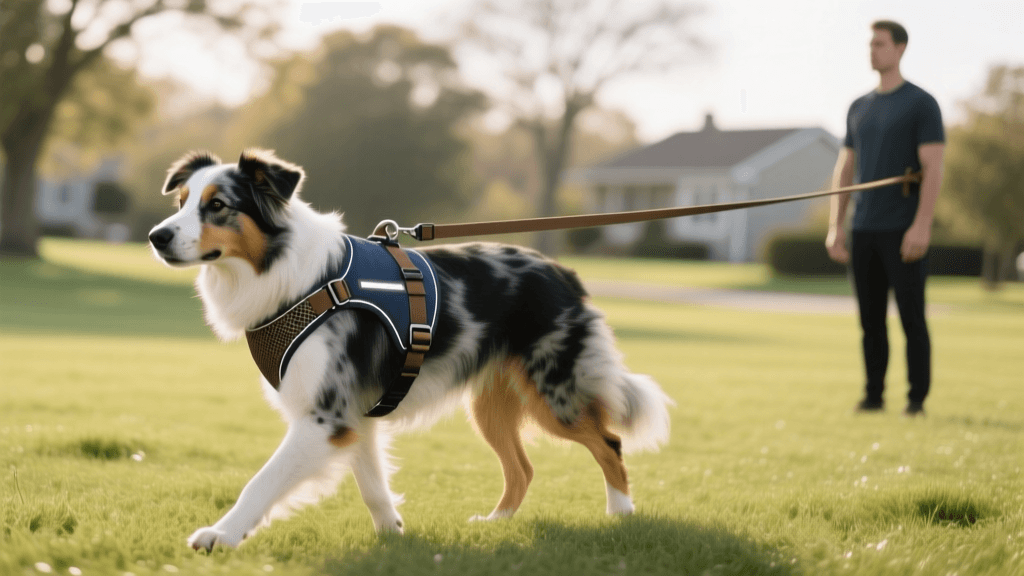
| Front-Clip Harness | Ruffwear Front Range | $39.95 | Reduces pulling leverage without causing tracheal pain or fear. |
| Long Line | 10ft Biothane Leash | $25.00 | Allows safe distance management for threshold work; waterproof and easy to clean. |
| Treat Pouch | DogTreat Toy Original | $18.50 | Magnetic closure ensures sub-second treat delivery, crucial for classical conditioning. |
| High-Value Treats | Zuke's Mini Naturals | $12.99 | Pea-sized, high-salience rewards. Low calorie to prevent satiation during 10-minute sessions. |
Note: Always deduct the caloric value of training treats from your dog's daily meal allowance to prevent obesity. For a 50lb dog, a 15-minute training session using Zuke's Minis should replace approximately 1/4 cup of their daily kibble.
Real-World Troubleshooting and Management
Even with meticulous planning, real-world environments are unpredictable. Here is how to handle common training setbacks using behavior analysis principles:
1. The Ambush Trigger
If a dog suddenly rounds a corner and appears well within your dog's threshold (the Red Zone), abandon the training protocol immediately. Your priority is now management and escape. Use an 'Emergency U-Turn' cue, toss a handful of treats on the ground to engage the dog's scavenging instinct (which naturally lowers the heart rate), and retreat to a sub-threshold distance. Do not punish the reaction; simply increase the distance.
2. Treat Refusal
If your dog refuses a piece of boiled chicken or hot dog, they are over threshold. The sympathetic nervous system has suppressed their digestive drive. Do not force the treat or repeat your cues. Silently increase the distance from the trigger until the dog willingly takes the food. The refusal of a high-value treat is the most accurate biological indicator of a dog's stress levels.
3. Session Duration
Reactivity training is mentally and neurologically exhausting. Limit CC&D sessions to 5 to 10 minutes maximum, 2 to 3 times per day. Prolonged exposure, even at sub-threshold distances, can lead to latent trigger stacking and delayed reactivity later in the evening.
Conclusion
Overcoming leash reactivity is not a test of physical strength or dominance; it is an exercise in empathy, environmental management, and neurological conditioning. By respecting your dog's thresholds, utilizing high-salience rewards, and adhering to the science of counter-conditioning, you can systematically rewire your dog's emotional response to the world. Remember that behavior modification is a marathon, not a sprint. Celebrate the micro-victories—a single glance away from a trigger, a relaxed tail carriage, or a willingly eaten treat—and trust the behavioral science to guide your journey toward calmer, more connected walks.
hannah-wickes
All our authors care for dogs every day — read more of their work on the authors page.