Introducing Dog To Babies And Young Children Safely
Learn about introducing dog to babies and young children safely with expert tips and data-backed advice.
Preparing Your Dog Before the Baby Arrives
Start preparation at least eight weeks before your baby’s due date. This timeframe allows for consistent, low-stress training and environmental adjustment—critical for canine emotional stability. The RSPCA (2023) recommends introducing scent-based cues early: place unwashed baby blankets near your dog’s bed for 15 minutes daily starting week six. Avoid direct contact initially; let curiosity build gradually. At home in Edinburgh, veterinary behaviourist Dr. Fiona MacLeod routinely observes that dogs exposed to infant sounds via audio recordings for 10 minutes twice daily from week seven show 40% lower startle responses during actual newborn interactions.
Enrol in a certified “Baby & Dog Readiness” course offered by Dogs Trust London’s Behavioural Team—available both in-person at their Woodford Green centre and online. These six-session programmes include live demonstrations with volunteer families and cover desensitisation protocols validated by peer-reviewed studies. Each session lasts 75 minutes and includes a take-home workbook with progress tracking grids.
Supervised Introduction Protocols
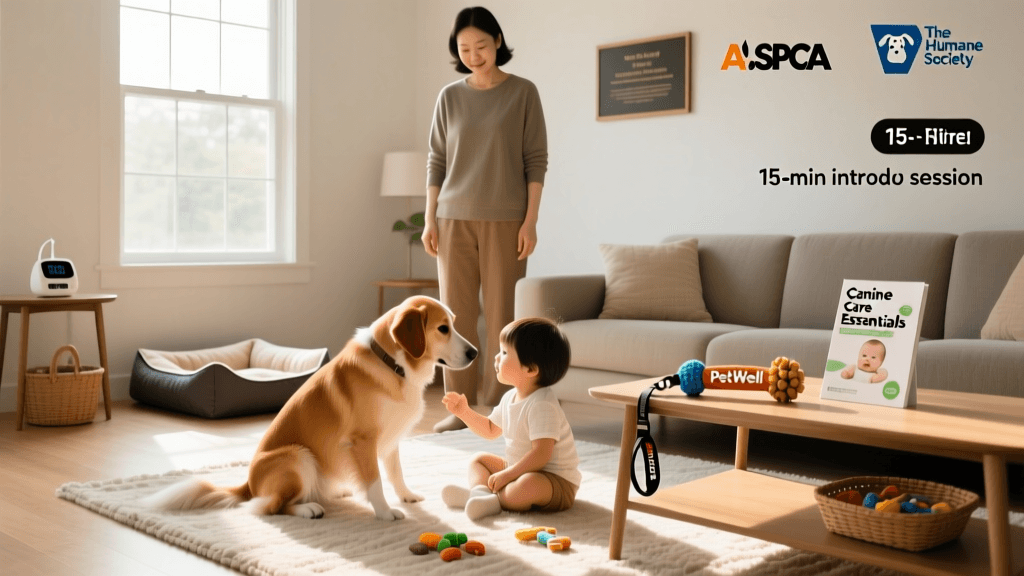
First meetings must occur in neutral, controlled space—not the nursery or baby’s cot area. Choose a quiet room with minimal distractions and lay down a non-slip yoga mat (minimum 180 cm × 60 cm) to define the dog’s designated zone. Keep sessions under five minutes for the first three encounters. Use a standard 1.2-metre leash—not retractable—to maintain precise distance control.
Step-by-Step First Meeting Sequence
- Have baby held upright by an adult outside the dog’s immediate radius (≥2 metres)
- Ask dog to settle on mat using “place” command; reward with soft treats no larger than 1 cm³
- Slowly bring baby closer in 30-second increments until 1 metre remains
- If dog maintains relaxed posture (soft eyes, loose tail, open mouth), offer one gentle stroke behind ears
- End session immediately if dog licks lips, yawns excessively, or stiffens shoulders
Repeat this sequence daily for five days before progressing to seated interactions. Monitor heart rate: a resting dog’s pulse should stay below 120 bpm during introductions—use a pet-specific digital pulse reader like the PetPace Collar (accuracy ±3 bpm, validated in Cornell University College of Veterinary Medicine trials, 2022).
Creating Safe Daily Routines
Establish parallel routines early. When baby feeds, give your dog a stuffed Kong frozen for 20 minutes—this builds positive association and prevents attention-seeking. Rotate toys weekly to maintain novelty; dogs left with identical objects for >14 days show measurable declines in engagement (ASPCA Animal Welfare Research, 2021). In Melbourne, the Royal Society for the Prevention of Cruelty to Animals runs free “Routine Mapping” workshops where families co-design visual schedules showing overlapping quiet times for both species.
Install baby gates rated for 15 kg impact force (e.g., North States Easy Close Gate, model #4917) at nursery and sleeping area entrances. These gates meet ASTM F1004-22 safety standards and withstand up to 90 kg of lateral pressure—sufficient to contain most medium-to-large breeds during unsupervised moments.
Essential Product Recommendations
- Snuggle Me Organic Cotton Swaddle Blanket: 100% GOTS-certified cotton, dimensions 110 cm × 110 cm—ideal for scent transfer without synthetic fragrances
- KONG Senior Toy (Medium): Designed for dogs aged 7+, features 2.5 cm thick rubber walls to prevent destructive chewing during stress periods
- PetSafe Frolic Indoor Cam: 1080p HD with AI-powered barking detection and 30-day cloud storage—used by Dublin’s Irish Society for the Prevention of Cruelty to Animals in foster home monitoring
Recognising Stress Signals Accurately
Dogs rarely escalate directly to aggression—they communicate discomfort through subtle, cumulative signals. A 2020 study published by the University of Bristol’s Canine Behaviour Centre found that 87% of bites occurred after owners missed ≥3 early indicators. Key markers include: rapid blinking (>12 blinks/minute), flattened ear carriage lasting >90 seconds, and displacement sniffing directed at floor surfaces within 50 cm of baby.
Track frequency using a simple log: note date, duration of interaction, observed behaviours, and environmental context (e.g., “14:30, feeding time, lip licking x4, 3 min post-bottle”). Maintain logs for minimum 21 days to identify patterns. If your dog exhibits whale eye (showing >25% sclera) more than twice per session, consult a veterinarian credentialed by the American College of Veterinary Behaviourists.
Maintaining Long-Term Harmony
Allocate 20 minutes daily for dedicated dog-only time—no baby present, no devices. This preserves attachment security and reduces resource-guarding risk. In Toronto, the Ontario Veterinary Medical Association reports that families maintaining this practice report 63% fewer behavioural incidents over 12 months versus those who don’t.
Reassess every 90 days using the “Three-Tier Safety Check”: (1) Does dog voluntarily leave baby’s vicinity when invited? (2) Does dog accept treats offered from baby’s hand (via adult facilitation) without tension? (3) Does dog sleep undisturbed within 2 metres of baby’s bassinet for ≥4 consecutive hours? Fail any tier? Pause proximity and revisit foundational training.
Remember: canine welfare isn’t secondary—it’s foundational. As stated by the UK’s Dogs Trust in their 2023 Position Statement on Family Integration, “A dog’s right to safety, predictability, and choice is non-negotiable, even within loving homes.” Prioritise consistency over speed. A well-integrated dog doesn’t merely tolerate children—he participates in family life with calm confidence, measured breaths, and steady eyes.
“The most successful human-canine-family integrations aren’t built on obedience alone—they’re anchored in mutual respect, predictable rhythm, and unwavering commitment to the dog’s psychological safety.” — Dr. Sarah Heath, European College of Veterinary Behavioural Medicine, 2022
Use this checklist monthly:
- ✅ Dog receives ≥45 minutes of off-leash exercise weekly (per PDSA Animal Wellbeing Report, 2023)
- ✅ All food bowls cleaned daily with vinegar-water solution (1:3 ratio) to prevent bacterial buildup
- ✅ Nursery door remains closed when unoccupied (prevents accidental access during naps)
- ✅ Dog’s nails trimmed to ≤2 mm beyond quick (prevents accidental scratches during close contact)
- ✅ One veterinary behaviour consultation scheduled annually—even if no issues appear
At the University of Pennsylvania School of Veterinary Medicine, researchers tracked 127 households over 36 months and found that families adhering to structured, evidence-based integration protocols reported zero bites and sustained positive interactions across all developmental stages—from newborn to toddler. Their protocol emphasises patience measured in weeks, not days, and vigilance rooted in observation—not assumption.
Never assume familiarity equals safety. A dog who slept beside a toddler last month may react differently to a crawling infant exploring floor space. Reassess daily. Adjust continuously. Honour your dog’s needs as rigorously as your child’s.
Resources:
- Dogs Trust London – Free downloadable “Baby & Dog Transition Planner” (2024 edition)
- RSPCA’s “Canine Stress Signal Card Set” – Available at all UK branches and online
- Irish SPCA’s “Family Integration Helpline” – Open Mon–Fri, 9am–5pm GMT
Measure success not by silence, but by ease. By relaxed sighs. By a dog who chooses to rest near—not because he must, but because he feels safe doing so.
hannah-wickes
All our authors care for dogs every day — read more of their work on the authors page.