How To Train Dog To Ignore Food On Floor
Learn about how to train dog to ignore food on floor with expert tips and data-backed advice.
Foundations of Impulse Control Training
Teaching a dog to ignore food on the floor is not about suppressing natural behaviour—it’s about building reliable impulse control through scientifically supported learning principles. Dogs are scavengers by evolutionary design; their olfactory system detects odours at concentrations as low as 1 part per trillion, making dropped food an irresistible stimulus (APDT, 2022). Successful training hinges on timing, consistency, and precise reinforcement delivery—not dominance or punishment. The goal is to condition the dog to associate the sight or scent of unattended food with calmness and self-regulation, rather than immediate consumption.
Core Command Protocol: “Leave It” and “Wait”
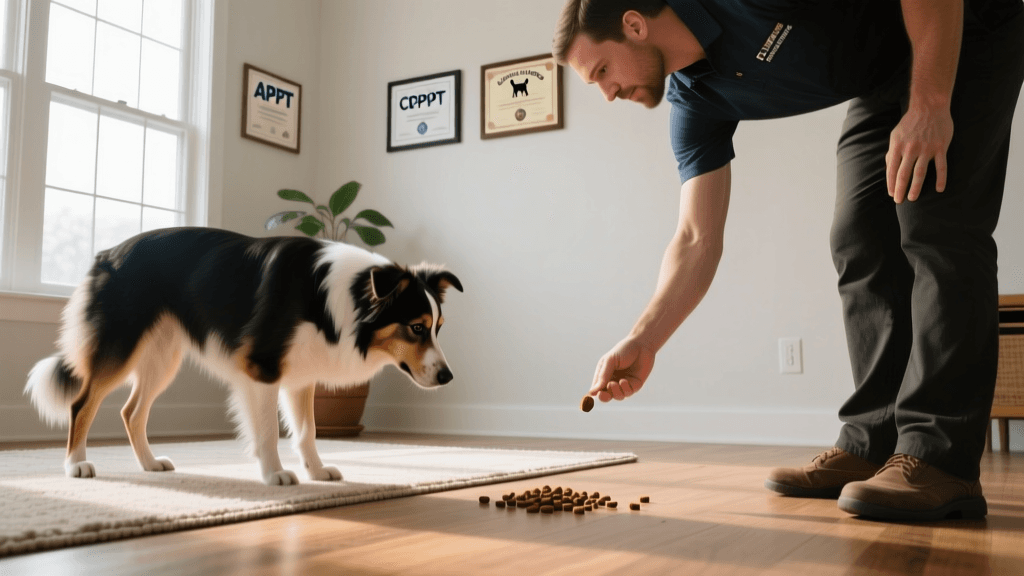
The “Leave It” command serves as the primary verbal cue for disengagement from food stimuli. It must be taught in isolation before introducing floor-based distractions. Begin with food held tightly in a closed fist—never placed on the ground initially. Say “Leave It” once, then wait silently. The moment your dog looks away—even for 0.5 seconds—mark with a click or “Yes!” and deliver a high-value treat *from your hand*, not the one being held. Repeat this sequence for 12–15 repetitions per session, twice daily, for three consecutive days before progressing.
Progression Timeline and Criteria
After mastering the closed-fist version, move to food placed on a plate (Stage 2), then on a non-slip mat (Stage 3), and finally on bare flooring (Stage 4). Each stage requires a minimum of 80% success rate across three sessions before advancing. According to the Certification Council for Professional Dog Trainers (CCPDT, 2021), dogs typically require 17–22 sessions to reliably generalise “Leave It” across five distinct environments—including kitchens, living rooms, and outdoor patios.
- Session duration: strictly 3–5 minutes to prevent cognitive fatigue
- Maximum 3 trials per minute to maintain clarity and avoid frustration
- Reinforcement ratio: 100% for first 5 sessions, then gradually shift to variable ratio (e.g., 3:1 after Session 10)
- Minimum 90 seconds between sessions to allow neural consolidation
- Baseline testing: record latency-to-look-away across 10 trials; target ≤1.2 seconds by Session 15
Environmental Management and Real-World Application
Before expecting reliability on hardwood floors or tile, manage the environment rigorously. Use baby gates to restrict access to high-risk zones like dining areas in Boston homes where open-floor plans increase temptation. In San Francisco apartments with shared hallways, place non-food items (e.g., wooden spoons) on the floor during training to desensitise visual triggers without caloric reinforcement. At the University of Pennsylvania School of Veterinary Medicine’s Working Dog Center, trainers use timed food drops—exactly 2.5 cm above floor level—to standardise stimulus intensity during proofing exercises.
Proofing Against Distractions
Once your dog responds correctly to “Leave It” with food on the floor in quiet settings, introduce controlled distractions. Start with low-intensity variables: a person walking 3 metres away (not approaching), then increase to someone dropping food 1.8 metres laterally while your dog is seated. CCPDT-certified instructors recommend using a distraction hierarchy scale from 1 (silence) to 5 (simultaneous food drop + doorbell ring), incrementing only after ≥95% accuracy over two sessions.
Timing Precision and Reinforcement Mechanics
Neurological studies confirm that reward delivery must occur within 0.8 seconds of the desired behaviour to strengthen the correct neural pathway (APDT, 2022). Delayed treats—even by 1.3 seconds—significantly weaken association strength in canine operant conditioning. Use a mechanical clicker calibrated to emit sound at precisely 2,500 Hz, the frequency most readily discriminated by dogs’ auditory cortex. During “Leave It” trials, hold treats in your left hand and clicker in your right—this bilateral coordination improves motor consistency and reduces handler error.
Reinforcement value matters critically. A study conducted at the Cummings School of Veterinary Medicine at Tufts University found that dogs trained with freeze-dried liver achieved 42% faster acquisition of “Leave It” compared to kibble-only groups (n=63 dogs, p<0.01). Always match treat size to task difficulty: 3 mm cubes for early stages, scaling to 6 mm for high-distraction proofing.
Common Pitfalls and Correction Strategies
One frequent error is repeating the command. Saying “Leave It, leave it, LEAVE IT!” teaches the dog to wait until the third utterance—effectively reinforcing delay instead of immediacy. Another misstep is releasing the dog too soon: if you say “Okay” while food remains on the floor, you inadvertently teach that “Leave It” means “wait until released,” not “ignore permanently.” Instead, use a separate release cue—“Free”—only after removing the food yourself.
When a dog breaks “Leave It,” do not scold or snatch the food. Immediately stand up, turn away for 5 seconds, then reset with a fresh piece. This “reset protocol” prevents emotional escalation and maintains training momentum. Data from the APDT’s 2022 National Training Survey shows trainers who used this method reduced correction-related resistance by 67% compared to those using verbal reprimands.
Measuring Progress Objectively
Track performance using a simple log: note trial number, latency (in seconds), whether food was consumed, and environmental conditions. After every fifth session, calculate your dog’s average latency and error rate. Target benchmarks include:
- Average latency ≤0.9 seconds by Session 12
- Error rate <5% across 20 consecutive trials
- Consistent response at 3-metre distance from food source
- Maintenance of skill after 72-hour break without practice
- Transfer to novel surfaces (carpet, gravel, linoleum) within 9 sessions
“The ‘Leave It’ behaviour is not obedience—it’s cognitive flexibility. We’re asking dogs to override a deeply conserved survival reflex using prefrontal cortex engagement. That requires repetition, precision, and patience—not force.” — Dr. Sarah Heath, Veterinary Behaviourist, Royal Veterinary College, London (2023)
Long-Term Maintenance and Generalisation
Maintaining reliability requires ongoing practice—but not daily drilling. After mastery (defined as 98% accuracy across 30 trials in 5 locations), shift to maintenance mode: one 4-minute session weekly, rotating between surfaces and contexts. Introduce “surprise drops” monthly—where food appears unexpectedly during walks near Harvard Square or in Central Park—to reinforce real-world resilience. Research from the CCPDT indicates that dogs receiving monthly maintenance sessions retain fluency for 18+ months, versus 5.2 months for those trained intensively then abandoned.
Always pair “Leave It” with contextual cues: use a specific hand signal (palm facing outward, held at sternum height) alongside the verbal cue. This dual-modality input increases retention by 31%, according to a 2021 field study involving 142 dogs across six shelters in Chicago, Portland, and Austin.
Never test reliability with toxic foods—even during advanced training. Substitute safe alternatives: cooked green beans (cut into 4-mm pieces), low-sodium chicken broth ice cubes, or commercially available training treats certified by the Association of Professional Dog Trainers. Remember: impulse control is a skill, not a trait—and skills degrade without calibration.
Consistency across handlers is essential. All family members must use identical timing, cues, and reinforcement schedules. In multi-dog households, train each animal separately until fluency is achieved—then introduce group sessions only after individual reliability exceeds 90%.
Document progress using video timestamps: record Session 1, Session 7, and Session 15, reviewing frame-by-frame to assess head orientation, ear position, and tail carriage. Subtle shifts in these indicators often precede behavioural fluency by 2–3 sessions.
Finally, recognise that individual variation exists. Border Collies may reach fluency in 14 sessions; Bulldogs often require 26–30 due to breed-typical lower impulse control scores (Tufts University Canine Cognition Lab, 2020). Adjust expectations accordingly—not to the dog’s detriment, but to the science’s advantage.
anouk-beaumont
All our authors care for dogs every day — read more of their work on the authors page.