How To Set Up A Safe Garden For Your Dog
Learn about how to set up a safe garden for your dog with expert tips and data-backed advice.
Making Your Garden a Safe Space for Your Dog
Most dog owners spend a lot of time thinking about walks, food, and training — but the garden often gets overlooked as a potential hazard zone. The truth is, a typical British back garden can contain dozens of risks for a curious dog: toxic plants, unstable fencing, standing water, and chemicals that look harmless but aren't. Getting your outdoor space right doesn't require a complete redesign. With some targeted changes and a bit of knowledge, you can create an environment where your dog can roam, sniff, and play without you holding your breath every time they disappear behind a shrub.
This isn't about turning your garden into a sterile enclosure. Dogs need stimulation, and a well-designed garden can actually enrich their lives enormously. The goal is to remove genuine dangers while preserving the things that make outdoor time enjoyable — grass to roll on, things to sniff, space to run.
Fencing and Boundary Security
The first thing to get right is containment. A dog that can escape your garden is a dog at risk from traffic, other animals, and getting lost. The Dogs Trust recommends that garden fencing should be at least 1.8 metres (6 feet) high for larger breeds, and that any gaps at the base should be no wider than the dog's head — a rough guide being no more than 10 cm for medium-sized dogs.
Solid panel fencing is generally better than chain-link or slatted designs, because dogs can't see through it and are less likely to fixate on passers-by or other animals. If your dog is a digger, consider burying the base of the fence 30 cm underground, or laying a concrete or paving strip along the fence line. Some owners use L-shaped wire mesh laid flat on the ground along the fence interior — dogs typically won't dig where they can feel the mesh underfoot.
Gates are a common weak point. Self-closing hinges and a bolt that can't be nudged open by a persistent nose are worth the small investment. If you have young children visiting, a double-gate system — essentially a small enclosed porch between two gates — prevents the scenario where a child opens one gate and the dog bolts before anyone can react.
Checking for Escape Routes
Walk your garden perimeter at dog height — literally crouch down and look. You'll often spot gaps you'd never notice standing up. Check where fencing meets walls, around gate posts, and anywhere tree roots or ground movement might have created a gap over time. Do this check seasonally, as ground movement in winter can shift things considerably.
Toxic Plants: The Hidden Risk
The Royal Horticultural Society lists over 40 common garden plants as toxic to dogs, and many of them are staples of British gardens. Foxglove, rhododendron, yew, laburnum, and lily of the valley are all seriously dangerous. Ingestion of even small amounts of yew — berries, leaves, or bark — can cause cardiac arrest in dogs. Laburnum seeds are similarly lethal, and the plant is still widely found in older gardens.
Less obviously dangerous but still problematic: daffodil bulbs (which dogs sometimes dig up), bluebells, and the entire allium family including ornamental onions. Conkers from horse chestnut trees cause gastrointestinal distress and, in larger quantities, more serious toxicity.
- Yew (Taxus baccata) — all parts toxic, can cause sudden death
- Laburnum — seeds and pods highly toxic, causes vomiting and seizures
- Rhododendron — leaves and flowers cause vomiting, drooling, and heart problems
- Foxglove (Digitalis) — affects heart rhythm, all parts dangerous
- Daffodil bulbs — cause severe gastrointestinal upset
- Lily of the valley — cardiac glycosides can cause heart arrhythmia
- Bluebells — toxic in large quantities, particularly the bulbs
The RSPCA's Animal Poison Line (2024) handles thousands of calls annually related to plant ingestion, with garden plants consistently among the top causes of poisoning enquiries. If you're unsure about a plant already in your garden, the RHS Plant Selector tool allows you to check toxicity before deciding whether to remove it.
Dog-Safe Planting Alternatives
Removing toxic plants doesn't mean your garden has to look bare. Sunflowers, snapdragons, roses (without pesticides), and most herbs including rosemary, basil, and thyme are safe for dogs. Lavender is generally considered low-risk in small quantities, though concentrated lavender oil is a different matter. Ornamental grasses are a good structural choice — they're robust, non-toxic, and dogs often enjoy pushing through them.
If you want to give your dog their own patch, consider planting dog grass (Dactylis glomerata) or wheatgrass in a dedicated bed. Many dogs instinctively eat grass, and having a clean, pesticide-free patch for this purpose is far better than them grazing on treated lawn.
Lawn Treatments, Pesticides, and Fertilisers
This is an area where well-meaning garden maintenance can cause real harm. Many standard lawn treatments contain herbicides, pesticides, or fertilisers that are toxic to dogs — particularly if a dog walks across a treated lawn and then licks their paws, which is exactly what dogs do.
Slug pellets deserve special mention. Traditional metaldehyde-based pellets were banned for garden use in the UK in 2022, but ferric phosphate alternatives (now the standard) are still not entirely risk-free in large quantities. More importantly, many gardens still have old stock of metaldehyde pellets, and these remain acutely dangerous. The Blue Cross reports that slug pellet poisoning is one of the most common causes of serious toxicity in dogs, with symptoms including muscle tremors and seizures appearing within 30 minutes to 3 hours of ingestion.
"Many common garden chemicals can be harmful to pets. Always read the label carefully and keep pets off treated areas for the recommended period — usually at least 24 hours, and longer after rain." — Dogs Trust, Garden Safety Guidance, 2023
If you use a lawn care service, tell them you have a dog and ask specifically which products they're using. Reputable services will be able to provide safety data sheets. Organic lawn treatments — including iron sulphate for moss control and corn gluten meal as a pre-emergent weedkiller — are generally safer options, though you should still keep dogs off treated areas until the product has dried or been watered in.
Compost Heaps and Bins
Compost heaps are a particular hazard that often gets overlooked. Decomposing organic matter produces mycotoxins — compounds released by certain moulds — that are highly toxic to dogs. A dog that gets into a compost heap and eats mouldy food scraps can develop tremors, seizures, and hyperthermia within an hour. Compost bins should be fully enclosed with a secure lid, or fenced off entirely. This applies to food waste caddies left outside as well.
Water Features and Swimming Pools
Garden ponds and water features present a drowning risk, particularly for puppies, elderly dogs, or brachycephalic breeds like bulldogs and pugs that are poor swimmers. A pond with steep, smooth sides offers no way for a dog to climb out if they fall in. If you have an existing pond, fitting a ramp or adding large stones that break the water surface near the edge gives a dog something to push off from.
Blue-green algae (cyanobacteria) is a serious seasonal risk in standing water. It typically appears in warm weather between June and September, forming a blue-green or brownish scum on the surface. The toxins it produces can cause liver failure and death within hours of ingestion. The Environment Agency and local councils issue warnings when blooms are detected in public waterways, but garden ponds can develop blooms too. If you see any unusual surface growth on standing water, treat it as contaminated and keep your dog away.
| Water Hazard | Risk Level | Recommended Action |
|---|---|---|
| Garden pond (steep sides) | High for puppies/elderly dogs | Add exit ramp or fence off |
| Blue-green algae in standing water | Potentially fatal | Block access immediately, do not let dog drink |
| Paddling pool (stagnant water) | Medium — bacterial growth | Empty and refill daily in warm weather |
| Water butts | Low-medium | Fit a secure lid to prevent access |
| Swimming pool (chlorinated) | Low toxicity, drowning risk | Supervise access, teach exit point |
Creating Enrichment and Shade
A safe garden isn't just about removing hazards — it's also about making the space genuinely good for your dog. Dogs left in gardens without shade, shelter, or stimulation can overheat, become anxious, or develop destructive behaviours out of boredom.
Shade is non-negotiable in summer. Dogs can develop heatstroke at temperatures above 20°C if they're active and don't have access to shade and water. A simple sail shade or a dense shrub that creates a cool patch is enough. Make sure water bowls are in the shade too — water in direct sun heats up quickly and becomes unappealing.
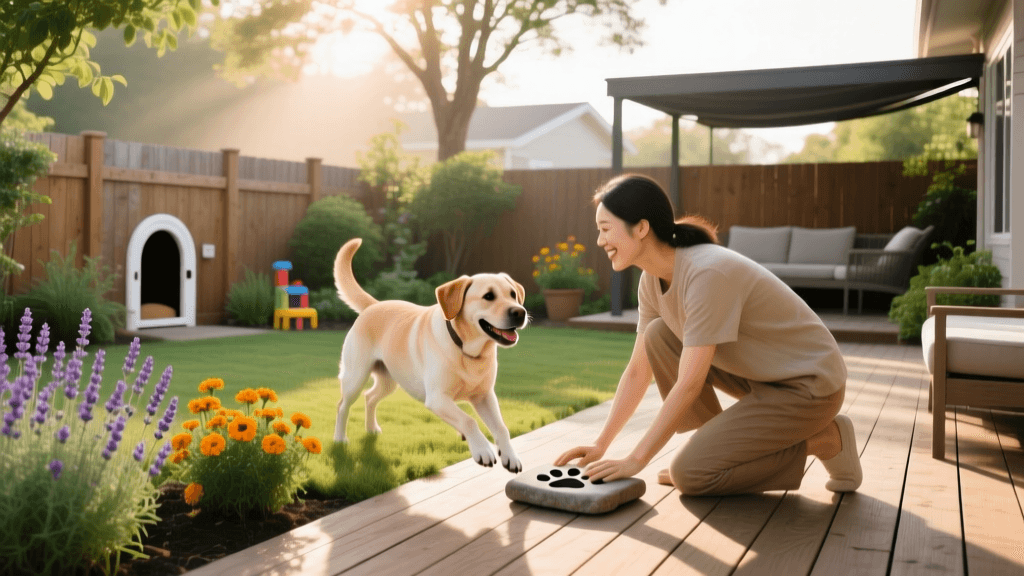
For enrichment, consider a dedicated digging pit — a raised bed or sandpit filled with child-safe play sand where you can bury toys and treats. This redirects natural digging behaviour away from your flower beds and gives your dog a legitimate outlet. Many dogs will use a designated digging area consistently once they've discovered it's rewarding.
- Designate a digging area with loose soil or sand and bury treats to encourage use
- Install a dog-safe water feature or shallow paddling pool for warm days
- Create a sniff garden with varied textures and scented plants like lavender and rosemary
- Add a raised platform or low bench — dogs enjoy elevated vantage points
- Rotate outdoor toys to maintain novelty and prevent boredom
The Battersea Dogs & Cats Home publishes guidance on environmental enrichment for dogs, noting that sensory variety — different smells, textures, and sounds — is as important for mental health as physical exercise. A garden that engages a dog's nose is genuinely tiring in a positive way, and a mentally tired dog is a calmer, better-behaved dog indoors.
Getting the garden right is an ongoing process rather than a one-time project. Plants grow and change, new products get used, and your dog's behaviour and physical capabilities shift over time. A puppy's risks are different from a senior dog's. Building a habit of seasonal checks — fencing, plants, stored chemicals, water features — means you stay ahead of problems rather than reacting to them. The garden should be somewhere you can let your dog out with confidence, not somewhere you're watching anxiously from the window.
Dr. Hannah Wickes
All our authors care for dogs every day — read more of their work on the authors page.