How To Brush Your Dogs Teeth
Learn about how to brush your dogs teeth with expert tips and data-backed advice.
The Case for Daily Dental Care in Dogs
Dental disease is the most commonly diagnosed health problem in dogs seen by veterinary practices across the UK. According to the British Veterinary Dental Association, an estimated 80% of dogs show signs of periodontal disease by the age of three. Left untreated, the bacteria responsible for gum disease can enter the bloodstream and contribute to damage in the kidneys, liver, and heart. Brushing your dog's teeth is the single most effective way to prevent this — more effective than dental chews, water additives, or specialist diets used alone.
The good news is that most dogs can be trained to accept tooth brushing with patience and the right technique. Starting early makes the process easier, but even adult dogs with no prior experience can learn to tolerate — and sometimes enjoy — a daily brushing routine. This guide walks through everything you need to know, from choosing the right equipment to handling a reluctant dog.
Understanding Canine Periodontal Disease
Periodontal disease begins with plaque — a soft, sticky film of bacteria that forms on tooth surfaces within 24 to 48 hours of eating. If plaque is not removed, it mineralises into tartar (also called calculus) within three to five days. Tartar cannot be removed by brushing alone and requires professional scaling under general anaesthesia at a veterinary clinic.
The PDSA Animal Wellbeing (PAW) Report 2023 found that only 8% of dog owners brush their pet's teeth daily, despite dental disease being one of the top five reasons dogs are brought to a vet. The same report noted that dental treatment is among the most expensive routine veterinary procedures, with professional cleaning under anaesthesia typically costing between £200 and £600 at UK practices.
Stages of Periodontal Disease
Periodontal disease is graded on a scale from 0 to 4 by veterinary professionals, as outlined in the British Small Animal Veterinary Association (BSAVA) Manual of Canine and Feline Dentistry and Oral Surgery. Grade 0 represents a clinically healthy mouth. By Grade 2, there is early bone loss visible on dental radiographs. Grade 4 involves severe bone loss of more than 50% around the tooth root, often requiring extraction.
Small and toy breeds — including Cavalier King Charles Spaniels, Yorkshire Terriers, and Dachshunds — are disproportionately affected due to the crowding of teeth in a smaller jaw. Brachycephalic breeds such as Pugs and French Bulldogs face similar risks for the same reason.
What Happens Without Intervention
Without regular brushing, plaque accumulates along the gumline, causing gingivitis — inflammation of the gums. Gingivitis is reversible with professional cleaning and improved home care. However, once the disease progresses to periodontitis, involving the deeper supporting structures of the tooth, the damage is permanent. Research published in the Journal of Veterinary Dentistry has shown that dogs with untreated periodontal disease have a statistically higher incidence of chronic kidney disease compared to dogs with healthy mouths.
Choosing the Right Equipment
Using the correct tools makes brushing more effective and more comfortable for your dog. The market offers several options, and the best choice depends on your dog's size, temperament, and your own dexterity.
Toothbrushes
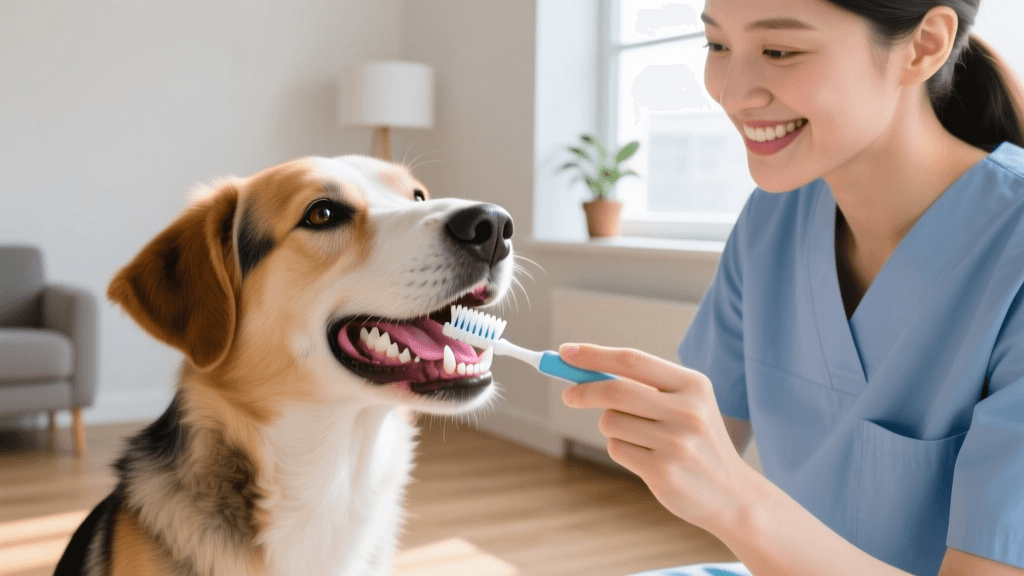
A soft-bristled toothbrush designed specifically for dogs is the gold standard. These are available in two main formats: a long-handled brush similar in shape to a human toothbrush, and a finger brush that fits over the tip of your index finger. Finger brushes give you greater tactile control and are often better tolerated by nervous dogs. For very small breeds, a child's soft toothbrush can also work well.
- Long-handled dog toothbrush: Best for larger breeds; allows you to reach the back molars more easily.
- Finger brush: Ideal for small breeds and dogs new to brushing; provides better control and a gentler introduction.
- Dual-headed brush: Features two brush heads at different angles to clean multiple surfaces simultaneously; useful once your dog is fully comfortable with brushing.
Replace your dog's toothbrush every one to three months, or sooner if the bristles become frayed. A worn brush is significantly less effective at removing plaque.
Toothpaste
Never use human toothpaste on a dog. Human formulations contain fluoride and xylitol, both of which are toxic to dogs. Xylitol in particular can cause a rapid drop in blood sugar (hypoglycaemia) and liver failure even in small amounts. Dog-specific toothpastes are enzymatic — they contain glucose oxidase and lactoperoxidase, which help break down plaque chemically even when brushing is incomplete. They come in flavours such as poultry, beef, and vanilla mint, which most dogs find palatable.
"Enzymatic toothpastes have been shown to reduce plaque accumulation by up to 70% when used consistently as part of a daily brushing routine." — BSAVA Manual of Canine and Feline Dentistry and Oral Surgery, 4th Edition
How to Introduce Tooth Brushing Step by Step
Rushing the introduction is the most common mistake owners make. Dogs that are forced into brushing before they are comfortable will resist, making the process stressful for both animal and owner. A gradual, reward-based approach is far more likely to result in a dog that accepts — or even looks forward to — the routine.
Allow at least two to four weeks for the full introduction process, particularly with adult dogs or those with any history of mouth sensitivity. Each session should last no more than two to three minutes and should always end on a positive note.
- Week 1 — Handling the mouth: Gently lift your dog's lips and touch the teeth and gums with your finger for a few seconds each day. Follow immediately with a high-value treat. The goal is to associate mouth handling with something positive.
- Week 2 — Introducing toothpaste: Place a small amount of dog toothpaste on your finger and let your dog lick it off. Then apply a little to the gums and teeth using your finger. Continue rewarding generously.
- Week 3 — Introducing the brush: Let your dog sniff and lick the toothbrush with toothpaste on it. Then gently brush two or three teeth at the front of the mouth. Keep sessions very short.
- Week 4 and beyond — Building up: Gradually increase the number of teeth you brush each session until you can cover the full mouth. Focus on the outer surfaces of the upper teeth, where plaque accumulates most rapidly due to contact with the cheek.
If your dog shows signs of stress — lip licking, yawning, turning away, or freezing — stop the session and go back a step. Progress should always be led by the dog's comfort level.
Brushing Technique and Frequency
Effective brushing requires the right angle and motion. Hold the brush at a 45-degree angle to the gumline, where the tooth meets the gum. Use small, circular or oval strokes rather than a back-and-forth scrubbing motion. The bristles should gently reach just under the gumline, where the majority of harmful bacteria accumulate.
Concentrate on the outer (buccal) surfaces of the teeth. The tongue naturally cleans the inner surfaces to some degree, so these are lower priority. Pay particular attention to the upper carnassial teeth — the large shearing premolars — which are the most common site for periodontal disease in dogs.
Daily brushing is the target recommended by both the BSAVA and the American Veterinary Dental College (AVDC). Studies have shown that brushing every other day allows enough plaque to accumulate to begin the mineralisation process, reducing the overall effectiveness of the routine. If daily brushing is not achievable, a minimum of three to four times per week is considered the threshold for meaningful plaque control.
| Brushing Frequency | Plaque Control Effectiveness | Recommended By |
|---|---|---|
| Daily (7 days/week) | Optimal — prevents mineralisation | BSAVA, AVDC |
| Every other day (3–4 days/week) | Moderate — some plaque accumulation | Acceptable minimum |
| Once or twice per week | Low — tartar formation likely | Not recommended as sole intervention |
| Rarely or never | Negligible — professional cleaning required | Professional cleaning needed |
Complementary Dental Care Products
Brushing is the foundation of dental care, but several adjunctive products can support oral health when used alongside it. None of these should be considered a replacement for brushing.
- Dental chews: Products carrying the Veterinary Oral Health Council (VOHC) seal of acceptance have been independently tested and shown to reduce plaque or tartar by at least 10%. Look for the VOHC logo on packaging. Give one appropriately sized chew per day.
- Water additives: These are added to your dog's drinking water at a dose of approximately 1 teaspoon (5 ml) per 250 ml of water. They contain antimicrobial agents such as chlorhexidine or zinc that reduce bacterial load in the mouth. Effectiveness varies and evidence is less robust than for brushing.
- Dental diets: Prescription dental diets, such as those produced by Hill's or Royal Canin and carrying VOHC approval, use larger kibble size and specific fibre orientation to mechanically clean teeth as the dog chews. These are particularly useful for dogs that refuse brushing entirely.
- Dental gels and sprays: Applied directly to the gums, these typically contain chlorhexidine at a concentration of 0.12% to 0.2%. They are useful as a bridge during the introduction phase or for dogs that cannot tolerate a brush.
When to See a Vet
Even with excellent home care, most dogs will benefit from at least one professional dental examination per year. Your vet will assess the degree of tartar build-up, probe for periodontal pockets, and advise whether a professional scale and polish under general anaesthesia is needed.
Contact your vet promptly if you notice any of the following signs, which may indicate existing dental disease requiring treatment:
- Persistent bad breath (halitosis) that does not improve with brushing
- Visible brown or yellow tartar on the teeth, particularly near the gumline
- Red, swollen, or bleeding gums
- Pawing at the mouth or reluctance to eat hard food
- Loose or missing teeth
- Drooling more than usual, or drooling that contains blood
The Royal Veterinary College (RVC) in Hertfordshire, one of the UK's leading veterinary institutions, recommends that dental health be assessed at every routine vaccination appointment, not just dedicated dental checks. This ensures problems are caught early, before they progress to stages requiring extraction or more complex intervention.
Puppies should have their first dental check at their initial vaccination appointment, typically at eight to ten weeks of age. This is also the ideal time to begin the tooth-brushing introduction process, as young dogs habituate to new experiences far more readily than adults. The transition from deciduous (milk) teeth to permanent adult teeth occurs between four and seven months of age — a period during which the mouth may be tender and brushing should be approached with extra gentleness.
Investing ten minutes a day in your dog's dental health is one of the most impactful things you can do for their long-term wellbeing. The cost of a toothbrush and a tube of enzymatic toothpaste is negligible compared to the expense — and the discomfort for your dog — of advanced periodontal treatment. With the right approach and a little consistency, most dogs adapt well, and the routine becomes as unremarkable as any other part of the daily care schedule.
Priya Sutaria
All our authors care for dogs every day — read more of their work on the authors page.