How Dogs Smell Time and Emotion: The Science of Scent
Discover the science behind canine olfaction. Learn how dogs smell time, detect human emotions, and how to use scent enrichment for better mental health.

The Invisible World: Understanding Canine Olfaction
When we take our dogs for a walk, we often view the experience through a human lens: a visual journey of sights and sounds. However, for your dog, a walk is an immersive, three-dimensional olfactory experience. Dogs do not just smell odors; they process complex chemical data that tells them a story about the environment, the passage of time, and even the emotional states of the humans around them. Understanding the science behind canine olfaction is not just an academic exercise—it is the key to unlocking better mental health, reduced anxiety, and a deeper bond with your furry companion.
The Anatomy of a Supercomputer Nose
To understand how dogs perceive the world, we must first look at their biological hardware. According to the American Kennel Club, a dog's olfactory acuity is staggering when compared to our own. While humans have approximately 6 million olfactory receptors in our noses, a Bloodhound can possess up to 300 million. Furthermore, the part of a dog's brain that is devoted to analyzing smells is proportionally 40 times greater than ours.
Dogs also possess a secondary olfactory system known as the vomeronasal organ, or Jacobson's organ. Located just above the roof of the mouth and behind the upper incisors, this specialized structure is dedicated to detecting pheromones—chemical signals that convey information about species, gender, and reproductive status. When a dog curls their lips back slightly (the Flehmen response) or intently sniffs a fire hydrant, they are actively pumping scent molecules into this organ to decode the 'chemical calling cards' left by other animals.
Smelling the Clock: How Dogs Perceive Time
One of the most fascinating discoveries in canine cognitive science is the concept that dogs can literally 'smell' time. Dr. Alexandra Horowitz, a leading canine cognition researcher at Barnard College, explains that odors are not static; they degrade and move over time. As detailed in Smithsonian Magazine, a dog can determine when a person or animal passed by based on the concentration and degradation of the scent molecules left behind.
Consider a tree in your yard. The scent at the base of the trunk, where an animal may have rubbed against it hours ago, is older and more degraded. The scent carried by the wind from the leaves, or the scent of a rabbit that darted past just seconds ago, is fresh and potent. By reading these gradients of scent concentration, dogs map the passage of time.
Furthermore, dogs rely on convection currents to tell the time of day. In the cool morning, heavy, moisture-laden air keeps scent molecules close to the ground, creating a rich, intense olfactory landscape. As the sun heats the earth, thermal currents lift these molecules higher into the air, causing the ground-level scents to dissipate. Your dog's insistence on a long morning sniff session is their way of reading the 'morning paper' before the ink fades in the afternoon heat.
Detecting Human Emotion Through Chemosignals
Dog owners often swear that their pets know when they are sad, anxious, or stressed. While dogs are masters at reading human body language and facial expressions, science confirms they are also smelling our emotional shifts. When humans experience stress, our autonomic nervous system triggers the release of volatile organic compounds (VOCs) through our breath and sweat.
A landmark 2022 study published in PLOS ONE demonstrated that dogs can detect these stress-associated odors with remarkable accuracy. Researchers collected breath and sweat samples from humans during high-stress mental tasks and during relaxed states. When presented with these samples, the dogs successfully identified the 'stress' samples up to 93.75% of the time. This proves that your dog isn't just reacting to your furrowed brow; they are inhaling the biochemical markers of your cortisol and adrenaline spikes. Recognizing this can help owners understand why their dogs might become clingy or exhibit appeasement behaviors during chaotic household moments.
Practical Scent Enrichment: Actionable Advice for Owners
Knowing the science of canine olfaction means we can leverage it to improve our dogs' welfare. Mental stimulation through scent work is vastly more tiring for a dog than physical exercise. In fact, canine behaviorists often note that 15 to 20 minutes of intense sniffing can equate to an hour of physical walking in terms of cognitive fatigue. Here is how you can implement science-backed scent enrichment into your daily routine.
1. The Decompression 'Sniffari'
A 'Sniffari' is a walk where the dog's nose dictates the pace and direction. The goal is not physical cardio, but olfactory exploration.
- Equipment: Ditch the short 4-foot leash. Invest in a 10 to 15-foot Biothane long line (brands like Mendota Pets or Mighty leash cost between $25 and $40). Biothane is waterproof, easy to clean, and won't burn your hands if your dog lunges toward an interesting bush.
- Timing: Dedicate 20 to 30 minutes, ideally in the early morning or late evening when scent molecules are most concentrated near the ground.
- Execution: Let your dog sniff a single patch of grass for five uninterrupted minutes if they wish. Do not pull them away unless they are in danger. This lowers their heart rate and satisfies their primary biological drive.
2. Snuffle Mats and Foraging
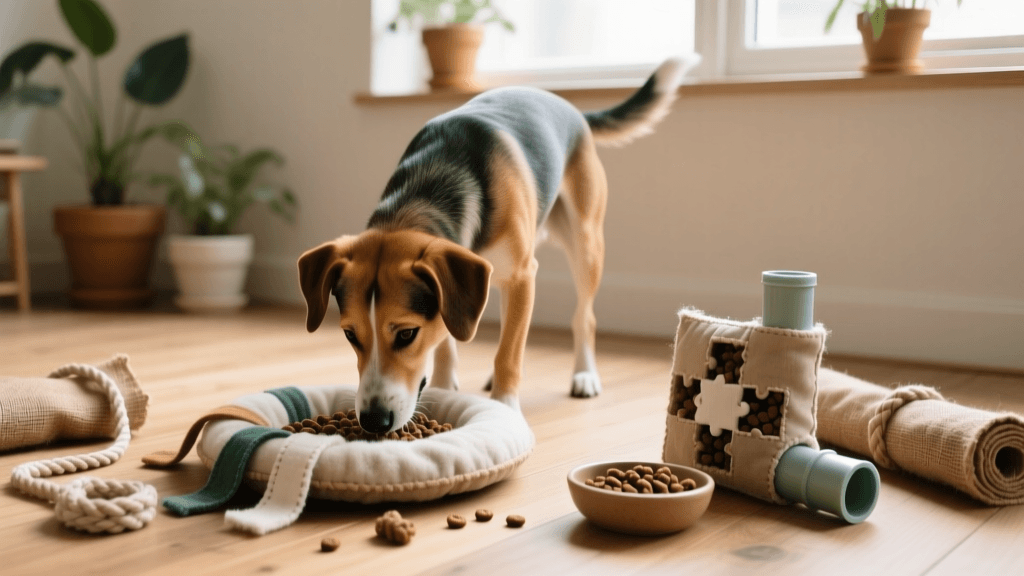
Instead of feeding your dog from a stainless steel bowl (which takes seconds and provides zero mental stimulation), use a snuffle mat. These mats mimic the act of foraging in deep grass.
- Cost: High-quality fleece snuffle mats range from $20 to $40 on retail sites. Alternatively, you can DIY one using a rubber sink mat and strips of old fleece blankets for under $10.
- Usage: Scatter your dog's daily kibble allowance deep into the fleece strips. This forces them to use their nose to locate each piece of food, slowing down fast eaters and reducing the risk of bloat in deep-chested breeds.
3. DIY Scent Discrimination Trails
You can introduce your dog to introductory nose work using dog-safe essential oils.
- Materials: Purchase a canine scent work starter kit containing Birch, Anise, and Clove essential oils (typically $15 to $25 online). You will also need cotton swabs and small tin containers with holes punched in the lids.
- Setup: Place one drop of Birch oil on a cotton swab. Hide the tin in an easy, visible location in your living room and reward your dog with high-value treats (like boiled chicken or freeze-dried liver) the moment they sniff the tin.
- Progression: Gradually increase the difficulty by hiding the tin behind furniture, in different rooms, or in the yard, forcing your dog to follow the 'scent cone' to its source.
Scent Enrichment Comparison Chart
| Enrichment Activity | Estimated Cost | Time Commitment | Primary Cognitive Benefit |
|---|---|---|---|
| Decompression Sniffari | $25 - $40 (Long line) | 20 - 30 mins daily | Lowers cortisol, provides mental fatigue |
| Snuffle Mat Foraging | $15 - $40 (or DIY for $10) | 10 - 15 mins per meal | Slows eating, stimulates natural foraging |
| DIY Scent Trails | $15 - $25 (Oil kits) | 15 mins setup/training | Enhances problem-solving and confidence |
Reading Your Dog's Scent Body Language
As you engage in these activities, watch how your dog's body language shifts when they are processing heavy olfactory data. You will notice specific behaviors that indicate deep concentration:
- The Closed-Mouth Sniff: Dogs will often close their mouths and breathe rapidly through their nose to draw more scent molecules over the olfactory epithelium.
- Ear Flicks and Head Tilts: Dogs have independent muscle control over their ear pinnae. They will cup their ears forward or tilt their heads to funnel airborne scents toward their nose.
- The Nasal Sneeze: After an intense session of sniffing, your dog may sneeze or snort forcefully. This is a biological mechanism to clear the nasal passages of trapped debris and reset the olfactory sensors for the next scent cone.
Conclusion
By shifting our perspective from a visual world to an olfactory one, we can vastly improve the quality of life for our canine companions. The science of canine olfaction reveals that dogs are not just smelling the world; they are reading its history, its chemistry, and its emotional undercurrents. By incorporating structured scent enrichment like Sniffaris, snuffle mats, and scent trails into your routine, you are honoring your dog's most powerful biological gift. The result is a calmer, more fulfilled dog, and a profoundly deeper connection between you and your best friend.
marcus-aldridge
All our authors care for dogs every day — read more of their work on the authors page.