Before and After: The Ultimate Dog-Proofing Home Transformation
Discover the ultimate before and after guide to dog-proofing your home. Learn essential transformations, costs, and safety tips for your new puppy's arrival.

The 'Before' State: Hidden Hazards in a Standard Home
Bringing a new dog into your life is a momentous occasion, but the environment you consider a safe haven is actually an obstacle course of hidden dangers. Before any transformations take place, a standard home is designed for human convenience, not canine curiosity. Puppies explore the world with their mouths, and adult rescue dogs may exhibit stress-induced chewing or scavenging behaviors when introduced to a novel environment. According to the ASPCA Animal Poison Control, thousands of pets are treated annually for ingesting household toxins, human medications, and dangerous objects that were left within reach. Understanding the 'before' state requires looking at your home from a dog's eye level—literally. Get down on your hands and knees to identify exposed electrical cords, low-hanging blind cords, toxic houseplants, and small objects like coins or children's toys that pose severe choking hazards.
The Living Room Transformation: From Danger Zone to Safe Lounge
Before: The Chewing and Strangulation Risks
In an unprepared living room, power strips sit openly on the floor behind the sofa. Venetian blinds feature long, looping cords that dangle at the exact height of a jumping puppy. Houseplants like the Monstera Deliciosa and Sago Palm sit on low coffee tables, and fragile decor items are easily swiped off shelves by a wagging tail.
After: The Secure Sanctuary
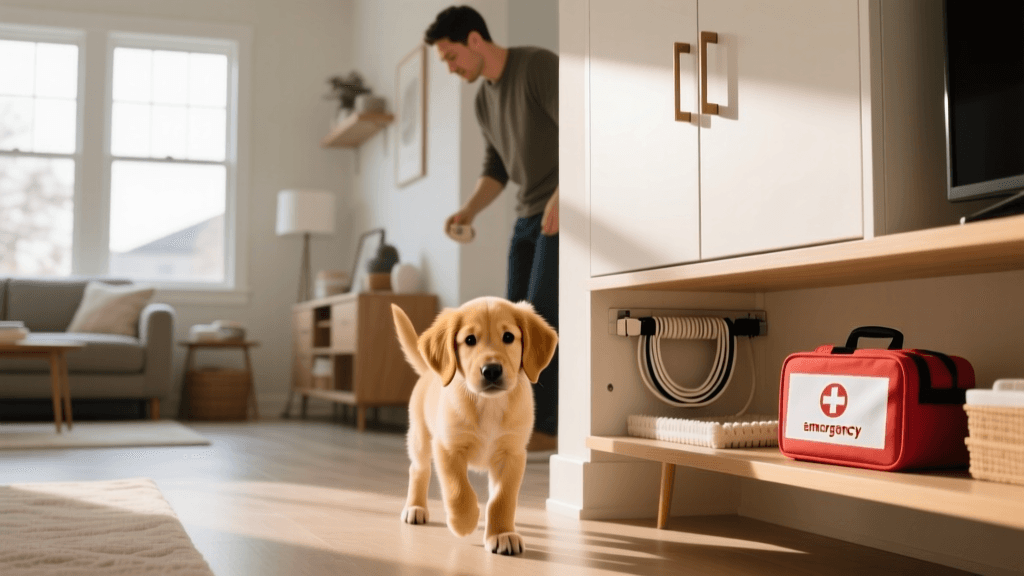
The transformation of the living room focuses on concealment and elevation. Power strips are mounted to the wall using adhesive brackets, and all exposed wires are encased in split-loom wire loom tubing or hard PVC cord protectors to prevent fatal electrocution and expensive veterinary dental surgeries. Cordless cellular shades replace traditional blinds, entirely eliminating the strangulation risk. Toxic plants are rehomed, replaced by ASPCA-approved pet-safe alternatives like Calatheas, Spider Plants, and Boston Ferns. Furniture legs are wrapped in bitter apple spray or physical plastic guards to deter destructive chewing during the teething phase.
The Kitchen Overhaul: Securing the Toxicity Trap
Before: The Scavenger's Paradise
The kitchen is arguably the most dangerous room in the house before dog-proofing. Standard step-on trash cans are easily flipped by a determined Labrador. Under the sink, toxic cleaning supplies like bleach, ammonia, and dishwasher pods sit behind doors with simple magnetic catches that a clever poodle can nose open. On the counters, foods that are highly toxic to dogs—such as grapes, onions, macadamia nuts, and peanut butter containing xylitol—are left in reach of counter-surfing breeds.
After: The Fortified Food Zone
The 'after' kitchen is a fortress of food safety. The flimsy step-on trash can is replaced with a heavy-duty, locking stainless steel bin, such as the simplehuman Locking Trash Can, which requires a manual latch release. Cabinet doors, especially those housing chemicals or the trash, are retrofitted with Safety 1st magnetic child-proof locks that require a specific magnetic key to open. Countertops are kept entirely clear of food, utilizing airtight, heavy glass or ceramic canisters for pantry staples. The Centers for Disease Control and Prevention (CDC) emphasizes that preventing access to human food not only avoids acute toxicity but also reduces the risk of obesity and pancreatitis in dogs over their lifetime.
The Backyard Metamorphosis: Building a Secure Perimeter
Before: The Escape Artist's Playground
A standard backyard often features a 4-foot wooden fence with gaps wider than three inches. The gate relies on a simple gravity latch that can be bumped open by the wind or a nudging snout. Landscaping often includes cocoa bean mulch, which smells like chocolate to a dog but contains theobromine, a compound that is highly toxic and potentially fatal if ingested.
After: The Impenetrable Oasis
The transformed yard is tailored to the specific physical capabilities of your new dog. For terriers and dachshunds, an 'L-footer' wire mesh is buried 12 inches deep and angled inward to prevent digging escapes. For sighthounds and athletic breeds like German Shepherds, the fence is extended to a minimum of 6 feet, and coyote rollers are installed along the top rail to prevent them from gaining the leverage to pull themselves over. Cocoa mulch is entirely removed and replaced with dog-safe cedar bark or pine straw. Gates are upgraded with self-closing hinges and dual-action carabiner latches to ensure they are never accidentally left ajar.
Before and After Cost vs. Value Breakdown
Many new owners hesitate at the upfront costs of dog-proofing. However, when compared to the potential veterinary bills and property damage of an un-proofed home, the investment is minimal. Below is a structured comparison of the financial realities of the 'before' and 'after' states.
| Home Area | Before (Risk & Potential Cost) | After (Solution & Investment Cost) |
|---|---|---|
| Living Room Wires | Electrocution or $800+ dental repair for chewed cables | $25 for split-loom tubing and adhesive cable clips |
| Kitchen Trash | $3,000+ emergency surgery for bowel obstruction from trash ingestion | $120 for a heavy-duty locking trash can |
| Cabinet Toxins | $1,500+ intensive care for chemical burns or poisoning | $30 for a 12-pack of magnetic cabinet locks |
| Backyard Fence | Lost dog recovery costs, impound fees, or traffic injury trauma | $150 for L-footer wire, gate springs, and secure latches |
| Houseplants | $2,000+ for Sago Palm liver failure treatment | $40 to swap toxic plants for pet-safe Calatheas and Ferns |
Breed-Specific Transformations
Not all dogs interact with their environment in the same way. The 'after' state must be customized to the breed or mix you are adopting:
- The Counter-Surfer (e.g., Golden Retrievers, Boxers): Require strict kitchen management, induction cooktops that do not retain residual heat, and heavy, non-slip rugs to prevent joint strain when jumping down from elevated areas.
- The Digger (e.g., Terriers, Huskies): Require designated 'dig boxes' filled with safe sand and buried toys to redirect their natural instincts away from the fence line and expensive landscaping.
- The Anxious Chewer (e.g., Rescue Mixes, Separation Anxiety Prone Breeds): Require a designated 'safe zone' or crate area reinforced with heavy-duty, chew-proof crate pads and interactive puzzle toys to mitigate destructive stress behaviors.
The 'After' State: Behavioral and Emotional Benefits
The transformation of your home goes far beyond physical safety; it profoundly impacts your new dog's behavioral development. The American Veterinary Medical Association (AVMA) notes that environmental management is a cornerstone of behavioral modification. A dog placed in an un-proofed home is constantly corrected with 'no' and 'leave it,' which can lead to anxiety, confusion, and a breakdown of the human-animal bond. Conversely, a dog brought into a thoroughly transformed, dog-proofed home is set up for success. They are free to explore, sniff, and engage with their environment without constant reprimand. This autonomy builds confidence, accelerates house-training, and fosters a deep, trusting relationship between you and your new companion.
Your 30-Day Pre-Arrival Transformation Checklist
To ensure your home is fully transformed before your dog's paws touch the floor, follow this actionable timeline:
- 30 Days Out (The Audit): Walk the perimeter of your yard. Measure fence gaps. Audit all houseplants against the ASPCA toxic plant list. Identify all accessible electrical cords.
- 21 Days Out (The Purchase): Order heavy-duty trash cans, magnetic cabinet locks, cord concealers, and self-closing gate hardware. Purchase pet-safe enzymatic cleaners for future accidents.
- 14 Days Out (The Installation): Install all hardware. Mount power strips. Bury L-footer wire along the fence line. Swap out toxic plants and safely dispose of them outside the home.
- 7 Days Out (The Deep Clean & Setup): Vacuum thoroughly to remove small choking hazards. Set up the designated 'safe zone' with the crate, bed, and water bowls. Test all gate latches and cabinet locks.
Conclusion
The journey of getting a dog is a profound life change, and the physical transformation of your living space is the first step in that journey. By acknowledging the hidden hazards of the 'before' state and investing the time and resources into creating a secure 'after' environment, you are doing more than just puppy-proofing a house. You are building a sanctuary. This proactive transformation ensures that when your new dog finally walks through the door, they are stepping into a space where they can safely thrive, learn, and become a cherished member of your family for years to come.
aaron-whyte
All our authors care for dogs every day — read more of their work on the authors page.