Herding vs Sporting Breeds: Matching Instincts to Lifestyle
Discover the psychological differences between herding and sporting breeds. Learn how to match canine instincts and energy to your daily lifestyle.
The Psychology of Purpose: Why Breed Instincts Matter
When selecting a dog, many prospective owners focus primarily on aesthetics, size, or coat type, often overlooking the profound psychological blueprint hardwired into the animal's brain. Centuries of selective breeding have not only shaped the physical form of our canine companions but also their neurology, behavioral drives, and instinctual responses to the world. Understanding these deep-seated instincts is the cornerstone of successful breed selection and long-term behavioral harmony in the home.
According to the American Kennel Club's Herding Group profiles, dogs were historically developed to perform highly specific cognitive and physical tasks. When a dog is placed in an environment that contradicts its genetic purpose, the resulting frustration often manifests as destructive behavior, anxiety, or hyperactivity. By comparing two of the most popular and active categories—Herding breeds and Sporting breeds—we can decode the psychology behind their actions and learn how to match their unique instincts to the right human lifestyle.
Herding Breeds: The Micro-Managers of the Dog World
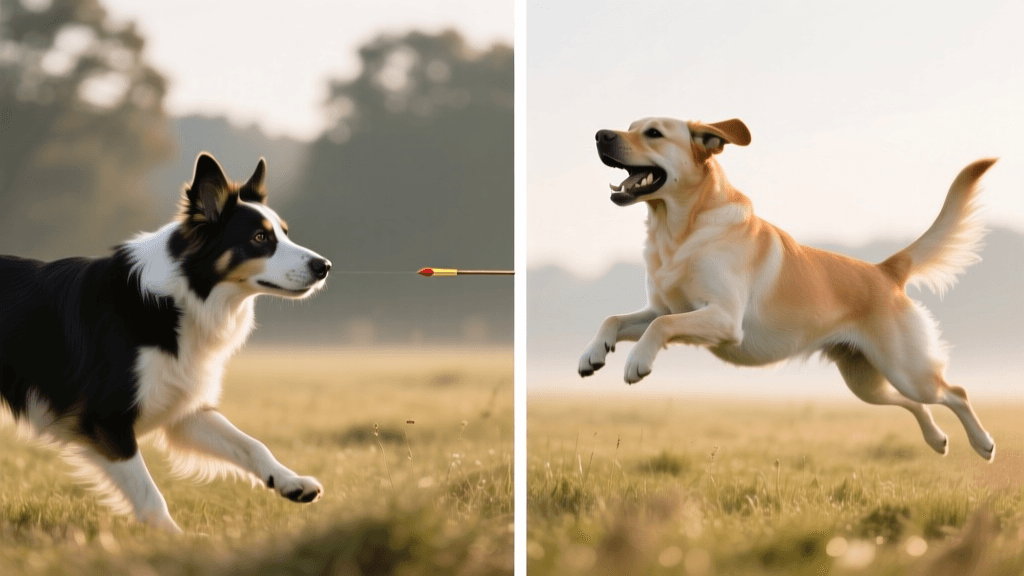
Herding breeds, such as the Border Collie, Australian Shepherd, and Pembroke Welsh Corgi, were bred to control the movement of livestock. This requires a high degree of intelligence, independence, spatial awareness, and an intense, laser-like focus. Psychologically, herding dogs are 'micro-managers.' They are genetically predisposed to monitor their environment and react to rapid movements.
Behavioral Traits and Body Language
The most distinct psychological trait of a herding dog is the 'herding eye'—a hard, unblinking stare used to intimidate and control sheep. In a domestic setting, this instinct can be misdirected toward running children, bicycles, or cars. You will often see a herding dog lower its head, stiffen its shoulders, and exhibit 'whale eye' (showing the whites of its eyes) when overstimulated by movement. If their instinct to nip at the heels of moving objects is not properly channeled, it can lead to severe behavioral issues and liability concerns.
Actionable Advice: Channeling the Herding Drive
To satisfy a herding dog's psychological need for control and movement without relying on actual livestock, owners should engage them in Treibball (urban herding). This sport involves the dog using its nose and shoulders to herd large exercise balls into a goal.
- Equipment: Purchase a 25-inch to 35-inch puncture-resistant herding ball (e.g., the Jolly Ball or Mega Ball), which typically costs between $40 and $80.
- Training Time: Dedicate 20 to 30 minutes daily to impulse control games, such as 'wait' and 'leave it,' to teach the dog how to turn off their arousal state.
- Environment: Herding dogs need visual barriers. If you have a fenced yard, consider installing privacy slats to prevent the dog from obsessively barking at passing cars or neighborhood dogs.
Sporting Breeds: The Nose-Driven Retrievers and Pointers
The AKC Sporting Group includes breeds like the Labrador Retriever, Golden Retriever, and German Shorthaired Pointer. Unlike herding dogs, which control movement, sporting dogs were bred to assist hunters by finding, flushing, or retrieving game. Their psychology is heavily rooted in scent processing, endurance, and cooperative teamwork with humans.
Behavioral Traits and Body Language
Sporting dogs possess a modified 'prey drive.' While a wolf's prey drive follows the sequence of search, stalk, chase, grab-bite, and kill-bite, sporting dogs have been genetically selected to truncate this sequence. Retrievers are bred to stop at the 'grab-bite' phase, resulting in the famous 'soft mouth' that allows them to carry birds without damaging them. Pointers, on the other hand, are bred to freeze (point) upon locating scent. You will notice a sporting dog's body language is generally looser and more relaxed than a herding dog's. They communicate excitement through full-body wags, play bows, and soft, relaxed ears. However, when they catch an interesting scent, they will exhibit 'tunnel vision,' completely ignoring verbal commands as their olfactory cortex takes over.
Actionable Advice: Satisfying the Hunting Urge
Because sporting dogs process the world primarily through their noses, physical exercise alone (like a simple walk) is rarely enough to exhaust them mentally. They require olfactory enrichment.
- Scent Work: Enroll in AKC Scent Work classes. Dogs are trained to find specific essential oils (Birch, Anise, Clove). Introductory group classes usually cost around $120 to $180 for a six-week session.
- At-Home Enrichment: Ditch the food bowl. Use snuffle mats ($20-$40) or scatter kibble in the grass to force the dog to use its nose for 15 minutes before meals. This mimics the 'search' phase of the hunt and provides immense psychological satisfaction.
- Retrieving Games: Use a Chuckit! launcher ($20-$30) to throw tennis balls further, satisfying the retrieving urge while saving your shoulder. Ensure you teach a solid 'drop it' command to prevent resource guarding.
Head-to-Head Comparison: Herding vs. Sporting
To help you determine which psychological profile aligns with your lifestyle, review the structured comparison below:
| Trait | Herding Breeds (e.g., Border Collie, Corgi) | Sporting Breeds (e.g., Labrador, Pointer) |
|---|---|---|
| Primary Drive | Visual movement and spatial control | Olfactory (scent) and retrieving |
| Energy Type | Burst energy, hyper-vigilant, reactive | Endurance energy, steady, rhythmic |
| Handler Focus | Intense; constantly checks in for direction | Moderate; easily distracted by environmental scents |
| Common Behavioral Issues | Nipping, car chasing, shadow staring, reactivity | Counter-surfing, roaming, pulling on leash, eating non-food items |
| Ideal Owner Lifestyle | Active, structured, enjoys precision training and agility | Outdoorsy, enjoys hiking, running, and casual exploration |
Decoding Stress Signals in Both Groups
According to the ASPCA's guide on common dog behavior issues, many behavioral problems stem from unrecognized stress and unmet instinctual needs. Understanding how each group expresses stress is vital for selection and management.
When a herding dog is overwhelmed by a chaotic environment (like a noisy children's birthday party), they may attempt to 'herd' the children by nipping at ankles, or they may shut down and exhibit lip licking, yawning, and a tucked tail. They require a quiet, predictable environment to decompress.
When a sporting dog is under-stimulated or stressed, they are more likely to engage in oral fixation behaviors. This includes destructive chewing of furniture, excessive licking of their own paws (lick granulomas), or eating inappropriate items (pica). Providing durable chew toys, such as a Kong Classic stuffed with frozen peanut butter and blueberries, can redirect this oral fixation constructively.
Real Costs of Meeting Instinctual Needs
Selecting a breed based on instinct means committing to the financial and temporal costs of fulfilling those needs. Here is a realistic breakdown of the annual costs associated with keeping these high-drive breeds psychologically balanced:
- Dog Sports & Classes: Agility or Herding clinics for herding breeds can cost $300 to $600 annually. Scent work or Dock Diving for sporting breeds typically ranges from $200 to $400 annually.
- Enrichment Gear: Puzzle toys (e.g., Outward Hound Nina Ottosson puzzles, $15-$30 each), flirt poles ($25), and long-lines for safe sniffaris ($20). Budget at least $150 per year for rotating enrichment toys.
- Daycare & Exercise Services: If you work an 8-hour day, a high-drive dog will likely need mid-day stimulation. Dog walking services ($20-$25 per walk) or daycare ($30-$50 per day) can add $1,000 to $2,500 to your annual pet budget.
Conclusion: Choosing Based on Psychology, Not Just Looks
Ultimately, understanding your dog begins before you even bring them home. Herding breeds offer unparalleled trainability and a deep, almost psychic connection with their handlers, but they demand a lifestyle of structure, mental rigor, and movement management. Sporting breeds offer joyous, forgiving companionship and an endless enthusiasm for the outdoors, but they require owners who are willing to engage their noses and tolerate a bit of mud and slobber.
By looking past the puppy's cute face and evaluating the deep-seated psychological instincts of the breed group, you can ensure a harmonious, fulfilling relationship that honors the dog's genetic heritage while perfectly complementing your daily life.
beth-carrasco
All our authors care for dogs every day — read more of their work on the authors page.