Puppy Separation Anxiety 2026: Smart Cameras & Crate Training Guide
Discover how to manage puppy separation anxiety in 2026 using gradual crate desensitization and the Furbo treat-tossing camera. Expert schedules inside.
Understanding Puppy Separation Anxiety in 2026
Bringing a new puppy home is one of life’s greatest joys, but as the initial honeymoon phase fades, many owners are confronted with a challenging reality: the puppy cannot handle being left alone. As we navigate the hybrid work schedules and active lifestyles of 2026, puppies are frequently expected to transition from constant companionship to spending several hours solo. When this transition is rushed, it often results in separation anxiety. Separation anxiety in puppies is not merely a display of stubbornness or a lack of obedience; it is a profound state of panic triggered by isolation. According to the ASPCA, dogs with separation anxiety exhibit extreme stress behaviors because they are deeply distressed by being separated from their primary guardians.
In 2026, the modern puppy owner has access to better behavioral science and smarter technology than ever before. By combining gradual crate desensitization protocols with interactive smart pet cameras, you can build your puppy’s confidence and teach them that being alone is not only safe, but actually quite rewarding. This comprehensive guide will walk you through the exact steps, tools, and schedules needed to cure and prevent puppy separation anxiety.
Normal Puppy Whining vs. True Separation Anxiety
Before diving into training, it is crucial to differentiate between normal puppy protests and clinical separation anxiety. A puppy who whines for five minutes after you leave the room, then settles down to chew a toy or take a nap, is simply experiencing normal boundary-testing and mild frustration. This is a standard part of early development.
True separation anxiety, however, is characterized by an escalating state of panic. Signs include:
- Continuous, hoarse barking or howling that lasts for hours.
- Destructive behavior directed specifically at exit points (scratching at door frames, digging at carpets near the front door).
- Inappropriate elimination (urination or defecation) inside the crate or home, even if the puppy is fully potty trained.
- Excessive drooling, panting, and pacing that begins the moment you initiate your departure routine (e.g., putting on shoes, grabbing keys).
- Attempts to escape the crate resulting in broken teeth or damaged nails.
If your puppy displays these severe symptoms, punishment is never the answer. Scolding a panicked puppy will only increase their anxiety. Instead, we must use systematic desensitization and modern technology to rewrite their emotional response to being alone.
The 2026 Tech Stack: Monitoring and Interactive Engagement
You cannot manage what you cannot measure. In 2026, leaving a puppy alone without a smart camera is a thing of the past. Monitoring your puppy’s stress levels in real-time allows you to intervene before their anxiety peaks, ensuring that training sessions remain below their panic threshold.
Furbo 360 Dog Camera
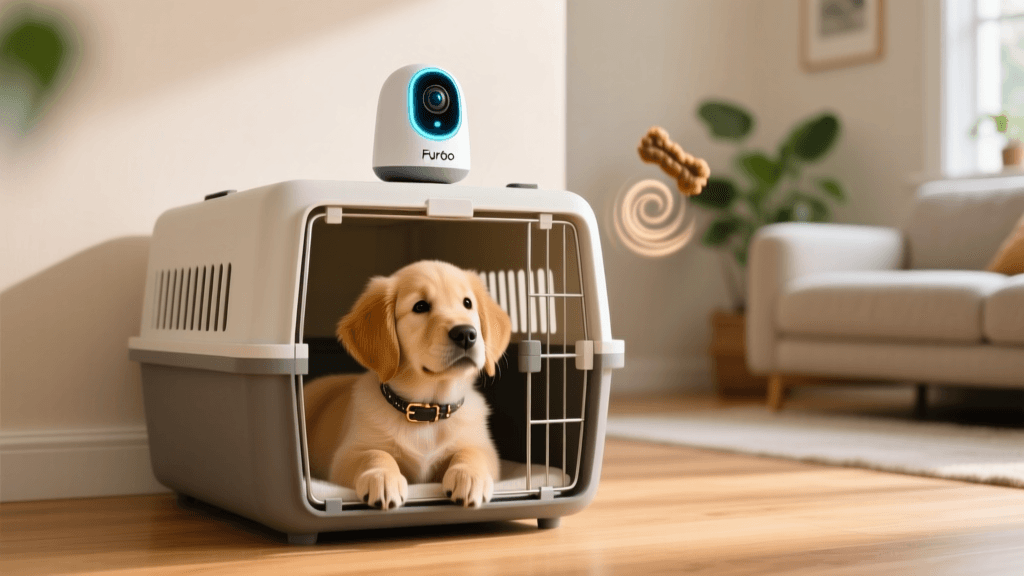
The Furbo 360 remains the gold standard for interactive puppy monitoring. Its 2026 iteration features enhanced AI bark differentiation, meaning it can distinguish between a playful 'boof' and a distressed, continuous howl, sending you targeted smartphone alerts. The treat-tossing mechanism is invaluable for separation anxiety training. When you see your puppy settle down quietly on their mat via the camera, you can remotely toss a treat to reward the calm behavior, reinforcing that being alone yields positive outcomes.
Wyze Cam v4
For a budget-friendly secondary angle, the Wyze Cam v4 offers excellent color night vision and sound detection. Placing one camera facing the crate door and another facing the puppy’s primary play area gives you a complete picture of their solo behavior, helping you identify environmental triggers (like the sound of the garbage truck or neighborhood dogs) that might be spiking their anxiety.
The Gradual Crate Desensitization Protocol
The American Kennel Club emphasizes that a crate should be a sanctuary, not a prison. For a puppy with separation anxiety, the crate must become the safest place in the world. Follow this step-by-step protocol over the course of several weeks.
Phase 1: Building Positive Associations (Days 1-7)
Never force the puppy into the crate. Start by feeding all of their daily meals inside the crate with the door wide open. Toss high-value treats (like boiled chicken or freeze-dried liver) into the back of the crate and let the puppy enter and exit freely. Introduce a specific verbal cue like 'Place' or 'Kennel' and reward heavily when they choose to go inside on their own.
Phase 2: The Door Game (Days 8-14)
Once the puppy is happily entering the crate, begin closing the door while they eat their meal. The moment they finish, open the door. Gradually increase the duration the door stays closed after the meal by 10-second increments. If the puppy whines, you have increased the time too quickly. Drop back to a shorter duration where they remain silent and relaxed.
Phase 3: Out of Sight, Short Durations (Days 15-21)
With the puppy resting comfortably in the closed crate, stand up and walk out of the room for exactly three seconds. Return before the puppy has time to become upset. Toss a treat through the crate bars. Repeat this, gradually increasing the time out of the room: 5 seconds, 10 seconds, 30 seconds, 1 minute. Use your Furbo camera to monitor their body language. If they stand up and stare at the door, return immediately and reset. You are teaching them that your departure is temporary and boring.
Phase 4: The Departure Routine Desensitization
Puppies are masters of pattern recognition. If your puppy panics when you pick up your car keys, you must desensitize them to these triggers. Pick up your keys, then sit back down on the couch. Put on your coat, then take it off and make a cup of coffee. Do this 10 to 15 times a day until the puppy no longer reacts to these cues. Only when they are completely indifferent to your keys and coat should you begin combining these cues with actual departures.
Puppy Alone Time Progression Schedule
Managing a puppy's alone time requires respecting their physical and emotional limits. The following table outlines the maximum recommended alone time based on age, alongside appropriate crate sizing and enrichment strategies. Note that these times represent absolute maximums; shorter periods are always preferable for anxious puppies.
| Puppy Age | Bladder Capacity | Max Alone Time | Crate Setup | Recommended Solo Enrichment |
|---|---|---|---|---|
| 8 - 10 Weeks | 1.5 - 2 Hours | 1 Hour | Small wire crate, fully covered | Lick mat smeared with wet food |
| 11 - 14 Weeks | 2 - 3 Hours | 2 Hours | Wire crate with divider panel | Frozen KONG Classic (Peanut Butter) |
| 3 - 4 Months | 3 - 4 Hours | 3 Hours | Plastic travel crate for den feel | West Paw Toppl with kibble & yogurt |
| 5 - 6 Months | 4 - 6 Hours | 4 Hours | Large crate with plush bedding | Snuffle mat hidden in the crate |
| 7 - 12 Months | 6 - 8 Hours | 5 Hours | Open crate in a puppy-proofed pen | Calming chew + interactive puzzle toy |
Note: Puppies under 6 months should never be left in a crate for a full 8-hour workday. If you work outside the home, hiring a midday dog walker or utilizing a local puppy daycare is mandatory for their physical health and mental well-being.
High-Value Enrichment for Solo Sessions
To combat separation anxiety, you must change the puppy's emotional response to your departure. You can achieve this by providing an 'only-when-I-leave' toy. This toy should be incredibly high-value and exclusively available when the puppy is alone in their crate or pen.
The 2026 Frozen KONG Recipe for Anxious Pups
Licking and chewing are naturally soothing behaviors for dogs that release endorphins and lower heart rates. Prepare this recipe the night before your workday:
- Base Layer: Plug the small hole of a KONG Classic with a dab of dog-safe peanut butter (ensure it contains zero xylitol).
- Core Filling: Mix 1/2 cup of plain, unsweetened Greek yogurt with 1/4 cup of mashed banana and a handful of the puppy’s regular kibble. Spoon this mixture into the KONG.
- Topper: Seal the large hole with a spoonful of pureed pumpkin or low-sodium chicken broth.
- Freeze: Place the KONG upright in the freezer for at least 4 hours. A fully frozen KONG will occupy a teething, anxious puppy for 30 to 45 minutes, easily carrying them through the peak anxiety window immediately following your departure.
Common Mistakes That Fuel Separation Anxiety
Even with the best intentions, owners often inadvertently reinforce their puppy's anxiety. Avoid these common pitfalls:
- Making a Fuss at Departures and Arrivals: Saying 'I'll miss you, be a good boy!' in a high-pitched voice spikes the puppy's arousal levels. Instead, ignore your puppy for 10 minutes before you leave and 10 minutes after you return. Your comings and goings must become utterly mundane.
- Using the Crate for Punishment: If the crate is used as a timeout zone for bad behavior, the puppy will associate it with fear and isolation, destroying all the positive associations you have built.
- Returning to a Whining Puppy: If you use your Furbo camera and see the puppy whining, do not rush home or speak through the two-way audio. This teaches the puppy that vocalizing summons you. Wait for a brief moment of silence, toss a treat via the camera, and only then consider ending the session.
When to Call a Veterinary Behaviorist
If you have diligently followed a gradual desensitization protocol for several weeks and your puppy continues to exhibit self-injurious behavior, extreme panic, or refusal to eat high-value treats when alone, it is time to seek professional help. A certified veterinary behaviorist can evaluate your puppy for underlying medical issues and discuss whether short-term, anti-anxiety medications are appropriate to help lower their baseline stress levels enough for behavioral modification to take hold. Remember, treating separation anxiety is a marathon, not a sprint. With patience, consistency, and the right tools, your puppy will learn to embrace their alone time.
tom-renshaw
All our authors care for dogs every day — read more of their work on the authors page.