Front-Clip No-Pull Harness Training Guide for 2026
Learn how to stop leash pulling in 2026 using a front-clip no-pull harness. Step-by-step loose-leash training protocol for dogs of all sizes.
The Evolution of Force-Free Leash Training
As we navigate through 2026, the dog training community has overwhelmingly moved away from aversive equipment, embracing force-free, science-based methods that prioritize canine welfare. At the center of this movement is the front-clip no-pull harness. Unlike traditional back-clip harnesses or slip leads, a front-clip harness fundamentally alters the biomechanics of how a dog moves on a leash, providing handlers with a humane, effective tool to teach loose-leash walking. However, a harness alone is not a magic fix; it is a training aid that must be paired with a structured behavioral conditioning protocol.
According to the American Kennel Club, consistency in rewarding the dog for staying by your side is the most critical factor in leash training. This guide will walk you through the biomechanics of front-clip harnesses, how to select the right model for your dog's build, and a comprehensive 4-week training protocol to eliminate pulling for good.
The Biomechanics: Why Front-Clip Works
To understand why the front-clip harness is the gold standard for leash training in 2026, we must look at canine biomechanics and the 'opposition reflex.' When pressure is applied to a dog's chest or back via a traditional collar or back-clip harness, their natural instinct is to push forward against that pressure. This is why sled dogs wear back-clip harnesses—it maximizes their pulling power.
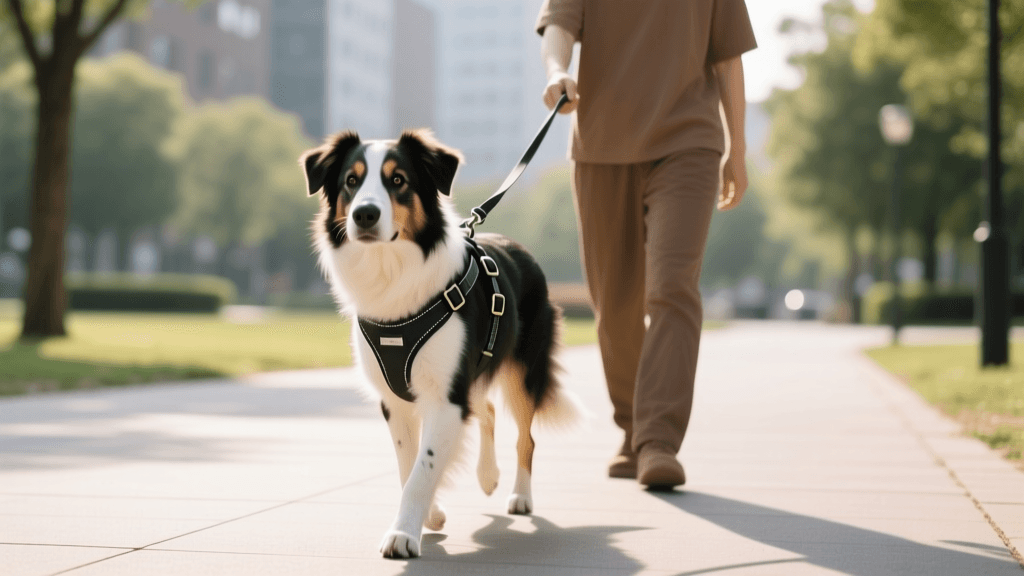
A front-clip harness features a leash attachment ring located on the sternum strap. When the dog pulls forward and hits the end of the leash, the tension is applied to the front of their chest. This gently redirects the dog's center of mass, turning their shoulders and head back toward the handler. It physically prevents the dog from leveraging their full body weight to pull, effectively neutralizing the opposition reflex without causing pain or tracheal damage.
Selecting the Right Harness in 2026
Not all no-pull harnesses are created equal. Modern veterinary physical therapists emphasize the importance of a Y-shaped front design, which allows for full shoulder extension and prevents gait alteration. When shopping for a harness this year, look for the following features:
| Harness Feature | Why It Matters in 2026 |
|---|---|
| Y-Shaped Front Strap | Preserves shoulder extension, preventing long-term joint strain and altering natural gait biomechanics. |
| Dual-Clip System | Features both front and back rings, allowing you to use a double-ended leash for transitional training. |
| Martingale Chest Loop | Tightens slightly upon pulling to prevent the chest strap from sliding into the dog's armpits without choking. |
| Padded Neoprene Lining | Prevents chafing and friction burns during high-activity walks or sudden stops. |
The ASPCA emphasizes that walking equipment should never cause pain, restrict natural movement, or impair a dog's breathing. Always avoid T-shaped harnesses that cut horizontally across the dog's shoulder joints, as these can cause long-term musculoskeletal issues.
The 4-Week Front-Clip Training Protocol
Equipped with a properly fitted Y-shaped front-clip harness, you are ready to begin the behavioral conditioning process. This protocol relies on positive reinforcement, marker training, and environmental management.
Week 1: Indoor Acclimation and Marker Training
Before hitting the streets, your dog must associate the harness and the leash with positive outcomes in a zero-distraction environment.
- Desensitization: Leave the harness on the floor with high-value treats (like freeze-dried liver or boiled chicken) placed on and around it. Let the dog investigate and eat the treats.
- Targeting: Teach your dog to 'mark' the position next to your left leg. Use a clicker or a verbal marker like 'Yes!' the moment they look up at you while standing in the heel position.
- Indoor Follow: Clip the leash to the front ring and walk around your living room. Every time the leash is slack and the dog is near your leg, mark and reward.
Week 2: Low-Distraction Outdoor Introduction
Move to a quiet driveway or an empty cul-de-sac. The goal is to introduce mild environmental stimuli while maintaining engagement.
- The U-Turn Method: Walk forward. The second your dog pulls ahead and the leash goes tight, immediately stop, say a cue like 'Let's go,' and turn 180 degrees in the opposite direction. When the dog catches up to your side and the leash is slack, mark and reward.
- Repetition: You may spend an entire 20-minute session just doing U-turns. This teaches the dog that pulling forward actually results in moving away from their desired destination.
Week 3: The 'Be a Tree' Technique and Neighborhood Walks
Now, transition to your regular neighborhood route where distractions like squirrels, other dogs, and passing cars are present.
- Be a Tree: If the dog lunges toward a distraction, simply stop walking and stand completely still ('be a tree'). Do not yank the leash or pull the dog back. Wait for the dog to look back at you or take a step back toward you, which creates slack in the leash. The moment there is slack, mark, reward, and resume walking.
- Latency Building: Begin delaying your rewards. Instead of treating every single step, treat every three steps, then every five, then every ten. This builds duration on the loose leash.
Week 4: Proofing in High-Distraction Zones
Take your training to a local park or a busy street. This is the 'proofing' phase, where the dog learns to generalize the loose-leash behavior to all environments.
- Premack Principle: Use the environment as the reward. If your dog walks politely on a loose leash toward a sniffing spot (like a fire hydrant), use the cue 'Go sniff' and release them to explore. Pulling gets them nowhere; walking politely gets them access to the park.
- Fading the Front Clip: If you have a dual-clip harness, you can begin attaching the leash to the back clip for short intervals to test their understanding. If pulling resumes, immediately switch back to the front clip.
Pro-Tip for 2026: Treat delivery matters just as much as the treat itself. Deliver the treat low, right at the seam of your pants near your knee. This physically encourages the dog to keep their head down and near your leg, rather than jumping up to your hand for the reward.
Troubleshooting Common Roadblocks
Even with the best equipment, handlers often make subtle errors that sabotage progress. Avoid these common pitfalls:
1. Jerking the Leash: A front-clip harness is designed for steady tension and redirection, not for leash pops. Jerking can cause whiplash and create negative associations with the harness.
2. Inconsistent Tension Rules: If you allow your dog to pull toward the mailbox 'just this once' because you are in a hurry, you have just taught them that pulling works if they do it hard enough. The leash must be slack 100% of the time for the walk to proceed.
3. Using Retractable Leashes: Retractable leashes teach dogs that pulling is required to get more line. Always use a fixed-length biothane or nylon leash (4 to 6 feet) when training with a front-clip harness.
Safety, Fit, and Veterinary Guidelines
Proper fit is paramount. A harness that is too loose will allow the dog to back out and escape, while a harness that is too tight will cause chafing and restrict breathing. Use the 'two-finger rule': you should be able to comfortably slide two fingers under every strap of the harness. The Humane Society of the United States recommends checking the fit of your dog's gear regularly, especially for growing puppies or dogs undergoing weight changes.
Furthermore, never leave a harness on an unsupervised dog, especially in a crate. The straps and rings can easily catch on crate wires or furniture, posing a severe choking hazard.
Conclusion
Mastering loose-leash walking with a front-clip no-pull harness is one of the most rewarding investments you can make in your relationship with your dog. By combining the biomechanical advantages of modern Y-shaped harnesses with a structured, positive-reinforcement training protocol, you can transform chaotic, frustrating walks into peaceful, bonding experiences. Stick to the 4-week plan, maintain your consistency, and enjoy the journey of force-free training in 2026 and beyond.
hannah-wickes
All our authors care for dogs every day — read more of their work on the authors page.