Force-Free Urban Leash Walking 2026: Best Harnesses & Tips
Master force-free urban leash walking in 2026. Discover top front-clip harnesses, positive reinforcement methods, and engage-disengage games for city dogs.
Navigating the Concrete Jungle with Positive Reinforcement
Urban dog walking in 2026 presents a unique set of challenges for pet parents. With the rapid proliferation of silent e-bikes, denser pedestrian traffic, and increasingly crowded city parks, our canine companions face a daily sensory overload. When a dog reacts to this environment by pulling, lunging, or barking, the walk quickly becomes a stressful chore rather than a bonding experience. Fortunately, the dog training community has overwhelmingly shifted toward force-free, positive reinforcement (R+) methods that prioritize the dog's emotional well-being and the human-animal bond.
Historically, leash pulling and urban reactivity were addressed using aversive tools like prong collars, choke chains, or electronic shock collars. These methods rely on positive punishment and negative reinforcement—essentially, applying pain or discomfort to suppress a behavior. However, modern veterinary behaviorists and certified force-free trainers strongly advise against these outdated techniques. Suppressing a dog's outward reaction does not change their underlying emotional state; in fact, it often increases fear, anxiety, and the risk of sudden, unpredictable aggression.
The Science of Force-Free Urban Walking
Positive reinforcement focuses on rewarding the behaviors we want to see, making those behaviors more likely to occur in the future. When navigating a busy city, this means teaching your dog that staying near you and offering calm engagement is far more rewarding than pulling toward a discarded food wrapper or a passing skateboard.
Leading animal welfare organizations have made their stance clear on this topic. According to the American Veterinary Society of Animal Behavior (AVSAB), reward-based methods are the standard of care for dog training. The AVSAB explicitly notes that aversive tools can cause physical harm and exacerbate behavioral issues by associating triggers (like other dogs or loud noises) with pain. By utilizing force-free methods, we build a foundation of trust, allowing our dogs to navigate the chaotic 2026 urban landscape with confidence rather than fear.
Essential Gear for Urban Positive Reinforcement
To successfully implement a force-free loose leash walking protocol, you need the right equipment. The goal is to maximize comfort, ensure safety, and allow for rapid delivery of rewards.
1. The Rabbitgoo No-Pull Dog Harness (2026 Edition)
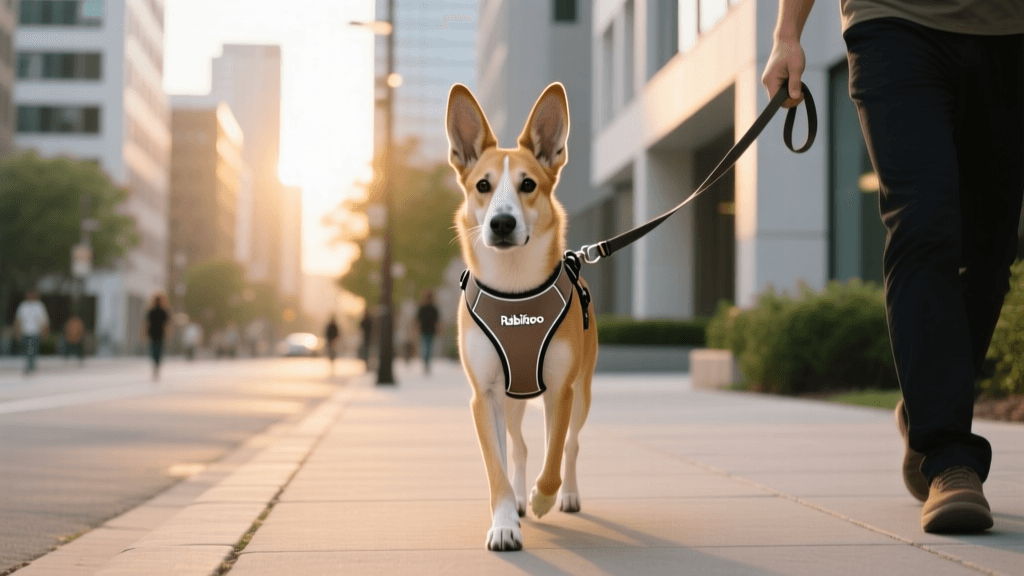
The Rabbitgoo No-Pull Harness remains a top choice for urban force-free walkers. The updated 2026 edition features enhanced breathable air-mesh and a reinforced front-clip D-ring located on the dog's chest. When a dog pulls on a front-clip harness, the biomechanics gently turn their body back toward the handler, naturally discouraging forward momentum without applying pressure to the delicate trachea. The back-clip is reserved for safe, non-pulling environments or for attaching a long line.
2. Ruffwear Treat Trader Pouch
In a high-distraction city environment, timing is everything. Fumbling in a pocket for treats will cause you to miss the critical one-second window for marking a good behavior. The Ruffwear Treat Trader features a magnetic closure that allows for lightning-fast treat delivery and a built-in poop bag dispenser. Its adjustable waist belt keeps the pouch stable on your hip, ensuring you are always ready to reward your dog for making a good choice.
3. Biothane Long Line (10-Foot)
A standard 6-foot leash can sometimes feel restrictive and create accidental tension, which inadvertently signals the dog to pull. A 10-foot Biothane long line provides your dog with a sniffari radius, allowing them to explore and decompress while you maintain safe control in urban settings. Biothane is waterproof, easy to clean, and does not tangle as easily as nylon.
4. High-Value Urban Treats
In a city environment, dry kibble rarely competes with the smell of discarded fast food or the sight of a running squirrel. For 2026 urban training, you need jackpot rewards. Boiled chicken breast, freeze-dried beef liver, or low-sodium string cheese cut into pea-sized pieces are ideal. The key is high odor and rapid consumption so you can keep moving.
Top Front-Clip Harnesses Compared for City Walking
Not all harnesses are created equal. Below is a comparison of the most popular force-free front-clip harnesses favored by certified trainers in 2026.
| Harness Model | Front-Clip Placement | Best For | Force-Free Feature |
|---|---|---|---|
| Rabbitgoo No-Pull (2026) | Center Chest | Heavy pullers, broad-chested breeds | Y-shape design preserves shoulder mobility |
| Kurgo Tru-Fit Smart | Lower Chest (V-neck) | Escape artists, deep-chested dogs | Crash-tested safety with dual-clip options |
| Ruffwear Front Range | Center Chest | Active city dogs, hiking transitions | Padded belly and chest for all-day comfort |
| Blue-9 Balance Harness | Center Chest | Custom fit, sensitive dogs | 6-point adjustment prevents chafing |
The Step-by-Step Engage-Disengage Protocol
Having the right gear is only half the equation. The core of force-free urban walking relies on changing your dog's emotional response to triggers. We use the Engage-Disengage game, popularized by Laura VanArendonk Baugh, combined with Leslie McDevitt's Look At That (LAT) framework.
Phase 1: Marker Training and the Sweet Spot
Before hitting the busy streets, establish a clear marker word like Yes! or use a clicker. The marker tells the dog exactly which behavior earned the reward. Next, define the Sweet Spot—the area right beside your knee or hip. Whenever your dog is in the Sweet Spot with a loose leash, mark and reward heavily. According to the ASPCA's guidelines on loose leash walking, rewarding the dog at your side before they have the chance to pull is the most effective way to build a habit of proximity.
Phase 2: Look At That (LAT) for Urban Triggers
When a trigger appears (e.g., a delivery e-bike or a reactive dog across the street), watch your dog's eyes. The moment they look at the trigger, mark with your Yes! and deliver a high-value treat (like boiled chicken or freeze-dried liver) near your Sweet Spot. This teaches the dog that seeing a scary or exciting thing predicts a reward from you, rather than an opportunity to lunge.
Phase 3: The Disengage and Check-In
As your dog progresses, delay the marker. Wait for the dog to look at the trigger, and then voluntarily turn their head back to you (disengage). Mark the moment they make eye contact with you, and reward. This builds a reflexive habit of checking in with the handler when the urban environment gets overwhelming.
Troubleshooting High-Distraction Urban Scenarios
Even with a solid foundation, city living will test your training. Here is how to handle common 2026 urban hurdles using force-free methods:
- Silent E-Bikes and Scooters: These are a major trigger because they approach quickly and silently. If an e-bike approaches, use an emergency U-turn. Lure your dog 180 degrees away with a high-value treat, creating distance before the dog goes over their reactivity threshold. Reward heavily for following you away from the trigger.
- Crowded Sidewalks: If the sidewalk is too narrow to maintain a loose leash, step into a driveway or alcove. Ask your dog for a sit or a down on a mat, and feed continuously until the crowd passes. This is known as scatter feeding and helps lower the dog's heart rate through the natural calming mechanism of sniffing and chewing.
- Other Reactive Dogs: Never force a greeting. If an oncoming dog is lunging, advocate for your dog by calmly crossing the street. As noted by Victoria Stilwell's Positively training methods, managing the environment to prevent rehearsed bad behaviors is just as important as the active training itself.
- Threshold Management: The most common mistake urban handlers make is pushing their dogs past their reactivity threshold. If your dog is stiff, staring, or refusing treats, you are too close to the trigger. Distance is your best tool. Increase the distance until your dog can comfortably take food, and resume the LAT game from that safer vantage point.
Conclusion: Patience and Consistency
Force-free urban leash walking is not a quick fix; it is a lifestyle choice that respects your dog's nervous system. By utilizing a front-clip harness like the Rabbitgoo, keeping high-value rewards accessible in a Ruffwear Treat Trader, and consistently applying the Engage-Disengage protocol, you can transform your daily walks from a battle of wills into a cooperative dance. Remember, every walk is a training session. Celebrate the small victories, keep your criteria manageable, and enjoy the vibrant city life with your best friend in 2026 and beyond.
hannah-wickes
All our authors care for dogs every day — read more of their work on the authors page.