Force-Free Cooperative Nail Trimming: Scratchboard & LickiMat 2026
Learn force-free cooperative care nail trimming for anxious dogs using scratchboards and LickiMat enrichment. Updated 2026 guide for stress-free vet care.
The Hidden Health Crisis of Overgrown Nails
When we think of canine health and wellbeing, we often focus on diet, exercise, and dental care. However, nail health is a critical, yet frequently overlooked, component of your dog's orthopedic wellbeing. Overgrown nails do not just look unsightly; they fundamentally alter your dog's posture and biomechanics. When nails touch the ground, they push the toe joints upward and force the dog's weight back onto their carpal and tarsal joints. Over time, this chronic unnatural stance leads to splayed feet, joint inflammation, carpal hyperextension, and severe arthritis.
Despite the health risks, nail trimming remains one of the most dreaded activities for both dogs and their owners. Historically, the veterinary and grooming industries relied on physical restraint—toweling, muzzling, or pinning—to force compliance. Today, we know that forceful restraint causes immense psychological trauma, leading to learned helplessness and heightened aggression. In 2026, the gold standard in veterinary behavior has shifted entirely toward positive reinforcement and force-free methods.
The Paradigm Shift: Why Force-Free Matters in 2026
As we navigate 2026, the consensus among leading behavioral experts is clear: emotional wellbeing is just as important as physical health. The American Veterinary Society of Animal Behavior (AVSAB) strongly advocates for humane, fear-free handling techniques that prioritize the animal's emotional state. Forcing a terrified dog to undergo a nail trim floods their system with cortisol and adrenaline, creating a negative feedback loop that makes every subsequent grooming session more dangerous and traumatic.
Force-free nail care is not about 'spoiling' your dog; it is about utilizing modern behavioral science to keep them safe, healthy, and pain-free. By replacing physical restraint with cooperative care and positive reinforcement, we can teach dogs to actively participate in their own husbandry routines.
Understanding Cooperative Care and the 'Start Button'
Cooperative care is a training philosophy where the animal is given a choice to participate in their own handling. Central to this concept is the 'start button'—a specific behavior the dog offers to signal they are ready and willing to proceed. If the dog stops offering the start button, or actively moves away, the handler immediately stops the procedure. This gives the dog a sense of control, which paradoxically makes them much more likely to tolerate and even enjoy the process.
The International Association of Animal Behavior Consultants (IAABC) frequently highlights cooperative care as a primary tool for reducing husbandry-related anxiety. For nail trimming, a common start button is a 'chin rest' or a 'paw target.' When the dog places their chin on a mat or their paw on a scratchboard, they are giving you consent to begin.
The Ultimate Force-Free Toolkit for 2026
To successfully implement force-free nail care, you need the right tools. The market in 2026 offers excellent, dog-centric equipment designed specifically for positive reinforcement protocols.
1. The Nail Scratchboard
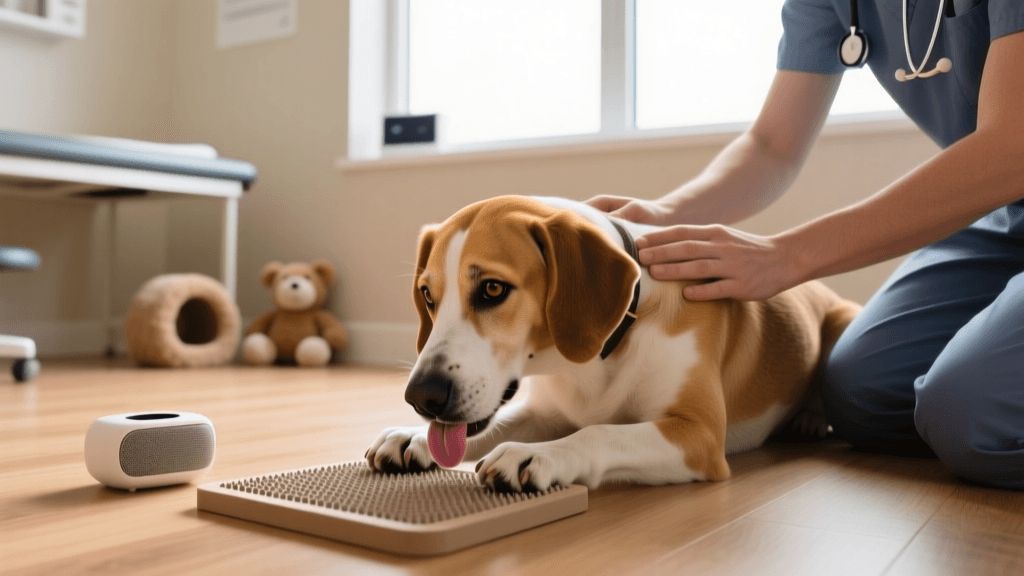
A nail scratchboard is a wooden or heavy-duty plastic board fitted with replaceable adhesive sandpaper (typically 60 to 80-grit). It allows the dog to file their own front nails by swiping their paws. This is the ultimate force-free tool because the dog is in complete control of the pressure and speed. In 2026, premium adjustable scratchboards with ergonomic angles and replaceable grit pads cost between $45 and $65.
2. LickiMat Soother and Enrichment Spreadables
For hind nails and dewclaws, which cannot be filed on a scratchboard, we use cooperative restraint paired with high-value enrichment. The LickiMat Soother, featuring a textured silicone surface, is designed to hold lickable treats. Licking releases endorphins in the canine brain, acting as a natural calming mechanism. A standard LickiMat costs around $12 to $15.
3. Whisper-Quiet Rotary Grinders
If you must grind the hind nails or dewclaws, modern 2026 cordless rotary grinders feature whisper-quiet motors and LED safety lights to help you see the quick. Look for models with variable speed settings and diamond bit grinders, typically priced between $30 and $50.
Step-by-Step Scratchboard Training Protocol
Training your dog to use a scratchboard requires patience and a clicker (or a verbal marker word like 'Yes!'). Never physically grab your dog's paw and drag it across the board; this defeats the entire purpose of force-free training.
Step 1: Shaping the Paw Swipe
Place the scratchboard on the ground flat. Hold a high-value treat (like plain pumpkin puree or a lickable meat tube) near the board to encourage your dog to investigate. The moment your dog lifts one paw and places it on or near the board, click and treat. Repeat this until your dog is confidently tapping the board with their paw.
Step 2: Adding the Sandpaper and Motion
Once your dog is comfortable touching the bare board, apply the 80-grit sandpaper. Lure your dog's paw slightly forward so that the nails drag across the grit. Click and reward heavily for any forward swiping motion. Keep sessions incredibly short—no more than 2 to 3 minutes—to prevent frustration or nail overheating.
Step 3: Refining the Angle and Duration
Prop the scratchboard up at a 30-degree angle using a wedge or a specialized stand. This mimics the natural angle of the dog's paw during a walk. Reward your dog for vigorous, sustained swiping. Remember, you must train both the left and right paws independently. Most dogs have a dominant paw and will need extra encouragement to use their non-dominant side.
Managing Dewclaws and Hind Nails with Cooperative Restraint
Scratchboards only work for the front nails that touch the ground. For dewclaws and hind nails, we combine the LickiMat with a cooperative side-lying position or a chin rest.
- Prepare the Mat: Spread a mixture of plain canned pumpkin, unsalted bone broth, and a little plain Greek yogurt onto the LickiMat Soother. Freeze it solid the night before. A frozen mat increases the duration of the licking behavior, buying you more time.
- Establish the Position:Place the frozen LickiMat on the floor or on a low, stable grooming table. Allow your dog to settle into a comfortable down or side-lying position to lick the mat.
- Introduce the Touch:While they are licking, gently touch their hind leg. If they stop licking or tense up, stop touching immediately. Wait for them to resume licking, then try again. This teaches them that the touch predicts the continuation of the treat, not a scary event.
- Introduce the Grinder:Turn the rotary grinder on a few feet away while they lick. Click and treat for calm behavior. Gradually move the grinder closer over multiple sessions until you can gently touch the spinning grinder to the tip of the nail for just one second. Build duration slowly over weeks.
Tool Comparison Chart for Canine Nail Care
Choosing the right tool depends on your dog's temperament, your training goals, and your budget. Below is a comparison of the most common nail care methods available in 2026.
| Tool | Method Type | Stress Level | Best For | 2026 Est. Cost |
|---|---|---|---|---|
| Nail Scratchboard | Active Force-Free | Very Low | Front nails, active dogs, highly fearful dogs | $45 - $65 |
| Rotary Grinder (w/ LickiMat) | Passive Cooperative | Low to Medium | Dewclaws, hind nails, thick nails | $30 - $50 (plus grinder) |
| Guillotine Clippers | Restraint / Force | High | Quick touch-ups on highly trained, consent-based dogs only | $10 - $20 |
| Scissor-Style Clippers | Restraint / Force | High | Not recommended for force-free protocols | $15 - $25 |
Recognizing Canine Stress and Calming Signals
Even with the best force-free tools, you must be fluent in canine body language. The Fear Free Pets organization emphasizes that handlers must recognize early signs of stress before they escalate into panic or aggression. If you see any of the following 'calming signals' or stress indicators, you must stop the session, give your dog a break, and evaluate your training plan:
- Whale Eye: Showing the whites of the eyes while looking away.
- Lip Licking: Repeatedly flicking the tongue over the nose when no food is present.
- Yawning: Out of context yawning is a major indicator of internal conflict and stress.
- Freezing: A sudden, rigid stillness. This is often mistaken for 'compliance' but is actually a severe fear response.
- Panting: Spatulate (wide) panting when the dog is not hot or exercising.
If your dog exhibits these signals, the session has gone on too long, the value of the treat is too low, or you have progressed too quickly. Back up to a previous, easier step in the training protocol where your dog was relaxed and confident.
Conclusion: Patience is the Ultimate Prescription
Transitioning to force-free cooperative care for nail trimming is not an overnight process. For a dog with a history of traumatic grooming experiences, it may take several months of daily, five-minute training sessions to rebuild trust. However, the investment is profoundly worth it. By utilizing scratchboards, LickiMats, and positive reinforcement, you are not just maintaining your dog's orthopedic health; you are actively strengthening your bond, building their confidence, and ensuring that their veterinary and grooming experiences in 2026 and beyond are rooted in safety, respect, and compassion.
tom-renshaw
All our authors care for dogs every day — read more of their work on the authors page.