Dog AAC Button Training & Signal Decoding Guide 2026
Master dog AAC button training in 2026. Learn to decode canine body language signals, set up FluentPet soundboards, and troubleshoot button spamming.
The Evolution of Canine AAC in 2026
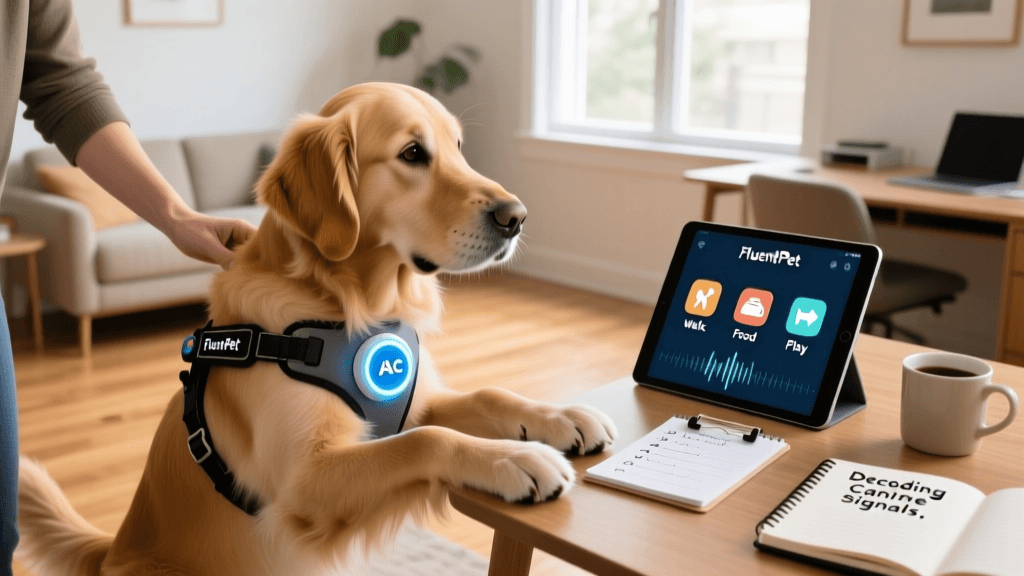
Augmentative and Alternative Communication (AAC) has fundamentally transformed how we share our daily lives with our dogs. What began as a niche experiment with a few viral internet dogs has evolved into a mainstream, scientifically backed practice for pet owners worldwide. In 2026, canine soundboards are no longer just novelty items; they are sophisticated tools integrated into our smart home ecosystems, allowing dogs to express complex needs, emotions, and observations. However, while technology like the latest NFC-enabled FluentPet HexTiles can record and timestamp every press, the most critical tool in your communication arsenal remains your ability to read your dog's natural physical signals.
Teaching a dog to use a soundboard is only half the equation. The other half—and arguably the more important one for a harmonious multi-pet household or a busy daily routine—is understanding the canine body language that precedes, accompanies, and sometimes contradicts their button presses. Dogs communicate volumes through subtle shifts in posture, ear carriage, and facial tension long before they ever lift a paw to tap a plastic button. This comprehensive guide will walk you through setting up a modern AAC system while deeply analyzing the canine signals that give context to their words.
The Science of Soundboards and Canine Cognition
Modern veterinary behaviorists emphasize that dogs possess the cognitive ability to associate abstract symbols and recorded words with specific outcomes, environments, or emotional states. According to the American Kennel Club (AKC), dogs can learn to use buttons to communicate basic needs and even string together rudimentary sentences to express more complex thoughts. In 2026, the focus of AAC training has shifted from simply getting a dog to press a button for a treat, to fostering genuine, two-way communication that reduces household frustration and anxiety.
When a dog learns that pressing 'Outside' results in the door opening, or 'Play' initiates a game of tug, they are exercising operant conditioning. But when they press 'Mad' or 'Stranger' while exhibiting specific physical postures, they are engaging in expressive communication. Bridging the gap between these physical postures and the digital soundboard is the key to advanced canine AAC mastery.
Recognizing Pre-Button Calming Signals
Before your dog has the vocabulary to tell you they are overwhelmed, anxious, or in pain, they will rely on innate calming signals. Pioneered by canine behavior expert Turid Rugaas and widely recognized by modern veterinary institutions, these signals are designed to de-escalate tension and communicate internal stress. The ASPCA's guide on canine body language highlights that recognizing these subtle cues early can prevent behavioral issues and improve your dog's overall welfare.
The Subtle Signs of AAC Frustration
When your dog is trying to communicate a need but lacks the specific button, or when the soundboard is temporarily unavailable (e.g., the batteries died or the mat is being washed), they will exhibit pre-button signals of frustration. Look for:
- The Paw Lift: A classic sign of anticipation mixed with uncertainty. If your dog lifts one front paw while staring at the soundboard, they know they need something but are unsure how to articulate it.
- Lip Licking and Yawning: Often mistaken for tiredness or hunger, these are primary stress-relief signals. If your dog yawns repeatedly while standing near the 'Outside' or 'Alone' buttons, they are likely feeling overstimulated and need a decompression break.
- Whale Eye: Showing the whites of their eyes while keeping their head pointed forward. This indicates high anxiety and is a critical signal to respect before a dog resorts to reactive behavior.
- Shake-Offs: A full-body shake, as if wet, when they are completely dry. This is a physiological reset button dogs use to release adrenaline after a stressful encounter or a confusing training session.
According to the Humane Society of the United States, understanding these stress signals is vital for any dog owner, but it becomes exponentially more important when you are asking your dog to engage in the cognitive heavy lifting required for AAC training.
Building Your 2026 FluentPet HexTile Layout
Setting up your soundboard requires strategic planning. The 2026 FluentPet HexTile systems allow for modular, expandable layouts that grow with your dog's vocabulary. A common mistake beginners make is placing buttons too close together or organizing them by human logic rather than canine spatial memory.
Core vs. Fringe Vocabulary
Start with Core Vocabulary—the high-frequency words your dog will use daily. These include 'Outside', 'Water', 'Play', 'All Done', and 'Love'. Place these on the outer edges of your mat where your dog's natural paw reach is most comfortable.
Fringe Vocabulary consists of context-specific words like 'Car', 'Squirrel', 'Bed', or 'Ouch'. These should be placed in the center or on secondary mats. In 2026, many owners use the companion smart apps to track 'button velocity'—how fast and hard a dog strikes a tile. A high-velocity strike on a fringe word often indicates high emotional arousal, which should prompt you to look for accompanying physical signals like a stiff tail or pinned ears.
Pro Tip: Always model the button press with your own hand while simultaneously performing the action or pointing to the object. Never force your dog's paw onto the button, as this creates physical resistance and negative associations with the soundboard.
Troubleshooting: When Signals and Buttons Mismatch
One of the most fascinating aspects of living with an AAC-trained dog is when their physical body language contradicts the button they just pressed. This is not necessarily 'lying'; rather, it is a nuanced expression of conflicting emotions or a learned behavior that has generalized incorrectly. Below is a troubleshooting chart to help you decode these mismatches in your daily routine.
| Physical Signal Observed | Button Pressed | Context / Scenario | True Underlying Need & Action Plan |
|---|---|---|---|
| Whale eye, tucked tail, lowered head | 'Play' | Guest arrives or loud noise outside | Need: Reassurance/Space. Action: Dog is using a familiar button to ask for your attention to soothe anxiety. Do not initiate rough play; offer gentle petting or move to a quiet room. |
| Stiff posture, hard stare, forward ears | 'Outside' | Looking out the window at a passing dog | Need: Territorial patrol/Reactivity. Action: Dog wants to bark at the trigger. Leash up before opening the door to maintain control and practice disengagement. |
| Frantic pawing, panting, spinning | 'All Done' | During a grooming or training session | Need: Immediate cessation of activity. Action: Respect the boundary immediately. The dog is politely using their vocabulary to set a limit before resorting to nipping. |
| Lethargy, sighing, resting chin on mat | 'Stranger' | No one is at the door | Need: Medical check or sensory issue. Action: The dog may hear or smell something you cannot, or they may be feeling unwell. Investigate the environment or consult a vet. |
Managing AAC in Multi-Dog Households
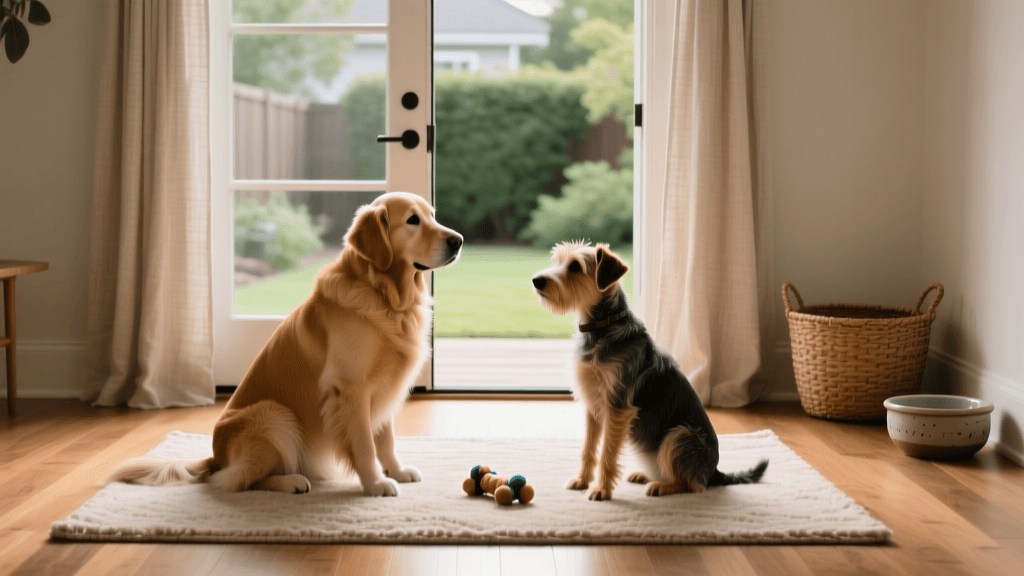
Sharing your life with multiple dogs adds a layer of complexity to AAC training. In 2026, multi-pet homes often utilize color-coded HexTiles or distinct voice recordings for each dog to help the smart-app track who is communicating. However, the physical signals between the dogs are just as important as the buttons.
Watch for resource guarding of the soundboard. If Dog A stands over the mat with a stiff, C-shaped curve to their body when Dog B approaches, they are claiming the communication tool as a high-value resource. To resolve this, establish multiple soundboard stations in different rooms, ensuring that the subordinate dog never has to cross the dominant dog's threshold to express a need like 'Water' or 'Outside'. Furthermore, pay attention to 'button stealing'—where one dog presses a button to manipulate the environment for themselves while the other dog exhibits calming signals like looking away or sniffing the ground to avoid conflict.
Conclusion: Blending Tech with Empathy
As we navigate dog ownership in 2026, the integration of smart technology and AAC soundboards offers unprecedented insight into our dogs' minds. Yet, a soundboard is merely a translator; the true language is still spoken through the flick of an ear, the tension in a jaw, and the carriage of a tail. By combining the structured vocabulary of a FluentPet system with a deep, empathetic understanding of canine calming signals, you create a profoundly enriched environment. You are not just giving your dog a voice; you are learning how to truly listen.
anouk-beaumont
All our authors care for dogs every day — read more of their work on the authors page.