First 30 Days: A Training Progression Plan For New Dogs
Discover a step-by-step 30-day training progression plan for your newly adopted dog. Build trust, establish routines, and teach essential cues.

The Philosophy Behind a Training Progression Plan
Bringing a new dog home is one of the most exciting milestones in your life, but it can be an overwhelming experience for your new canine companion. Many new owners make the critical mistake of rushing into advanced obedience or overwhelming their dog with too many rules on day one. A successful transition requires a structured training progression plan that prioritizes decompression, trust-building, and incremental learning. According to the American Society for the Prevention of Cruelty to Animals (ASPCA), giving your newly adopted dog time to adjust to their new environment is the foundational step for long-term behavioral success.
The 3-3-3 Rule of Dog Adoption:
3 Days: To decompress from the stress of the shelter or transport.
3 Weeks: To learn your daily routine, household rules, and begin to settle in.
3 Months: To fully build trust, form a deep bond, and feel truly at home.
This 30-day progression plan is designed around the first two phases of the 3-3-3 rule. By following this timeline, you will set realistic expectations, prevent behavioral burnout, and build a confident, well-adjusted dog. The American Kennel Club (AKC) emphasizes that short, positive, and progressive training sessions yield the best results, a principle we will apply to adult and adolescent dogs alike.
Week 1: Decompression, Routine, and Potty Training (Days 1–7)
Primary Focus: Environmental acclimation, trust-building, and establishing a bathroom routine.
During the first week, do not worry about teaching your dog to 'sit' or 'shake.' Your dog's brain is in survival mode, processing new scents, sounds, and people. Your primary training goals are potty training, crate acclimation, and name recognition.
Actionable Steps for Week 1
- Potty Training Schedule: Take your dog outside every 2 hours, immediately after meals, and right after waking up. Use a specific phrase like 'Go potty' in a calm, encouraging tone. Reward immediately with a high-value treat (e.g., Zuke's Mini Naturals, approx. $6 per bag) the second they finish.
- Crate Acclimation: The crate should be a sanctuary, not a punishment zone. Size it correctly: your dog should be able to stand, turn around, and lie down, but not have enough extra space to eliminate in one corner and sleep in another. Feed all meals inside the crate with the door open to build positive associations.
- Name Recognition Game: Say your dog's name once in a cheerful voice. The moment they look at you, mark the behavior with a 'Yes!' and give a treat. Repeat this 10 times per session, twice a day.
- Decompression Walks: Keep walks under 20 minutes. Let your dog sniff as much as they want. Sniffing lowers a dog's heart rate and provides crucial mental stimulation that tires them out faster than physical exercise alone.
Week 2: Foundation Cues and Impulse Control (Days 8–14)
Primary Focus: Basic communication, engagement, and introducing impulse control.
By week two, your dog is beginning to understand the household rhythm. Now, you can introduce foundational cues that will make living together harmonious. Keep training sessions to 5 minutes, three times a day. Dogs learn best in short bursts with frequent breaks.
Actionable Steps for Week 2
- Teaching 'Sit' and 'Down': Use a food lure. Hold a treat to your dog's nose and slowly move it up and back over their head to naturally guide their hindquarters to the floor for a 'Sit.' For 'Down,' move the treat from their nose straight down to the floor, then slowly pull it away toward you. Mark with 'Yes!' and reward the moment their elbows touch the ground.
- The 'Leave It' Cue: Place a low-value treat on the floor and cover it with your shoe. When your dog stops sniffing your shoe and looks up at you, mark 'Yes!' and reward them with a different, higher-value treat from your hand. This teaches them that ignoring a temptation yields a better reward.
- Handling Exercises: Gently touch your dog's paws, ears, and mouth, rewarding them with treats for calm acceptance. This is critical prep for future veterinary visits and grooming.
Week 3: Adding Duration, Distance, and Distractions (Days 15–21)
Primary Focus: Proofing behaviors and introducing the '3 Ds' of dog training.
A dog who sits perfectly in the kitchen may completely forget the cue when a squirrel runs by outside. Week three is about proofing—teaching your dog that cues apply in various contexts.
Actionable Steps for Week 3
- Adding Duration ('Stay'): Ask for a 'Sit,' show an open palm, and say 'Stay.' Wait just one second, mark 'Yes!', and reward. Gradually increase the time to 3 seconds, then 5, then 10. If your dog breaks the stay, you have increased the duration too quickly. Go back a step.
- Adding Distance: Once your dog can hold a stay for 10 seconds, take one single step back. Return immediately, mark, and reward. Slowly build up to taking three steps away. Always return to the dog to deliver the reward; this reinforces that staying put is the correct behavior.
- Recall on a Long Line: Attach a 15-foot biothane long line (approx. $25) to your dog's harness. In a safe, fenced area, let them wander. Say their name followed by 'Come!' in an excited tone. Gently reel them in if they don't respond, and throw a massive reward party (praise, treats, play) when they reach you. Never call your dog to you for something they perceive as negative, like a bath or nail trim.
Week 4: Real-World Application and Leash Manners (Days 22–30)
Primary Focus: Loose leash walking, polite greetings, and public manners.
The final week of your first month takes the training out of the house and into the real world. The environment is now the biggest distraction, and your management tools are essential.
Actionable Steps for Week 4
- Loose Leash Walking: Ditch the retractable leash. Use a standard 6-foot leather or nylon leash paired with a front-clip harness (like the Ruffwear Front Range, approx. $40). If your dog pulls, stop dead in your tracks. Become a tree. Only resume walking when the leash has slack. Alternatively, change direction abruptly when they pull, rewarding them when they catch up to your side.
- Polite Greetings: Teach your dog that four paws on the floor equals attention. If your dog jumps on you, cross your arms, turn your back, and ignore them completely. The second all four paws hit the floor, turn around, praise calmly, and pet their chest.
- The Premack Principle: Use real-life rewards. Ask your dog to 'Sit' before you open the front door for a walk, or before you put their food bowl down. This teaches them that calm behavior is the key to getting what they want.
30-Day Training Progression Checklist
Use this structured table to track your daily training focus and ensure you are not moving too fast or skipping vital foundational steps.
| Week | Primary Focus | Key Skills & Cues | Daily Time Commitment |
|---|---|---|---|
| Week 1 | Decompression & Routine | Potty schedule, Crate acclimation, Name recognition, Sniffari walks | 15 mins (divided into potty & play) |
| Week 2 | Foundation & Impulse | Sit, Down, Leave It, Handling exercises | 15 mins (3 x 5-min sessions) |
| Week 3 | Duration & Distance | Stay, Recall (long line), Adding mild distractions | 20 mins (incorporated into walks) |
| Week 4 | Real-World Manners | Loose leash walking, Polite greetings, Premack principle | 30 mins (outdoor walks & public exposure) |
Essential Gear for Your First Month
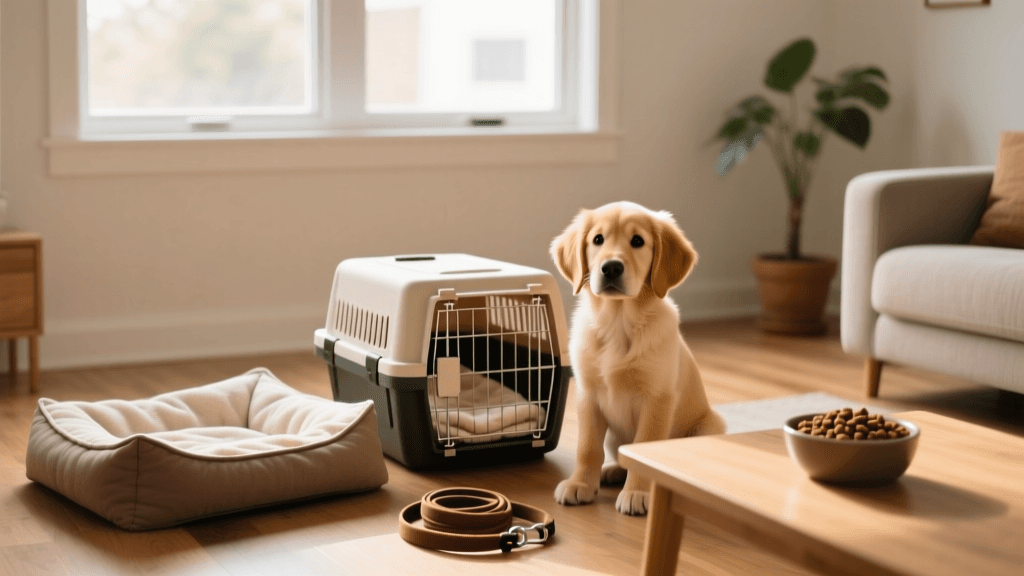
To execute this progression plan effectively, invest in the right tools. Avoid cheap, aversive tools like prong or choke collars, which can damage trust and physical health.
- Enzymatic Cleaner: Nature's Miracle or similar ($12–$18). Essential for completely eliminating potty accident odors so your dog doesn't re-soil the same spot.
- High-Value Treats: Zuke's Mini Naturals or boiled chicken breast. Keep them pea-sized to avoid overfeeding during repetitive training sessions.
- Front-Clip Harness: Ruffwear Front Range or Petsafe Easy Walk ($30–$45). Provides steering control without putting pressure on the dog's trachea.
- 15-Foot Long Line: Biothane material is highly recommended ($20–$30) because it is waterproof, doesn't tangle easily, and won't burn your hands like thin nylon.
- Interactive Puzzle Toy: Kong Classic ($15). Stuff with plain pumpkin puree and kibble, then freeze it to provide 30 minutes of calming mental enrichment.
Common Pitfalls to Avoid
Even with a solid plan, new owners often stumble. Avoid these common mistakes to keep your training progression on track:
- Inconsistency in Rules: If your dog is not allowed on the couch, they are never allowed on the couch. Allowing it 'just once' because they look cute will undo weeks of boundary training.
- Repeating Cues: Saying 'Sit, sit, sit, SIT!' teaches your dog that the cue is actually the fourth 'Sit.' Say it once, wait 3 to 5 seconds, and if they don't comply, gently lure them into the position or reset the environment.
- Skipping Decompression: Inviting 20 friends over on day two to meet the new dog is a recipe for a stress-bite or severe shutdown. Protect your dog's peace during the first 3 weeks.
By adhering to this 30-day training progression plan, you are not just teaching your dog commands; you are teaching them how to learn, how to trust you, and how to navigate the human world safely. Patience, consistency, and positive reinforcement will transform your newly adopted dog into a confident, lifelong companion.
anouk-beaumont
All our authors care for dogs every day — read more of their work on the authors page.