2026 Force-Free Puppy Leash Training: Best Harnesses & Methods
Master force-free puppy leash training in 2026 with the Engage-Disengage method. Compare top Y-front harnesses and learn positive reinforcement techniques.
The Evolution of Puppy Leash Training in 2026
Welcome to 2026, a landmark year where the veterinary and behavioral communities have universally cemented force-free, positive reinforcement methods as the absolute gold standard for puppy care. Gone are the dark ages of leash pops, choke chains, and outdated dominance theories. Today, we understand that a puppy's developing brain and body require patience, clear communication, and reward-based learning. Leash training a puppy is not about forcing them into a rigid heel position; it is about teaching them that walking with you is the most rewarding, engaging game in the world.
When we discuss force-free methods, we are referring to training protocols that avoid positive punishment and negative reinforcement. Instead, we focus on positive reinforcement (adding something the puppy loves to increase a behavior) and negative punishment (removing something the puppy wants to decrease a behavior, like stopping forward movement when the leash goes tight). This approach builds a bond of trust rather than fear, ensuring your puppy grows into a confident, well-adjusted adult dog.
The Science of Force-Free Leash Walking
The American Veterinary Society of Animal Behavior (AVSAB) explicitly states that reward-based training is the most effective and humane method for dogs, strongly advising against aversive tools. Puppies learn through operant conditioning, meaning they repeat behaviors that result in desirable outcomes. If pulling on the leash gets them to the tree they want to sniff, pulling is reinforced. If walking politely on a loose leash earns them high-value treats and access to their environment, loose-leash walking is reinforced.
Furthermore, a puppy's nervous system is highly impressionable during the critical socialization window (up to 16 weeks). Introducing aversive pain or pressure during this time can lead to lifelong leash reactivity, fear of the outdoors, and generalized anxiety. By utilizing positive reinforcement, we keep the puppy under their stress threshold, allowing the prefrontal cortex to remain engaged and receptive to learning.
Why Y-Front Harnesses are the 2026 Veterinary Standard
In 2026, veterinary orthopedic specialists universally recommend Y-front harnesses for puppies. Puppies have open growth plates in their shoulders and elbows that do not fully close until they are 12 to 18 months old. Harnesses that cross the chest horizontally or restrict the forward extension of the front legs can cause long-term biomechanical issues, altered gaits, and premature joint wear.
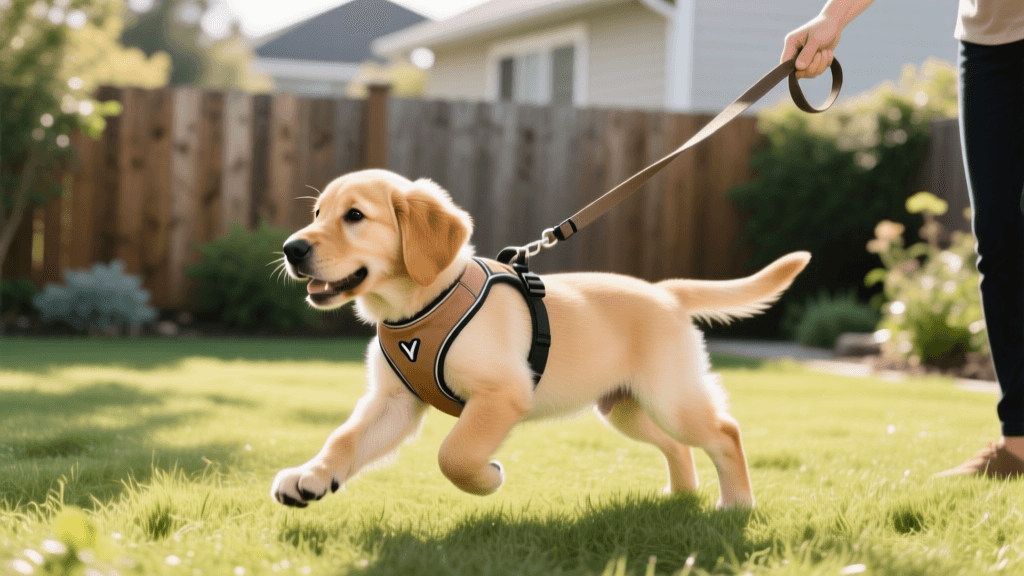
A Y-front harness features a chest strap that forms a 'Y' shape, resting safely on the sternum and allowing complete, unrestricted range of motion for the puppy's shoulders. When paired with a front-clip leash attachment, these harnesses gently redirect the puppy's momentum back toward the handler without applying choking pressure to the trachea or cervical spine.
2026 Harness Comparison Chart
| Harness Model | Best For | Puppy Weight Range | 2026 Price | Clip Options |
|---|---|---|---|---|
| Blue-9 Balance Harness | All breeds, highly adjustable | 2-15 lbs | $75.00 | Front & Back |
| Rabbit Go Harness | Toy breeds, sensitive skin | 1-10 lbs | $45.00 | Front & Back |
| Perfect Fit Modular | Chunky breeds (Bulldogs, Pugs) | 5-25 lbs | $65.00 | Front & Back |
When fitting any of these harnesses, you should be able to slide two fingers comfortably under every strap. Re-evaluate the fit every two weeks, as puppies experience rapid growth spurts that can quickly render a previously comfortable harness restrictive.
The Engage-Disengage Game: A Step-by-Step Guide
The Engage-Disengage game is a cornerstone of force-free leash training, particularly for puppies who are easily overstimulated by the environment. This protocol teaches the puppy to voluntarily check in with you when they see a distraction, rather than pulling toward it.
- Find the Threshold: Begin in a quiet environment. Your puppy should be able to notice a distraction (like a parked car or a distant person) without barking, lunging, or completely ignoring you. This is their 'threshold'.
- Mark the Engagement: The moment your puppy looks at the distraction, use a clicker or a marker word like 'Yes!' to mark the behavior. This tells the puppy that noticing the trigger is part of the game.
- Wait for Disengagement: Allow your puppy to process the distraction. Within a few seconds, they will naturally turn their head away or look back at you. The moment they disengage from the trigger and look at you, mark that behavior with a second 'Yes!'.
- Reward Heavily: Deliver a high-value treat directly to your puppy's mouth. Over time, the puppy learns that seeing a distraction is a cue to look at their handler for a reward.
Pro Tip for 2026: Never force your puppy to look at you by pulling the leash. The cognitive benefit of the Engage-Disengage game comes from the puppy making the voluntary choice to disengage and check in with you.
Essential Force-Free Gear for Puppies
Success in positive reinforcement training relies heavily on your timing and the quality of your rewards. The ASPCA Dog Training Guidelines emphasize that treat delivery must occur within 0.5 to 1 second of the desired behavior to create a clear neurological association.
- Clicker or Marker Word: A mechanical clicker (like the Karen Pryor i-Click) provides a consistent, unique sound that cuts through environmental noise. If you prefer a verbal marker, choose a short, sharp word like 'Yes!' and use the exact same tone every time.
- Treat Pouch: Fumbling in pockets ruins your timing. Use a dedicated treat pouch with a wide opening and a magnetic closure, worn on your hip. The Doggone Good Rapid Rewards Pouch remains a top choice for professionals in 2026.
- Biothane Long Line: For the first few months, avoid retractable leashes entirely. They teach puppies that pulling creates more leash, and the thin cords can cause severe friction burns. A 10-foot, 3/8-inch Biothane long line gives your puppy freedom to sniff while remaining completely waterproof and easy to sanitize.
- High-Value Treats: Kibble rarely works in distracting outdoor environments. Boil chicken breast, use freeze-dried beef liver, or string cheese. Cut treats into pea-sized pieces to prevent your puppy from getting full too quickly.
Troubleshooting Common Puppy Leash Behaviors
Even with the best positive reinforcement protocols, puppies will test boundaries. Here is how to handle common issues without resorting to force:
The Leash Bite and Tug: Puppies explore the world with their mouths, and a moving leash looks like a fantastic tug toy. If your puppy bites the leash, do not yank it away, as this triggers their prey drive. Instead, stop walking completely and become a 'boring tree.' Alternatively, carry a secondary braided fleece tug toy. When the puppy grabs the leash, immediately offer the fleece toy and reward them for engaging with the appropriate item.
The Sit-Down Protest: Many puppies will simply sit down and refuse to move, especially when overwhelmed or tired. Never drag a puppy by the leash. Instead, crouch down to their level, offer a high-value treat near their nose, and take a step backward to lure them forward. If they are truly exhausted or overstimulated, the most force-free option is to pick them up and carry them home, ending the session on a positive note.
Sniffing and Foraging: Sniffing is a natural decompression activity for dogs. According to Karen Pryor Clicker Training, allowing your puppy to engage in 'sniffaris' lowers their heart rate and provides immense mental enrichment. Use a release cue like 'Go Sniff' to reward polite leash walking with 30 seconds of uninterrupted sniffing time.
Conclusion
Force-free puppy leash training in 2026 is a journey of patience, observation, and mutual respect. By investing in a biomechanically sound Y-front harness, utilizing the Engage-Disengage game, and timing your positive reinforcement perfectly, you are setting your puppy up for a lifetime of enjoyable, stress-free walks. Remember that every walk is a training session, and every training session is an opportunity to deepen the bond with your best friend.
beth-carrasco
All our authors care for dogs every day — read more of their work on the authors page.