Decoding Leash Reactivity: Engage-Disengage Guide for 2026
Learn to manage leash reactivity in 2026 with the Engage-Disengage game. Decode calming signals and reduce canine anxiety with proven behavior protocols.
Leash reactivity remains one of the most pervasive and stressful behavioral challenges for dog owners. Whether your dog lunges, barks, or whines at the sight of other dogs, strangers, or passing vehicles, the underlying emotional state is almost always rooted in fear, anxiety, or profound barrier frustration. As we navigate 2026, the veterinary and behavioral science communities have moved entirely away from outdated, dominance-based corrections. Instead, modern canine psychology emphasizes threshold management, biometric monitoring, and force-free counter-conditioning protocols. This comprehensive guide will walk you through decoding your dog's subtle stress signals and implementing the gold-standard Engage-Disengage game to transform your walks from chaotic battles into peaceful bonding experiences.
Understanding the Root of Leash Reactivity
Before we can modify a behavior, we must understand the emotion driving it. According to the Tufts Cummings School of Veterinary Medicine Pet Behavior Clinic, leash reactivity is rarely about 'aggression' in the malicious sense. It is typically a manifestation of the autonomic nervous system's fight-or-flight response. The leash acts as a physical barrier that restricts a dog's natural ability to flee or perform normal canine greeting rituals, leading to a phenomenon known as 'barrier frustration.' When a dog feels trapped, their anxiety spikes, and they resort to explosive displays intended to increase the distance between themselves and the perceived threat.
In 2026, certified behaviorists categorize reactivity into two primary buckets: fear-based reactivity and frustration-based reactivity. Fear-based dogs are saying, 'Stay away from me, you are a threat.' Frustration-based dogs are saying, 'I want to go say hello, but this leash is holding me back!' While the outward behavior (barking, lunging) looks identical, the internal emotional state requires slightly different long-term management strategies. However, the immediate intervention protocol for both remains the same: keep the dog under their stress threshold and change their emotional response to the trigger.
Decoding Canine Calming Signals
Dogs are master communicators, but their language is incredibly subtle. Long before your dog erupts into a barking fit, they will display a series of micro-behaviors known as 'calming signals.' Originally popularized by Norwegian dog trainer Turid Rugaas, these signals are an attempt by the dog to self-soothe and de-escalate a stressful situation. Recognizing these signals in 2026 is the cornerstone of proactive anxiety management.
- Lip Licking and Tongue Flicks: Quick, darting licks of the nose or lips when no food is present.
- Yawning: Out-of-context yawning is a massive indicator of internal stress and cognitive overload.
- Whale Eye: When the dog turns their head away from the trigger but keeps their eyes fixed on it, exposing the whites of their eyes.
- Ground Sniffing: Sudden, intense, and seemingly unmotivated sniffing of the dirt to avoid direct eye contact with a trigger.
- Shaking Off: A full-body shake, as if wet, used to literally 'shake off' a buildup of cortisol and adrenaline after a stressful encounter.
If you see these signals, your dog is already in the 'Yellow Zone' of their stress threshold. Ignoring these whispers forces your dog to eventually 'shout' through reactive outbursts.
The Engage-Disengage Game: A Step-by-Step Protocol
Developed by Leslie McDevitt in her seminal 'Control Unleashed' program, the Engage-Disengage game is a classical and operant conditioning hybrid. It teaches the dog that looking at a trigger predicts good things, and that looking away from the trigger is a highly rewarded choice. This protocol is heavily endorsed by Fear Free Pets as a primary tool for reducing canine anxiety without the use of aversive tools.
Phase 1: Engage (Marking the Trigger)
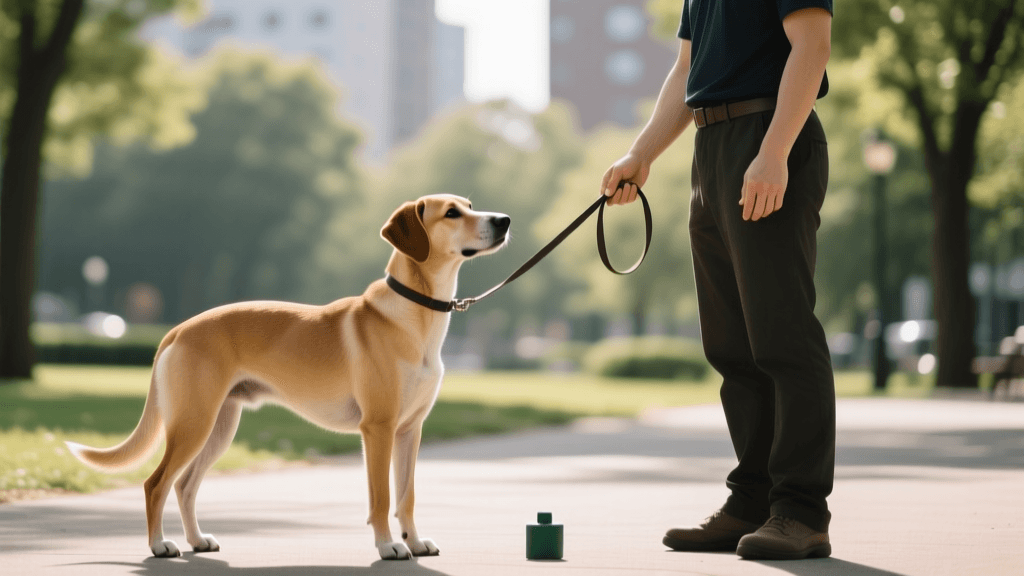
Set up your training environment at a distance where your dog notices the trigger (e.g., another dog across the park) but remains completely relaxed and willing to eat treats. This is the 'Green Zone.' The moment your dog looks at the trigger, use a marker word like 'Yes!' or a clicker. Then, deliver a high-value reward (like boiled chicken or freeze-dried liver). In this phase, you are simply pairing the sight of the trigger with a positive outcome. You are rewiring the brain's amygdala to associate the scary thing with a dopamine release.
Phase 2: Disengage (Rewarding the Choice)
Once your dog reliably expects a treat after looking at the trigger, you move to Phase 2. When your dog looks at the trigger, wait silently. Do not mark or prompt them. Wait for your dog to voluntarily turn their head away from the trigger and look back at you. The exact second they make that choice to disengage, mark with your 'Yes!' and deliver a jackpot reward. This phase empowers the dog, teaching them that they have control over their environment and that checking in with their handler is the most rewarding option available.
Integrating 2026 Smart Tech for Threshold Training
The year 2026 has brought incredible advancements in canine biometric tracking, removing the guesswork from threshold management. Modern smart collars, such as the Fi Series 4 or the Inupathy 2026 biometric harness, now track Heart Rate Variability (HRV) in real-time. HRV is the ultimate physiological indicator of autonomic nervous system balance. A dropping HRV indicates sympathetic nervous system arousal (stress/fight-or-flight), while a high HRV indicates parasympathetic dominance (rest/digest).
By pairing your dog's biometric collar with your smartphone, you can receive a haptic alert when your dog's HRV begins to dip, signaling rising anxiety before any physical calming signals are even visible. This allows you to increase distance and begin the Engage-Disengage game proactively, rather than reacting to a lunge. Furthermore, for dogs with severe separation anxiety or indoor reactivity to window triggers, smart treat cameras like the Petcube Bites 3 allow owners to run remote desensitization sessions, tossing high-value treats via an app the moment a delivery truck passes, effectively counter-conditioning the dog while the owner is at work.
Canine Threshold Management Chart
Understanding where your dog is on the reactivity spectrum dictates your training strategy. Use the following chart to assess your dog's state during walks in 2026.
| Threshold Zone | Distance to Trigger | Canine Body Language & HRV | Handler Action Required |
|---|---|---|---|
| Green (Sub-Threshold) | 50+ feet (Varies by dog) | Relaxed posture, soft eyes, open mouth, willing to take treats gently. HRV is stable and high. | Begin Engage-Disengage game; reward heavily for looking at trigger and back at handler. |
| Yellow (Approaching Threshold) | 20-50 feet | Stiffening, closed mouth, whale eye, slow treat uptake, lip licking. HRV begins to drop rapidly. | Stop training. Increase distance immediately; use an emergency U-turn; scatter feed on the ground to encourage sniffing. |
| Red (Over Threshold) | Under 20 feet | Lunging, barking, snapping, refusing food, piloerection (hackles up). HRV is bottomed out; cortisol is flooding the brain. | Do not attempt to train or correct. Remove the dog from the situation calmly. The learning brain is offline. |
Common Mistakes to Avoid in Modern Reactivity Management
Despite the wealth of information available through resources like the ASPCA Dog Care portal, many owners still fall victim to outdated training myths that exacerbate anxiety. The most common mistake is 'flooding'—forcing a dog to remain in the presence of a trigger at a distance that pushes them into the Red Zone, under the false assumption that they will eventually 'get used to it.' Flooding leads to learned helplessness or a massive escalation in aggressive displays.
Another critical error is punishing the growl. A growl is a vital piece of communication; it is the dog's way of saying, 'I am uncomfortable, please give me space.' If you punish the growl, you suppress the warning system, resulting in a dog that bites without any prior warning signs. In 2026, we celebrate the growl as valuable data, using it as a cue to increase distance and advocate for our dog's boundaries.
Final Thoughts on Anxious Dog Management
Managing a leash-reactive dog requires immense patience, consistency, and empathy. By learning to read your dog's subtle calming signals, leveraging modern biometric technology to monitor their internal stress levels, and faithfully executing the Engage-Disengage protocol, you can fundamentally change how your dog perceives the world. Remember that progress is rarely linear. There will be days when the wind is blowing the wrong way, the environment is too loud, and your dog's threshold shrinks. On those days, simply increasing distance and keeping your dog safe is a massive victory. With time, positive reinforcement, and a deep understanding of canine psychology, you and your dog will conquer the sidewalk together.
beth-carrasco
All our authors care for dogs every day — read more of their work on the authors page.