Force-Free Nail Grinding: Dremel PawControl Desensitization 2026
Learn force-free nail grinding for dogs in 2026 using the Dremel PawControl. Master cooperative care, desensitization, and stress-free routines.
The Shift to Cooperative Canine Care in 2026
For decades, dog owners and even some veterinary professionals relied on physical restraint to manage routine grooming tasks. Nail trimming, in particular, has historically been a battleground of pinned-down dogs, muzzles, and elevated stress hormones. However, as we navigate dog ownership in 2026, the paradigm has definitively shifted. The modern standard for canine husbandry is rooted in positive reinforcement, force-free methods, and cooperative care. By empowering your dog to participate willingly in their grooming routine, you not only protect their physical well-being but also deepen the trust between you and your canine companion.
According to the Fear Free Pets initiative, reducing fear, anxiety, and stress (FAS) during routine handling is critical for a dog's long-term behavioral health. When dogs are forced into compliance, their cortisol levels spike, leading to learned helplessness or defensive aggression. This comprehensive guide will walk you through a strictly force-free, desensitization-based protocol for nail grinding using the industry-leading Dremel PawControl, ensuring your dog's paws stay healthy without the trauma.
Why the Dremel PawControl is the 2026 Standard
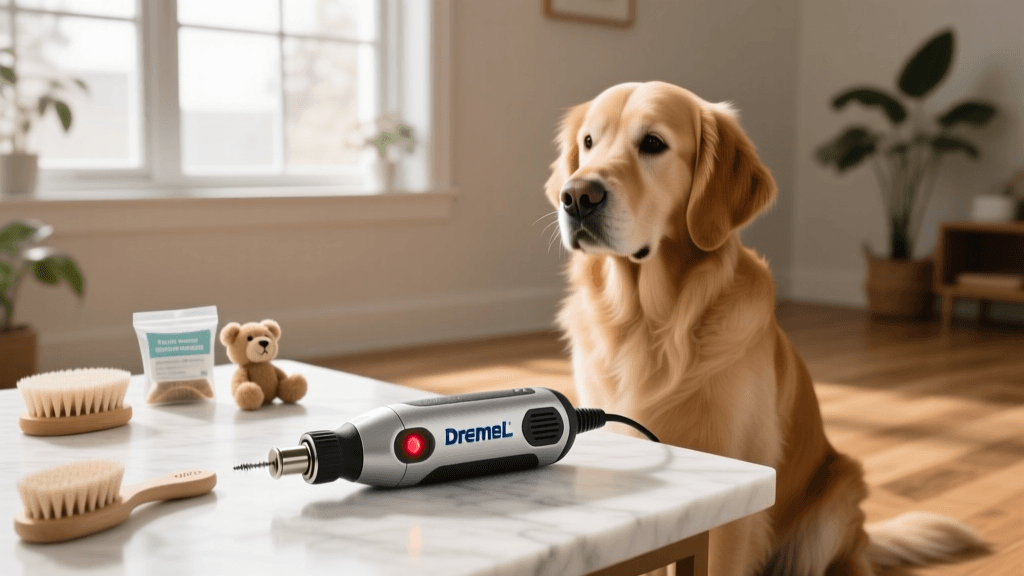
Traditional guillotine or scissor-style clippers carry a high risk of "quicking" the dog—cutting into the sensitive blood vessel inside the nail. This causes acute pain and instantly destroys any trust you have built. The Dremel PawControl Cordless Nail Grinder has emerged as the premier tool for force-free grooming in 2026 due to its specialized, dog-centric design features:
- Variable Speed Settings: Allows you to start on the lowest, quietest setting for highly sensitive dogs and gradually increase the RPM as the dog habituates to the vibration.
- 45-Degree Angle Guide: This patented attachment ensures you grind at the optimal angle, preventing accidental contact with the quick and reducing the chance of catching fur.
- Integrated LED Light: Illuminates the nail bed, making it significantly easier to identify the quick, especially in dogs with dark or black nails.
- Ergonomic, Quiet Motor: The 2026 models feature advanced sound-dampening technology, reducing the high-pitched whine that typically triggers auditory sensitivity in dogs.
By pairing this precision tool with high-value reinforcement, we transform a dreaded chore into an engaging training game.
The Foundation: Teaching a Consent Signal
Before you ever turn on the Dremel, your dog must have a way to communicate their willingness to participate. In force-free methodology, this is known as a "consent signal" or "start button." For nail grinding, the most effective consent signal is a sustained "paw target" or a "chin rest."
How to Teach the Paw Target
- Targeting a Mat: Place a small, distinct silicone mat or a folded towel on the floor. Lure your dog to place one front paw on the mat using a high-value treat.
- Mark and Reward: The exact moment their paw touches the mat, use a marker word (like "Yes!") or a clicker, and deliver the treat.
- Build Duration: Gradually delay the marker and reward. Require your dog to leave their paw on the mat for one second, then three seconds, then five seconds.
- The Opt-In Rule: If your dog pulls their paw away, do not grab it. Simply wait. When they voluntarily place their paw back on the mat, mark and reward heavily. This teaches the dog that keeping their paw on the mat makes the good things happen, and they always retain the agency to withdraw their paw if they feel overwhelmed.
Setting Up Your Treat Hierarchy
Desensitization requires exceptional motivation. Kibble will not suffice when introducing a loud, vibrating tool to your dog's sensitive paws. You must establish a treat hierarchy. The ASPCA's grooming guidelines emphasize using positive associations with food to counter-condition dogs to handling.
| Treat Tier | Examples | Usage Scenario |
|---|---|---|
| Low Value | Dry kibble, standard training biscuits | Baseline training, teaching the paw target on the mat. |
| Medium Value | Freeze-dried chicken, string cheese, commercial soft chews | Introducing the sight and smell of the turned-off Dremel. |
| High Value | Boiled chicken breast, low-sodium hot dogs, beef liver | Auditory desensitization (turning the Dremel on at a distance). |
| Jackpot / Lickable | KONG Easy Treat (Peanut Butter), Honest Kitchen Goat's Milk, bone broth popsicles | Actual grinding phase. Licking releases endorphins and naturally soothes canine anxiety. |
The 4-Phase Force-Free Desensitization Protocol
Patience is the cornerstone of cooperative care. Do not rush these phases. A single session should never exceed three to five minutes. If your dog shows signs of stress, end the session immediately on a positive note.
Phase 1: Visual and Olfactory Introduction
Place the turned-off Dremel PawControl on the floor next to your dog's enrichment mat or snuffle mat. Allow your dog to investigate it at their own pace. Every time they sniff or look at the tool, mark with your "Yes!" and toss a medium-value treat away from the tool. This builds a positive conditioned emotional response (CER) to the sight of the grinder.
Phase 2: Auditory Desensitization (The Sound Game)
Many dogs are more afraid of the noise than the physical sensation. Sit on the floor with your dog. Turn the Dremel on to its lowest speed, holding it at least three feet away from your dog. Immediately begin feeding high-value treats continuously. Turn the Dremel off, and the treat delivery stops. Turn it back on, and the treats resume. Repeat this until your dog visibly relaxes, offers a "play bow," or looks eagerly at you when they hear the motor. Gradually decrease the distance over multiple days.
Phase 3: Tactile Desensitization (Vibration Without Grinding)
With the Dremel turned off, ask for your dog's consent signal (paw on the mat). Gently touch the side of the plastic Dremel housing (not the sanding band) against their nail. Mark and reward. Next, turn the Dremel on, but use the back of the plastic handle to gently touch their leg and paw. This allows them to feel the vibration without the friction of the sanding band. Feed jackpot lickable treats during this step.
Phase 4: The Actual Grind
Once your dog is entirely relaxed with the vibration, attach the 45-degree angle guide and expose the sanding band. Ask for the paw target. Gently touch the spinning band to the very tip of one single nail for exactly one second. Mark, reward generously with a lickable treat, and release the paw.
Pro Tip for 2026: Never attempt to grind all four paws in one sitting during the first month of training. Grinding one nail per day is a massive victory in cooperative care. Over time, you can increase the criteria to three nails, then one full paw, always letting the dog's body language dictate the pace.
Reading Canine Stress Signals
Force-free training requires fluency in canine body language. Because dogs cannot speak, they use subtle "calming signals" and stress indicators to tell us when they are approaching their threshold. If you observe any of the following, you must stop grinding, increase your distance, or lower your criteria immediately:
- Whale Eye: Showing the whites of their eyes while looking away from you.
- Lip Licking & Yawning: When not related to food or tiredness, these are primary indicators of nervous system stress.
- Freezing: A dog that goes completely stiff is not a "good, calm" dog; they are in a state of tonic immobility (shutdown).
- Panting: Sudden, shallow panting when the room is cool.
- Leaning Away: Shifting their body weight away from your hands or the tool.
Troubleshooting Common Setbacks
What happens if your dog pulls their paw away during Phase 4? In traditional grooming, this is when a handler might tighten their grip. In force-free methodology, a withdrawn paw is simply data. It means your dog has reached their threshold for that session.
Do not chase the paw. Let your dog withdraw it. Wait a moment, then ask for the paw target again. If they refuse, the session is over. Analyze what went wrong: Was the Dremel speed too high? Did you grind for two seconds instead of one? Was the treat value too low? Adjust your variables, and try again tomorrow. By respecting their "no," you make their "yes" much more reliable in the future.
Conclusion: A Lifetime of Trust
Embracing force-free nail grinding with the Dremel PawControl is an investment in your dog's emotional well-being. While it may take several weeks to work through the desensitization phases, the payoff is immense. You will no longer need to dread grooming day, and your dog will no longer need to hide when the nail clippers come out. By utilizing cooperative care, high-value reinforcement, and a deep respect for canine body language, you are setting a gold standard for dog ownership in 2026. Your dog's paws will remain healthy, and your bond will remain unbroken.
marcus-aldridge
All our authors care for dogs every day — read more of their work on the authors page.