Dog Resource Guarding: Diagnosis and Proven Solutions
Learn how to diagnose resource guarding in dogs and implement proven, step-by-step solutions to manage aggression and ensure a safe, peaceful home.
Understanding Resource Guarding in Dogs
Resource guarding is one of the most common, yet deeply misunderstood, behavioral issues in domestic dogs. At its core, resource guarding is an evolutionary survival mechanism. In the wild, canines must protect their food, territory, and valuable items from competitors to survive. While our domestic dogs no longer need to fight for survival, the instinct to guard high-value items remains deeply ingrained in their DNA. When a dog perceives that a valuable resource is about to be taken away, they may exhibit defensive behaviors ranging from subtle body language cues to overt aggression.
According to the American Kennel Club (AKC), resource guarding is not a sign of a 'bad' or 'dominant' dog, but rather a natural canine behavior that has become maladaptive in a human household. For dog owners, especially those in multi-dog homes or families with young children, diagnosing the root triggers and implementing structured, force-free solutions is critical for safety and household harmony.
Diagnosing Resource Guarding: The Canine Ladder of Aggression
Many owners believe that resource guarding happens 'out of nowhere' when a dog suddenly bites. In reality, dogs communicate their discomfort long before a bite occurs. Behaviorists refer to this escalation as the 'Canine Ladder of Aggression.' Diagnosing the problem early requires learning to read the subtle, lower-rung signals.
Early Warning Signs (Subtle Cues)
- Whale Eye: The dog turns its head away but keeps its eyes fixed on the perceived threat, showing the whites of the eyes.
- Lip Licking and Yawning: Out-of-context calming signals indicating stress.
- Body Blocking: Positioning their body between the resource and the approaching person or dog.
- Freezing: A sudden, rigid stillness while eating or chewing. This is a critical red flag that the dog is preparing to escalate.
Escalation Signs (Overt Cues)
- Low Growl: A rumbling vocalization meant to increase distance.
- Snapping: A deliberate bite at the air, intended to warn without making contact.
- Biting: The final resort when all previous communication signals have been ignored or punished.
As noted by Fear Free Pets, punishing early warning signs like growling does not cure the guarding instinct; it simply suppresses the warning system. This results in a dog that bites without warning, making the situation vastly more dangerous.
Identifying Common Triggers
To solve the problem, you must first diagnose what your dog considers 'valuable.' Triggers generally fall into four categories:
- Food and Bowls: Guarding kibble, wet food, or the empty bowl itself.
- High-Value Chews and Toys: Bully sticks, yak cheese, raw bones, or favorite squeaky toys.
- Stolen Items: Trash, socks, shoes, or children's toys.
- Spatial and Owner Guarding: Guarding a specific bed, the couch, a doorway, or even a specific person from other dogs or guests.
Environmental Management: Tools and Costs
Before beginning behavioral modification, you must manage the environment to prevent rehearsal of the unwanted behavior. Every time a dog successfully guards an item, the behavior is reinforced. Management tools are essential for safety while training is underway.
- Baby Gates: Use gates like the Regalo Easy Step Walk Thru Baby Gate (approx. $40) to separate dogs during feeding times or when high-value chews are distributed.
- Puzzle Feeders: Toys like the KONG Classic ($15-$20) or Outward Hound Nina Ottosson Dog Brick ($25) can be used in a crate or separate room, keeping the dog mentally stimulated and safely contained.
- 6-Foot Leather Leash: For tethering or safely guiding a dog away from a dropped item without putting your hands near their mouth ($25-$40).
- High-Value Training Treats: For counter-conditioning, you need treats that are significantly better than the guarded item. Ziwi Peak Air-Dried Beef or freeze-dried beef liver ($30-$45 per bag) are excellent choices.
The 'Trade-Up' Protocol: Step-by-Step Solutions
The most effective, science-backed solution for resource guarding is Desensitization and Counter-Conditioning (DS/CC), often implemented via the 'Trade-Up' game. The goal is to change the dog's emotional response from 'They are going to take my stuff' to 'When they approach, I get something even better!'
Step 1: The Approach and Toss (Distance Training)
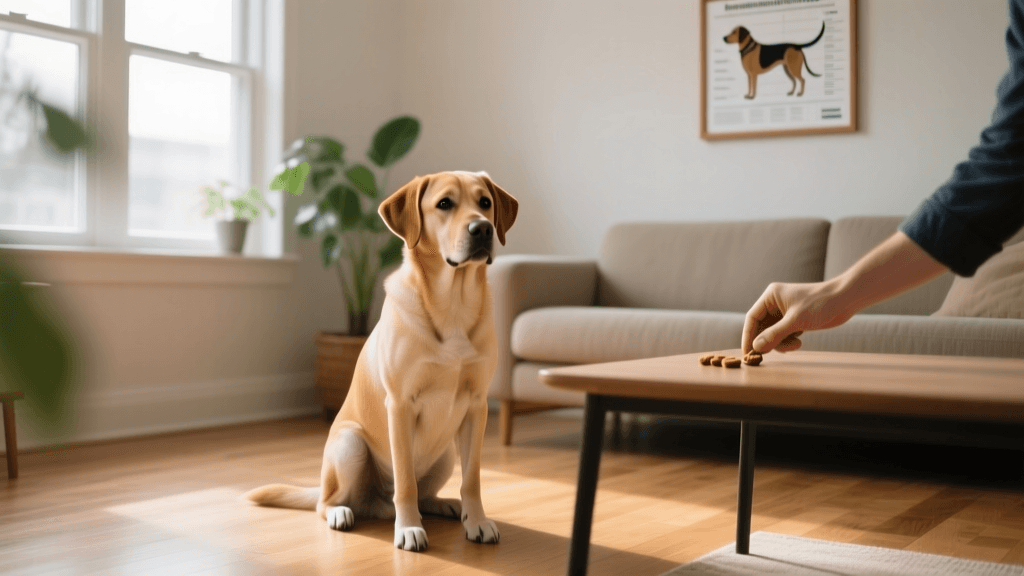
Start when your dog is eating a low-value meal (kibble). Stand at a distance where the dog shows zero signs of stress (e.g., 6 to 10 feet away). Toss a high-value treat (like a piece of Ziwi Peak beef) toward their bowl. Walk away. Repeat this 10-15 times per session, 3 times a week. The dog learns that your approach predicts a high-value reward, not a theft.
Step 2: Closing the Distance
Over several weeks, gradually decrease the distance by 1 foot per session, provided the dog remains relaxed (loose body, wagging tail, eating normally). If the dog freezes or stops eating, you have moved too close too quickly. Increase the distance and proceed slower.
Step 3: The Formal Trade (For Toys and Chews)
When your dog has a medium-value toy, approach with a handful of high-value treats. Say a cue word like 'Drop' or 'Trade,' and toss the treats on the floor a few feet away. When the dog drops the toy to eat the treats, calmly pick up the toy. Once the dog finishes the treats, give the toy back. Crucial Rule: You must give the item back 9 out of 10 times. If you only ever trade to take the item away permanently, the dog will stop trusting the trade.
Trigger Identification and Management Chart
| Trigger Type | Management Strategy | Training Protocol | Estimated Tool Cost |
|---|---|---|---|
| Food Bowls | Feed in separate rooms or crates | Approach & Toss high-value treats | $15 (Treats) |
| Bully Sticks / Chews | Use baby gates; feed in isolation | Trade-Up game with freeze-dried liver | $40 (Gate) + $30 (Treats) |
| Stolen Trash / Socks | Dog-proof home; use lidded trash cans | 'Drop It' cue trained with positive reinforcement | $20 (Lidded Can) |
| Spatial (Couch/Beds) | Block access with furniture or gates | 'Place' mat training; reward for staying on dog bed | $30 (Place Mat) |
What NOT to Do: Debunking the 'Alpha' Myth
Historically, outdated training methods suggested that owners should forcefully take items from a dog's mouth or perform 'alpha rolls' to establish dominance. The Best Friends Animal Society and modern veterinary behaviorists strongly advise against these methods. Forceful extraction triggers a dog's fight-or-flight response, escalating the aggression and damaging the trust between dog and owner. Furthermore, it teaches the dog to guard items more fiercely or to hide and consume them rapidly, which poses a severe choking hazard.
Instead of punishment, focus on management and positive reinforcement. If your dog grabs a dangerous or forbidden item, do not chase them. Chasing turns the interaction into a game of keep-away. Instead, run in the opposite direction while making excited noises, or grab a high-value treat to initiate a trade.
When to Seek Professional Help
While mild resource guarding (like freezing near the food bowl) can often be managed with the protocols above, severe guarding that involves snapping, biting, or guarding multiple unpredictable items requires professional intervention. If your dog has broken skin or if you have young children in the home, consult a certified professional immediately. Look for a Certified Applied Animal Behaviorist (CAAB) or a Certified Professional Dog Trainer (CPDT-KA) who utilizes force-free, science-based methods. With patience, proper management, and consistent counter-conditioning, resource guarding can be successfully mitigated, leading to a safer and more trusting relationship with your dog.
robin-maitland
All our authors care for dogs every day — read more of their work on the authors page.