Moving With Dogs: 2026 Boundary & Crate Training Guide
Relocating in 2026? Prevent obedience regression and separation anxiety with our expert boundary, crate, and house-training guide for dogs.
The Psychology of Canine Relocation Stress
Moving to a new home is consistently ranked as one of the most stressful life events for humans, but for our dogs, it can be a profound psychological shock. Dogs rely heavily on spatial memory, familiar scent markers, and predictable routines to feel secure. When you relocate, you strip away the environmental cues that reinforce their obedience and house-training. In 2026, veterinary behaviorists emphasize that a change in environment is a primary trigger for behavioral regression, including indoor marking, excessive barking, and separation anxiety.
According to the principles outlined by Fear Free Happy Homes, mitigating relocation stress requires a proactive approach to environmental management and positive reinforcement. Rather than expecting your dog to simply "figure it out" in the new house, you must actively re-establish boundaries, rebuild crate associations, and reinforce foundational obedience commands during the critical first 14 days in your new space.
Pre-Move Preparation: Scent and Crate Conditioning
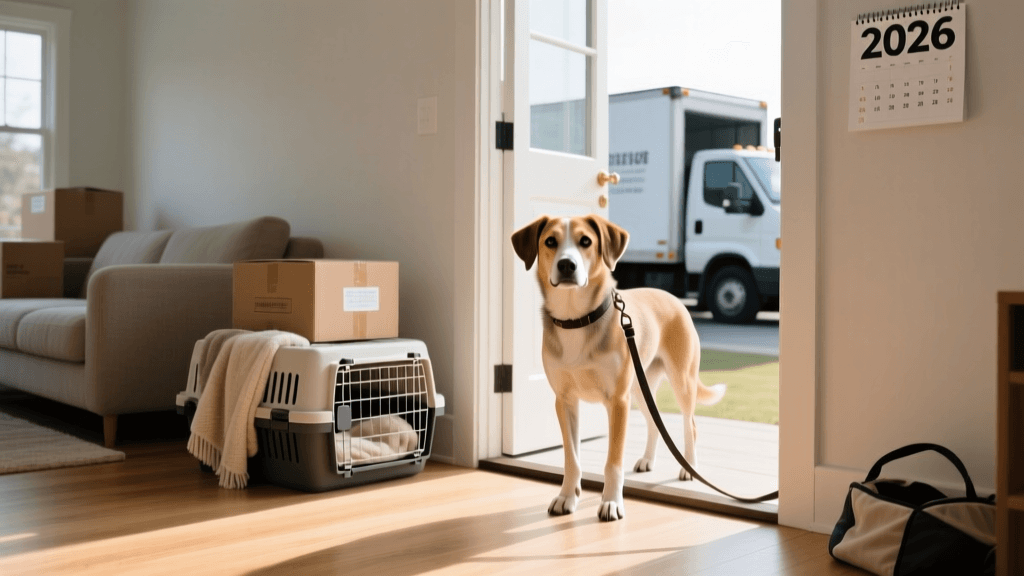
The transition begins before the moving truck even arrives. Your dog's crate and bedding are their primary anchors of security. A common mistake pet parents make is washing all of the dog's bedding and thoroughly cleaning their crate right before the move to ensure it arrives fresh. This is counterproductive.
Preserving Familiar Scents
Do not wash your dog's favorite blanket or crate mat for at least two weeks prior to the move. The natural oils and familiar scents will act as an olfactory anchor in the new, unfamiliar-smelling house. When setting up the new home, place the unwashed bedding in a quiet, low-traffic corner of the living room or your bedroom to create an immediate "safe zone."
Upgrading the Crate Experience
If your dog has shown mild reluctance toward their crate, a move is the perfect time to re-condition it using high-value enrichment. In 2026, interactive puzzle toys remain the gold standard for crate conditioning. The West Paw Toppl and the classic KONG Extreme are excellent choices. Freeze them with a mixture of plain Greek yogurt, pumpkin puree, and a dash of low-sodium chicken broth. Giving this to your dog exclusively inside the crate during the chaotic unpacking phase builds a strong positive association with their den.
Establishing Boundaries in the New Home
A new floor plan means new rules. Kitchens with island counters, open-concept living rooms, and multi-story staircases present novel hazards and temptations. To prevent your dog from developing bad habits—like counter-surfing or darting out the front door—you must establish physical and behavioral boundaries immediately.
Comparing Indoor Boundary Methods
Below is a comparison of the most effective boundary management tools available in 2026 to help you restrict access to unpacking zones, hazardous areas, or unfenced yards.
| Boundary Method | Best Use Case | Estimated 2026 Cost | Pros & Cons |
|---|---|---|---|
| Hardware-Mounted Gates (e.g., Carlson Extra Wide) |
Blocking kitchens, staircases, or nurseries permanently. | $60 - $90 | Pros: 100% physical barrier, highly durable. Cons: Requires drilling, visually obtrusive. |
| Smart Indoor Barriers (e.g., PetSafe Pawz Away) |
Keeping dogs off specific furniture or away from indoor trash cans. | $40 - $65 | Pros: Wireless, portable, uses gentle static correction. Cons: Requires dog to wear a receiver collar. |
| Freestanding Pet Pens (e.g., IRIS USA Exercise Pen) |
Creating a temporary "puppy zone" in open-concept living areas. | $70 - $120 | Pros: No installation, highly configurable. Cons: Takes up significant floor space. |
| Mat Training (Behavioral) ("Place" Command) |
Keeping the dog settled while movers or guests are in the home. | $25 - $45 (for a raised cot) | Pros: Builds impulse control, travels anywhere. Cons: Requires consistent daily training sessions. |
Re-Training House Manners and Potty Protocols
Even a perfectly house-trained dog may have an accident in a new home. The new flooring smells like previous occupants, cleaning chemicals, or new carpet adhesives. To prevent regression, treat your dog as if they are a brand-new puppy for the first week.
- Increase Potty Frequency: Take your dog out on a leash every 2 to 3 hours for the first 48 hours, even if they have a dog door. Leash walking them to their designated new potty spot helps them map the new yard and understand exactly where business is to be done.
- Use Enzymatic Cleaners: If an accident occurs, do not use standard household floor cleaners, which often contain ammonia derivatives that can actually attract dogs back to the spot. Use a high-quality enzymatic cleaner like Nature's Miracle Advanced Stain & Odor Remover to break down the uric acid crystals completely.
- Reward Heavily: Bring high-value treats (like freeze-dried beef liver) out to the new yard. The moment your dog eliminates in the correct spot, throw a "potty party" with lavish praise and treats.
Mastering the "Place" Command in a New Environment
The "Place" command is arguably the most valuable obedience tool during a life transition. It instructs your dog to go to a specific raised cot or mat and remain there until released. This is crucial when movers are carrying heavy furniture, or when you are unpacking fragile items.
Step-by-Step "Place" Refresh
- Introduce the Mat: Place a raised dog cot (like the Coolaroo Elevated Pet Bed) in a quiet corner. Lure your dog onto it with a treat.
- Mark and Reward: The second all four paws are on the mat, use a clicker or a marker word like "Yes!" and deliver the treat.
- Add Duration: Gradually increase the time between the reward, asking for a "Down" on the mat. Start with 3 seconds and build up to 5 minutes over several days.
- Add Distance: Once your dog is reliable up close, take one step away, say "Place," and reward when they go to the mat.
Trainer's Tip: In 2026, many professional trainers recommend using a raised cot rather than a flat mat for the "Place" command. The physical elevation provides a clear tactile boundary that helps dogs differentiate between being "on place" and "off place," speeding up the learning process in novel environments.
Managing Separation Anxiety in a New Environment
Separation anxiety often flares up after a move because the dog does not yet associate the new house with your eventual return. The ASPCA notes that dogs with separation anxiety exhibit distress behaviors primarily when left alone or separated from their guardians.
To combat this, utilize smart home technology to monitor and reward calm behavior. The Furbo 360 Dog Camera is an excellent investment for relocating pet parents. Its auto-rotation feature allows you to track your dog's movements around the new house while you are at work. When you observe your dog settling calmly on their bed rather than pacing or scratching at the door, use the app's treat-tossing feature to remotely reward that calm state of mind.
Additionally, practice "micro-departures." Walk out the new front door, close it, wait exactly three seconds, and walk back in without greeting your dog. Repeat this 20 times a day. This desensitizes the dog to the sound of the new door latch and the squeak of the new hinges, stripping those triggers of their anxiety-inducing power.
Crate Training: The Ultimate Safe Haven
If your dog is not crate trained, or if they view the crate as a punishment, a move is the time to reset that narrative. The Humane Society of the United States advocates for crate training as a vital tool for house training and keeping pets safe from household hazards. In a new home filled with exposed wires, unpacking boxes, and potentially toxic cleaning supplies, a crate is a lifesaver.
Feed your dog all of their meals inside the crate with the door open for the first week. Leave a trail of high-value treats leading into the crate throughout the day. Never force the dog inside or use the crate as a timeout space during the stressful moving period. The crate must remain a sanctuary.
The 14-Day Relocation Training Checklist
Follow this structured timeline to ensure a smooth behavioral transition for your dog.
Days 1 to 3: Decompression and Scent Mapping
- Keep the dog on a leash indoors to prevent wandering and sniffing out hidden hazards.
- Set up the crate and "Place" cot in a designated quiet room.
- Take leashed potty breaks every 2 hours to establish the new yard boundaries.
- Feed all meals inside the crate to build positive associations.
Days 4 to 7: Boundary Enforcement and Micro-Departures
- Install physical gates to block off unpacking zones and kitchens.
- Begin practicing 3-second micro-departures out the front door.
- Introduce the "Place" command in the new living room for 5-minute settling sessions.
- Begin short periods of alone time in the crate (10-15 minutes) while you are in another room.
Days 8 to 14: Routine Normalization
- Transition to off-leash indoor supervision, rewarding calm settling behavior.
- Extend alone time in the crate or safe room to 1-2 hours.
- Begin exploring the new neighborhood on structured, sniff-heavy decompression walks.
- Phase out the treat trail into the crate, relying on verbal praise and meal-feeding.
Final Thoughts on Canine Transitions
Patience is your most valuable training tool during a life transition. Your dog is processing a massive influx of new sensory data, and expecting flawless obedience on day one is a recipe for frustration. By proactively managing their environment with gates and crates, preserving familiar scents, and relying on positive reinforcement to rebuild their confidence, you will help your dog view their new house as a safe, permanent home. Stick to the 14-day protocol, utilize modern smart cameras to monitor their stress levels, and celebrate the small victories as your best friend settles into their new life.
jonas-cole
All our authors care for dogs every day — read more of their work on the authors page.