DIY Snuffle Mats and Scent Games to Unlock Canine Instincts
Discover how to make DIY snuffle mats and scent games to tap into your dog's natural foraging instincts, reduce anxiety, and boost mental enrichment.
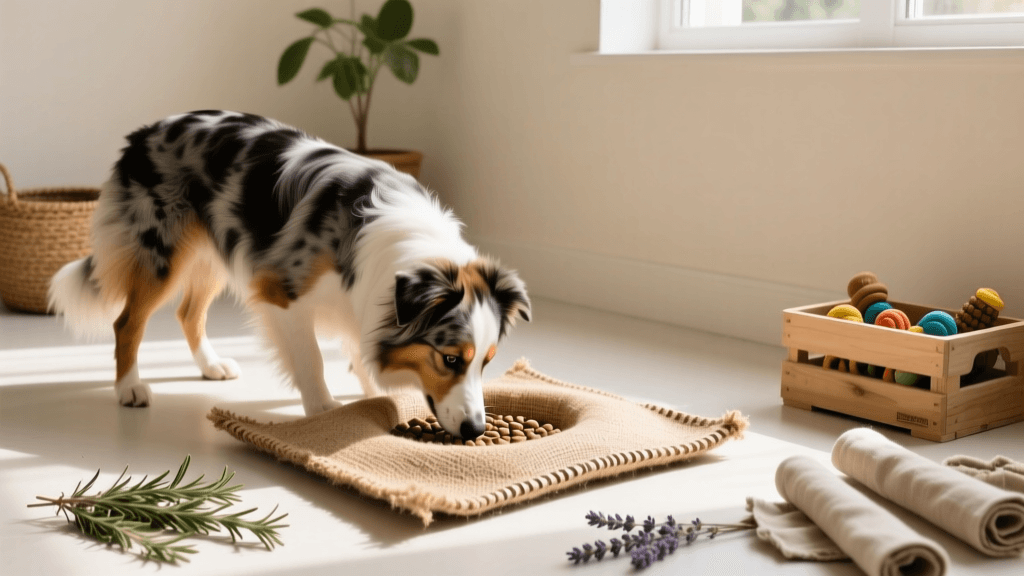
When we think of dog enrichment, we often picture physical exercise like fetch, agility, or long walks. However, understanding your dog requires looking beyond their physical needs and tapping into their deep-seated psychological drives. Dogs experience the world primarily through their noses. While humans rely heavily on sight, a dog's olfactory system is a complex, deeply ingrained tool for survival, communication, and mental stimulation. Commercial puzzle toys are excellent, but homemade solutions offer customizable, cost-effective ways to engage your dog's brain. By creating DIY snuffle mats and scent boxes, you not only save money but also gain a front-row seat to your dog's natural instincts, learning curve, and subtle body language.
The Psychology of a Dog's Nose: Why Foraging Matters
A dog's nose contains up to 300 million olfactory receptors, compared to our mere 6 million. Furthermore, the part of a dog's brain devoted to analyzing smells is proportionally 40 times greater than ours. When a dog sniffs, they are not just passively smelling; they are actively gathering complex data about their environment. This cognitive processing provides immense mental stimulation. According to the American Kennel Club (AKC), engaging a dog in nose work and scent games can build confidence, reduce anxiety, and tire them out mentally just as much as a long physical walk.
Sniffing actually lowers a dog's heart rate and releases dopamine, the brain's "feel-good" neurotransmitter. When you hide kibble or treats in a homemade foraging toy, you are allowing your dog to perform the natural predatory sequence: search, stalk, capture, and consume. In a domestic setting, dogs are often handed their food in a bowl, which bypasses this psychological need. DIY foraging games restore this natural rhythm, leading to a calmer, more fulfilled companion.
DIY Snuffle Mat: Step-by-Step Homemade Guide
A snuffle mat mimics the texture and complexity of tall grass, forcing your dog to use their nose to root out hidden morsels. It is one of the most effective homemade tools for understanding your dog's problem-solving skills and frustration tolerance.
Materials and Costs
- Base: 1 yard of a rubber sink mat or anti-fatigue mat with drainage holes (Approx. $10 - $15 at hardware stores).
- Strips: 2 yards of polar fleece fabric in 3-4 different colors (Approx. $8 - $12 at craft stores). Fleece is ideal because it does not fray when cut.
- Tools: Sharp fabric scissors and a ruler.
- Total Cost: Under $30 for a mat that would cost $60+ retail.
Assembly Instructions
- Cut the Fleece: Cut your fleece into strips measuring exactly 1 inch wide and 7 inches long. You will need roughly 300 to 400 strips depending on the size of your rubber mat.
- First Pass: Take one strip and push it through a hole in the rubber mat from the top down. Pull both ends so they are even.
- Tie the Knot: Tie a simple overhand knot around the rubber grid. Pull it tight so the fleece stands up.
- Repeat and Layer: Repeat this process through every single hole on the mat. For a denser, more challenging mat, tie a second layer of strips offset from the first.
- Fluff: Once finished, fluff the fleece strips so they resemble a shaggy rug. The rubber base should be completely hidden.
Homemade Scent Boxes and Decompression Games
While snuffle mats are great for mealtime, scent boxes are perfect for "decompression" sessions. Decompression is a psychological state where a dog is allowed to engage in unstructured, instinctual behaviors without commands or expectations. The Humane Society of the United States highly recommends food puzzles and scavenger hunts to alleviate boredom and destructive behaviors stemming from under-stimulation.
Building a DIY Scent Box
Materials: A large, shallow cardboard box (like a shipping box), empty toilet paper rolls, crumpled parchment paper, and high-value treats.
- Place the cardboard box on the floor in a quiet room.
- Scatter a handful of empty toilet paper rolls and crumpled balls of parchment paper inside.
- Hide small, smelly treats (like freeze-dried liver or bits of hot dog) deep within the paper rolls and under the crumpled paper.
- Bring your dog into the room, point to the box once, and say "Find it." Then, remain completely silent and observe.
Timing: Keep these sessions short—about 10 to 15 minutes. Mental fatigue sets in much faster than physical fatigue. If your dog works the box for 15 minutes, they may need a nap afterward, which is a sign of successful cognitive engagement.
Reading Your Dog's Body Language During Scent Work
Understanding your dog means learning to read their micro-expressions and body postures. Scent work is an incredible mirror for your dog's emotional state. By observing them as they interact with your DIY toys, you can identify whether they are in a state of "flow" or crossing the threshold into frustration.
| Body Part | Engaged and Searching (Healthy State) | Frustrated or Overwhelmed (Stress State) |
|---|---|---|
| Tail | Relaxed, sweeping gently, or held parallel to the spine. Occasional wagging upon finding a treat. | Tucked tightly between legs (anxiety) or held stiffly upright and vibrating (over-arousal/frustration). |
| Ears | Swiveling independently, tracking sounds, or pinned back softly in deep concentration. | Pinned flat against the head in fear, or darting rapidly toward the owner for help. |
| Breathing | Rapid, shallow sniffs (the "sniffle-sniffle" pattern used to draw scent into the vomeronasal organ). | Heavy panting, closed-mouth whining, or sudden sneezing (a common canine calming signal). |
| Posture | Head lowered to the ground, shoulders relaxed, weight shifted forward onto the front paws. | Pawing aggressively at the mat, flipping the toy, or abandoning the task to pace the room. |
Calibrating the Difficulty
If you notice the "Stress State" signals in the table above, your DIY game is too difficult. This is a crucial moment for understanding your dog's learning curve. Do not let them practice frustration. Instead, calibrate the difficulty by placing a few treats directly on top of the snuffle mat or box. As they succeed and their confidence returns, gradually bury the treats deeper in the fleece or paper. This builds resilience and teaches your dog that persistence yields rewards.
Safety Precautions for DIY Dog Enrichment
While homemade solutions are fantastic, safety must always be the priority. The ASPCA reminds pet owners that behavioral enrichment should never come at the cost of physical safety. Always supervise your dog during DIY scent games, especially if they are known to be aggressive chewers or prone to swallowing non-food items (pica).
- Inspect Fleece Strips: Regularly check your snuffle mat for loose threads or torn strips that could be ingested and cause an intestinal blockage.
- Avoid Toxic Materials: Never use fabrics treated with harsh chemical dyes, mothballs, or essential oils that are toxic to dogs (such as tea tree or eucalyptus).
- Cardboard Safety: If using a scent box, monitor your dog to ensure they are spitting out the cardboard and parchment paper rather than swallowing it. If your dog tends to eat the cardboard, switch to using safe, hard plastic ball-pit balls or rolled-up clean washcloths instead.
- Dietary Adjustments: Remember to deduct the kibble or treats used in your DIY games from your dog's daily caloric intake to prevent unwanted weight gain.
Conclusion
Understanding your dog is an ongoing journey of observation, empathy, and environmental design. By taking the time to craft DIY snuffle mats and homemade scent boxes, you are doing much more than saving money on commercial toys. You are honoring your dog's evolutionary biology, providing critical mental decompression, and learning to read the subtle physical cues that dictate their emotional well-being. The next time you watch your dog's nose twitch and their tail sway as they forage through a box of crumpled paper, you will know exactly what they are feeling: the deep, instinctual joy of simply being a dog.
tom-renshaw
All our authors care for dogs every day — read more of their work on the authors page.