Dental care routine for dogs at home
Brushing teeth, choosing chews and reading the signs of dental disease — a daily plan that prevents the most under-treated problem in UK pet dogs.
The State of Dog Dental Health
Periodontal disease affects an estimated 80% of dogs by the time they reach three years of age, according to the American Veterinary Medical Association (AVMA, 2023). Despite this staggering prevalence, dental care remains one of the most overlooked aspects of routine pet ownership. Bacteria accumulate on tooth surfaces within hours of a meal, forming plaque that hardens into tartar within 72 hours if not removed. Once tartar mineralizes, it cannot be brushed away at home — it requires professional scaling under anesthesia. The good news is that a consistent home routine can dramatically slow this process and protect your dog's long-term health.
The consequences of neglected dental hygiene extend well beyond bad breath. Chronic oral infection allows bacteria to enter the bloodstream, where research published by the AVMA has linked periodontal disease to increased risk of kidney, liver, and heart disease in dogs. A 2022 study from the Royal Veterinary College in London found that dogs with severe periodontal disease were 6.35 times more likely to develop endocarditis than dogs with healthy mouths. Starting a home care routine early — ideally when your dog is still a puppy — is the single most effective preventive measure available to owners.
Understanding Plaque, Tartar, and Gingivitis
Plaque is a soft, sticky biofilm composed of bacteria, saliva proteins, and food debris. It forms continuously on tooth enamel and along the gumline. When plaque is not disrupted by mechanical action — brushing, chewing, or dental wipes — it absorbs calcium and phosphate from saliva and calcifies into tartar, also called calculus. Tartar is porous and rough, providing an ideal surface for further bacterial colonization.
Gingivitis, the earliest stage of periodontal disease, presents as redness and swelling along the gumline. At this stage, the condition is fully reversible with proper cleaning. Left untreated, gingivitis progresses to periodontitis, where infection destroys the ligaments and bone supporting the teeth. The British Veterinary Dental Association (BVDA, 2021) classifies periodontal disease in four stages, with Stage 1 being gingivitis alone and Stage 4 involving more than 50% loss of supporting bone structure.
Recognizing Early Warning Signs
Many owners only notice dental problems when disease is already advanced. Watch for these indicators that your dog's mouth needs attention:
- Persistent bad breath that does not improve after eating or drinking
- Yellow or brown discoloration along the gumline, particularly on upper back molars
- Red, swollen, or bleeding gums when touched
- Pawing at the mouth or reluctance to chew hard food or toys
- Loose teeth or visible gaps where teeth have been lost
- Excessive drooling or drooling with blood-tinged saliva
A Labrador Retriever named Biscuit, treated at the Cornell University College of Veterinary Medicine, was brought in at age five with what her owner described as "just bad breath." Examination revealed Stage 3 periodontal disease with three teeth requiring extraction. Her owner had never been advised to brush her teeth and was unaware that home care was possible. After professional cleaning and a home routine was established, Biscuit's six-month recheck showed no new tartar accumulation on any remaining teeth.
Building a Daily Brushing Routine
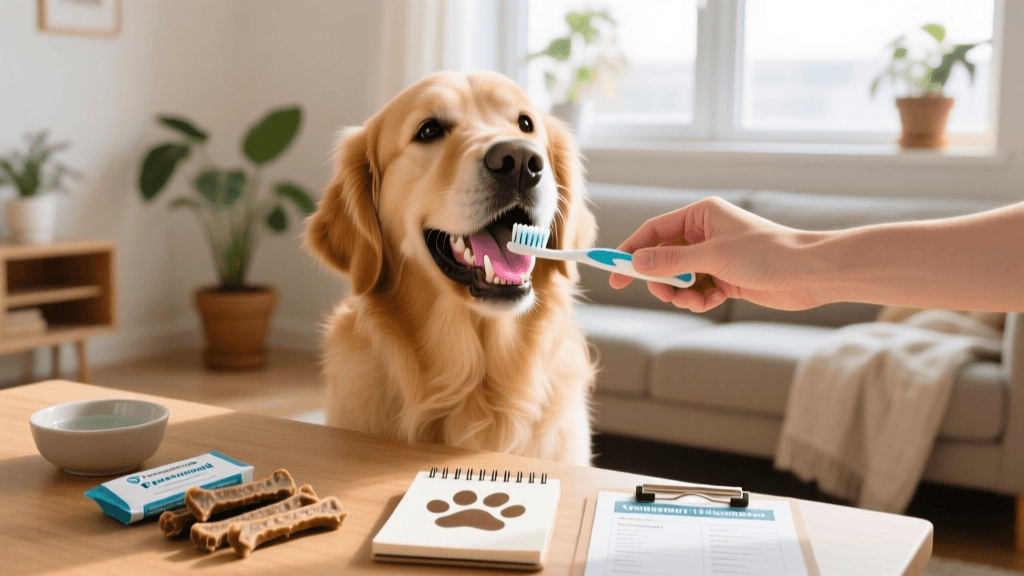
Daily brushing is the gold standard of home dental care. The mechanical action of bristles against tooth surfaces physically disrupts plaque before it can mineralize. Veterinary dentists at the University of California, Davis School of Veterinary Medicine recommend brushing for a minimum of 30 seconds per side of the mouth, focusing on the outer surfaces of the upper teeth where salivary glands deposit the most calcium-rich saliva.
The most important rule: never use human toothpaste on dogs. Human formulations contain fluoride and xylitol, both of which are toxic to dogs. Xylitol in particular causes a rapid release of insulin in dogs, leading to hypoglycemia, and can cause acute liver failure at doses as low as 0.1 grams per kilogram of body weight.
Choosing the Right Toothbrush
Finger brushes work well for small breeds and puppies because they give the owner precise tactile control. For medium and large breeds, a long-handled brush with a 45-degree angled head allows better access to the back molars. Bristles should be soft — medium or hard bristles can damage enamel and irritate gum tissue. Replace the brush every three months or sooner if bristles splay.
Several veterinary-approved options are widely available. The Virbac C.E.T. Dual-Ended Toothbrush has one large and one small head on the same handle, making it versatile for multi-dog households. The Arm & Hammer Dog Dental Kit includes a finger brush and a standard handle brush, which is useful when introducing brushing to a reluctant dog.
Introducing Brushing to an Adult Dog
Dogs that were not accustomed to tooth brushing as puppies require a gradual desensitization process. Rushing this step is the most common reason owners give up. The following sequence, recommended by the AVMA, typically takes two to four weeks:
- Week 1: Let your dog lick a small amount of enzymatic toothpaste from your finger each day. Do not attempt to touch the teeth yet. The goal is positive association with the taste and smell.
- Week 2: Use your finger to gently rub the outer surfaces of the front teeth for 10–15 seconds. Reward immediately with praise or a dental treat.
- Week 3: Introduce the toothbrush with toothpaste. Brush only the front teeth for the first few sessions, gradually working toward the back molars.
- Week 4 and beyond: Work toward a full 60-second brushing session covering all outer tooth surfaces. Most dogs accept this routine once it becomes predictable.
A Golden Retriever named Maple, seen at a private practice in Edinburgh, Scotland, had never been brushed in her seven years of life. Her veterinarian used this four-week protocol and reported that by day 28, Maple was presenting her muzzle voluntarily when her owner picked up the toothbrush. Her owner noted that the key was keeping sessions under 90 seconds and always ending on a positive note.
Toothpaste, Gels, and Enzymatic Products
Enzymatic toothpastes are the most effective over-the-counter dental products for dogs. They contain glucose oxidase and lactoperoxidase, enzymes that generate hydrogen peroxide in the presence of saliva. This creates an antibacterial environment that continues working even after brushing stops. The Virbac C.E.T. Enzymatic Toothpaste is one of the most widely recommended by veterinary dentists and comes in poultry, vanilla-mint, and beef flavors to improve palatability.
For dogs that resist brushing entirely, dental gels applied with a finger or a cotton swab can provide partial benefit. Maxi/Guard Oral Cleansing Gel contains zinc ascorbate and taurine, which support gum tissue health and have demonstrated antibacterial properties in clinical trials. It does not require brushing — the gel is applied directly to the gumline and works through contact.
"No other home-care method has been shown to be as effective as daily tooth brushing for controlling plaque and gingivitis in dogs. Enzymatic toothpastes enhance this effect but do not replace the mechanical action of the brush." — British Veterinary Dental Association, Clinical Guidelines for Home Oral Hygiene, 2021
Dental Chews, Water Additives, and Supplementary Tools
Brushing is not always possible every day, and supplementary products can help maintain oral health between sessions. The Veterinary Oral Health Council (VOHC) awards a seal of acceptance to products that have demonstrated efficacy in reducing plaque or tartar in controlled trials. Only products bearing the VOHC seal have met this evidentiary standard.
VOHC-accepted dental chews include Greenies Dental Treats, Purina Pro Plan Dental Chews, and Virbac C.E.T. HEXtra Chews. These products work through abrasive mechanical action as the dog chews, combined in some cases with active ingredients like chlorhexidine or enzymes. A chew given daily has been shown in VOHC-reviewed studies to reduce tartar accumulation by approximately 69% compared to no dental intervention.
Water additives such as Oxyfresh Pet Dental Water Additive and TropiClean Fresh Breath Water Additive are added to the dog's drinking bowl at a ratio of approximately 1 teaspoon per 8 ounces of water. They contain antimicrobial agents that reduce oral bacteria counts throughout the day. While they are not a substitute for brushing, they provide a low-effort supplementary benefit for owners who struggle with daily brushing compliance.
What to Avoid
Not all chewing products are safe or beneficial. Hard objects — including real bones, antlers, hooves, and nylon chews marketed as "indestructible" — are a leading cause of slab fractures of the carnassial teeth. The AVMA advises that if a product cannot be dented with your thumbnail, it is too hard for a dog to chew safely. Fractured teeth are painful, prone to abscess, and typically require extraction or root canal therapy costing between $800 and $2,500 per tooth at most veterinary dental specialists.
Professional Cleanings and Home Care Working Together
Home care and professional veterinary cleanings are complementary, not interchangeable. Professional cleaning under general anesthesia allows the veterinarian to scale tartar from below the gumline — the subgingival space where the most destructive bacterial activity occurs and where no home tool can reach. The AVMA recommends annual professional dental examinations for all dogs, with cleaning frequency determined by the individual dog's rate of tartar accumulation.
Dogs with consistent home care routines typically require professional cleanings every 12 to 18 months. Dogs with no home care may need cleanings every 6 months to prevent disease progression. The cost difference over a dog's lifetime is substantial: a dog receiving annual cleanings at approximately $400–$600 per procedure will cost significantly less than one requiring extractions and periodontal surgery, which can run $1,500–$4,000 per procedure at referral centers such as the Veterinary Dental Center in Denver, Colorado.
| Home Care Method | Plaque Reduction | Tartar Reduction | VOHC Accepted | Frequency |
|---|---|---|---|---|
| Daily brushing (enzymatic paste) | Up to 95% | Prevents formation | Yes | Daily |
| VOHC dental chews | ~69% | ~69% | Yes | Daily |
| Water additives | ~20–30% | Minimal | Some brands | Daily |
| Dental wipes | ~30–40% | Minimal | Some brands | Daily |
| Dental diet (e.g., Hill's t/d) | ~39% | ~43% | Yes | Fed as main diet |
The data above reflects findings from VOHC-reviewed clinical trials and manufacturer-submitted efficacy studies. Individual results vary based on the dog's breed, saliva composition, diet, and consistency of application. Brachycephalic breeds such as Bulldogs and Pugs tend to accumulate tartar faster due to crowded, rotated teeth, and may benefit from more frequent professional cleanings regardless of home care compliance.
Starting a dental routine does not require perfection. Even brushing three to four times per week provides meaningful protection compared to no brushing at all. The most effective routine is the one that fits realistically into your schedule and that your dog will tolerate. Work with your veterinarian to assess your dog's current oral health status, identify the right products for your dog's size and temperament, and set a realistic cleaning schedule. Your dog's mouth — and overall health — will reflect the effort.
Tom Renshaw
All our authors care for dogs every day — read more of their work on the authors page.