Decoding Puppy Body Language: A First-Time Owner Guide
Learn to read your new puppy's body language and calming signals. A practical first-time owner guide to building trust and preventing behavioral issues.
Welcoming Your Puppy: Beyond the Potty Training
Bringing home a new puppy is a whirlwind of excitement, chewed-up shoes, and sleepless nights. For first-time dog owners, the steepest learning curve isn't necessarily potty training or leash walking—it is understanding what your dog is actually trying to say. Dogs do not speak English, but they are constantly communicating through a complex system of body language, vocalizations, and spatial awareness. Misinterpreting these signals is the leading cause of frustration, broken trust, and behavioral issues in newly adopted dogs. This guide will decode your puppy's secret language, providing actionable, first-time owner strategies to build a lifelong bond based on mutual understanding.
The 3-3-3 Rule of Puppy Decompression
Before analyzing specific tail wags or ear flicks, first-time owners must understand the timeline of canine decompression. The '3-3-3 Rule' is a widely recognized benchmark for rescue puppies and dogs adjusting to a new environment.
- 3 Days (Overwhelm): Your puppy may refuse to eat, hide, or test boundaries. They are processing a massive environmental shift.
- 3 Weeks (Settling): Routines are established, and their true personality begins to emerge. You will start seeing their actual behavioral quirks.
- 3 Months (Bonding): The dog finally feels secure, understands the household rules, and forms a deep attachment to you.
Actionable Advice: During the first three days, limit visitors and keep the environment quiet. Invest in a wire crate (approx. $45-$70 for a mid-sized, adjustable crate) and drape a breathable blanket over it to create a den-like sanctuary. Do not force the puppy out; let them decompress on their own timeline.
The First-Time Owner’s Dictionary of Canine Signals
New owners often project human emotions onto dogs. A wagging tail doesn't always mean 'happy,' and a yawn doesn't always mean 'tired.' Use this quick-reference table to decode your puppy's physical cues.
| Body Part | The Signal | What It Actually Means | First-Time Owner Action |
|---|---|---|---|
| Tail | High, stiff, rapid wagging | High arousal, potential aggression or intense focus (not always joy). | Give the dog space; do not reach out to pet them. |
| Ears | Pinned flat against the head | Fear, stress, or submissive appeasement. | Stop the current interaction; remove the stressor. |
| Eyes | 'Whale Eye' (showing the whites) | Severe anxiety or feeling trapped. | Immediately back away and give the puppy an escape route. |
| Mouth | Lip licking (no food present) | A calming signal indicating mild stress or confusion. | Take a break from training; the puppy is overwhelmed. |
| Body | Play Bow (front down, rear up) | An invitation to play; a meta-signal that bites are just for fun. | Engage in gentle play or toss a toy. |
Calming Signals: How Dogs Say 'I'm Stressed'
Coined by Norwegian dog trainer Turid Rugaas, 'calming signals' are subtle behaviors dogs use to diffuse tension, self-soothe, or communicate peaceful intentions to humans and other dogs. First-time owners often miss these entirely, pushing a stressed puppy until they are forced to bite.
Common calming signals include sudden ground sniffing, turning the head away, yawning when not tired, and moving in slow, curved lines rather than walking straight toward you. If your puppy exhibits these behaviors while being hugged by a child or during a loud family gathering, they are politely asking for a break. Respect the signal by ending the interaction immediately.
The 'Guilty' Look Myth
One of the most damaging misconceptions for new owners is the 'guilty look.' When you come home to a destroyed couch and your puppy is cowering, ears pinned back, and eyes averted, you might think they know what they did. According to the Humane Society of the United States, this is actually an 'appeasement posture.' The dog is reacting to your angry tone, tense posture, and loud voice, not feeling guilt over a past action. Dogs live in the moment; they cannot connect a past behavior to a present scolding.
Actionable Step: Never punish after the fact. If you don't catch them in the act, silently clean the mess. To prevent future destruction, provide appropriate chewing outlets like a KONG Classic Dog Toy (Medium Red, approx. $15), stuffed with plain pumpkin puree and frozen overnight to soothe teething gums and keep them occupied.
Play vs. Aggression: Decoding the 'Land Shark' Phase
Puppies explore the world with their mouths, leading to the infamous 'land shark' phase where they bite hands, ankles, and pant legs. But how do you tell the difference between normal play and overstimulation?
- Healthy Play: Bouncy movements, self-handicapping (older dogs rolling over), sneezing (a play signal), and loose, wiggly bodies.
- Overstimulation: Stiff body, hard staring, deep guttural growls, and biting that breaks the skin or refuses to let go.
Actionable Step: Enforce the 'Three-Second Rule.' If a puppy bites too hard, say 'Oops!' in a neutral tone, withdraw your attention for exactly three seconds, and then redirect to a chew toy. If the puppy remains frantic and continues biting, they are likely overtired. Puppies need 18-20 hours of sleep a day. Put them in their crate or a quiet exercise pen for a mandatory nap.
Practical Tools and Timing for Behavior Redirection
Understanding your dog means understanding their breed instincts and providing an outlet for them. A Border Collie will herd children if not given a job; a Beagle will follow its nose into traffic. Enrichment is not a luxury; it is a behavioral necessity.
- Snuffle Mat ($20-$30): Mimics natural foraging instincts. Scatter kibble into the fabric strips to slow down eating and tire out their brain. Ten minutes of sniffing is equivalent to an hour of physical walking.
- Lickimat ($10-$15): Spread plain, xylitol-free Greek yogurt on it and freeze. Licking releases endorphins, naturally calming an anxious puppy during thunderstorms, grooming, or nail trims.
- Puppy Kindergarten ($120-$200 for 6 weeks): Crucial for socialization before the 16-week window closes. Look for classes certified by the ASPCA or AKC that strictly use positive reinforcement and require proof of vaccinations.
Common First-Time Owner Mistakes to Avoid
Even with the best intentions, new owners frequently make mistakes that damage communication. Avoid these three common pitfalls:
- Punishing the Growl: A growl is a warning system. If you punish a dog for growling, they will learn to skip the warning and go straight to a bite next time. If your dog growls, thank them for communicating, and remove them from the trigger.
- Forcing Greetings: Letting strangers pet a fearful puppy teaches the puppy that you will not protect them. Advocate for your dog. Teach guests to ignore the puppy until the puppy approaches them with a relaxed body.
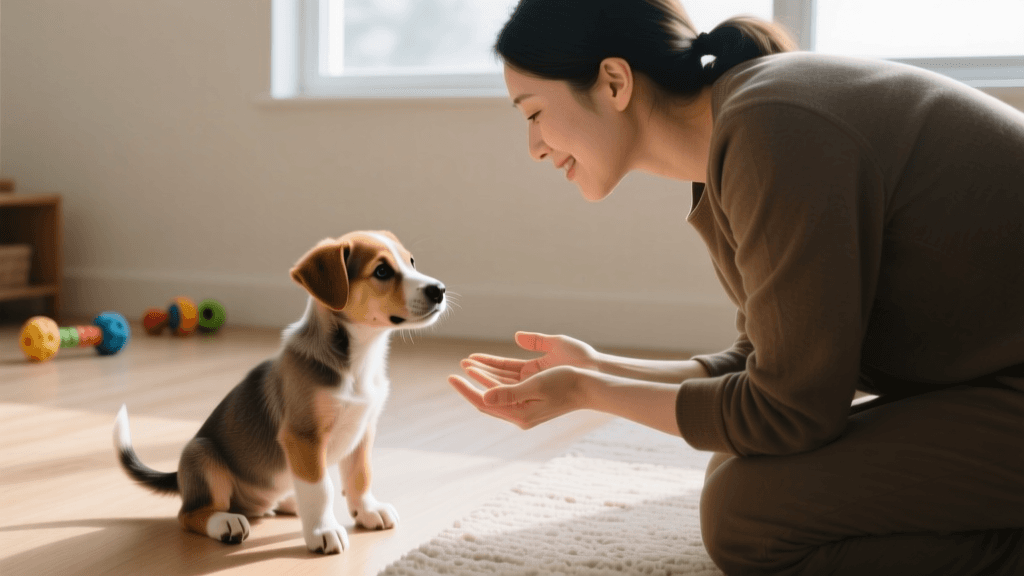
- Inconsistent Body Language: Dogs read posture, not words. If you lean over a dog while saying 'come,' your looming posture signals a threat, and they will back away. Crouch down, turn slightly sideways (a non-threatening posture), and use a high-pitched, happy tone.
When to Seek Professional Help
If your puppy exhibits resource guarding (stiffening or snapping when you approach their food bowl), severe separation anxiety (destroying door frames or injuring themselves to escape), or unprovoked aggression, do not wait for them to 'grow out of it.' Seek a Certified Applied Animal Behaviorist (CAAB) or a veterinary behaviorist immediately. Expect to pay between $150 and $300 per session, but early intervention can save the dog's life and your relationship.
Conclusion
Understanding your dog's body language is a lifelong journey. As a first-time owner, you will make mistakes, and your puppy will inevitably chew a favorite pair of shoes. However, by learning to read their calming signals, respecting their decompression timeline, and providing appropriate enrichment, you transition from being just a 'feeder' to a trusted partner. Pay attention to the subtle flick of an ear, the tension in a tail, and the softness in their eyes. Your dog is always talking to you; the key is simply learning how to listen.
jonas-cole
All our authors care for dogs every day — read more of their work on the authors page.