Decoding Dog Stress Signals In Agility Competitions 2026
Learn to read your dog's subtle stress signals during agility competitions in 2026. Improve performance and welfare with expert behavioral insights.
The Psychology of the Canine Athlete: Arousal vs. Distress
As we navigate the 2026 agility season, the sport has evolved into a highly sophisticated display of canine athleticism and handler-dog teamwork. Modern courses demand split-second decision-making, physical precision, and intense focus. However, beneath the surface of fast run times and championship ribbons lies a complex psychological landscape. Understanding your dog's mental state is no longer just a supplementary skill for handlers; it is the cornerstone of ethical competition and peak performance. According to the American Kennel Club (AKC), the most successful agility teams are those that prioritize canine behavioral welfare alongside physical conditioning.
To excel in agility, we must first understand the neurobiology of canine arousal. The Yerkes-Dodson law, a foundational psychological principle, dictates that performance improves with physiological or mental arousal, but only up to a certain point. When arousal levels become too high, performance plummets, and stress takes over. In the agility ring, the line between 'high drive' and 'high distress' is incredibly thin. A dog in a state of optimal arousal (drive) is focused, responsive, and physically fluid. A dog in a state of distress is overwhelmed, flooded with cortisol, and exhibiting subtle behavioral leaks that many handlers mistakenly interpret as stubbornness or distraction.
The 'Invisible' Stress Signals Often Missed on the Course
While overt signs of stress—such as tucking the tail, cowering, or attempting to flee the ring—are easy to identify, the subtle 'invisible' stress signals are frequently misread. The Humane Society of the United States (HSUS) emphasizes that dogs communicate discomfort through micro-expressions and displacement behaviors long before they resort to avoidance or reactivity. Recognizing these early warnings is critical for preventing a complete behavioral shutdown mid-run.
Subtle Indicators to Monitor in the Warm-Up Ring
- Whale Eye (Half-Moon Eye): When a dog turns its head away from a stressor but keeps its eyes fixed on it, exposing the whites of the eyes. In agility, this often happens when a dog is approached too quickly by another competitor or when facing a daunting obstacle like the A-frame.
- Commissure Tension: The corners of the mouth (commissures) pull back tightly, creating a 'spatulate' or spoon-shaped tongue. This is a classic indicator of sympathetic nervous system overdrive.
- Displacement Sniffing: If your dog suddenly becomes intensely interested in sniffing a bare patch of artificial turf right before a run, they are likely not tracking a scent. Sniffing is a calming signal and a displacement behavior used to self-soothe and avoid eye contact with a stressed handler.
- Pinned Ears and Tight Scalp: While breed-specific ear carriages vary, a sudden flattening of the ears combined with a wrinkled forehead indicates acute anxiety.
- Excessive Shedding and Dander: A sudden 'blow' of the coat or visible dander on the dog's back in the holding area is a physiological response to an adrenaline spike.
Comparison Chart: High Drive vs. High Stress
Distinguishing between a dog that is 'ready to work' and a dog that is 'over threshold' is essential. The table below breaks down the physical manifestations of both states to help you accurately assess your dog's readiness before stepping up to the start line.
| Behavioral Metric | High Drive (Optimal Arousal) | High Stress (Distress/Over-Threshold) |
|---|---|---|
| Eye Contact | Soft, engaged, checks in with handler frequently. | Hard staring at obstacles, whale eye, or complete avoidance of handler. |
| Tail Movement | Fluid, sweeping motions at or slightly above topline. | Stiff, rapid wagging at the very tip, or tucked tightly against the belly. |
| Vocalization | Occasional, rhythmic barking in anticipation of the release cue. | Frantic, high-pitched screaming, whining, or sudden uncharacteristic silence. |
| Response to Cues | Crisp, immediate execution of known behaviors. | Delayed response, 'learned helplessness', or offering random, unprompted behaviors. |
| Muscle Tone | Springy, relaxed readiness; weight evenly distributed. | Trembling, rigid posture, weight shifted backward in preparation to flee. |
Breed-Specific Stress Manifestations in 2026
Canine psychology is deeply intertwined with breed instincts. A Border Collie's stress response will look vastly different from that of a Jack Russell Terrier or a Golden Retriever. Understanding these genetic predispositions allows handlers to tailor their warm-up routines and handling strategies accordingly.
Herding Breeds (e.g., Border Collies, Australian Shepherds)
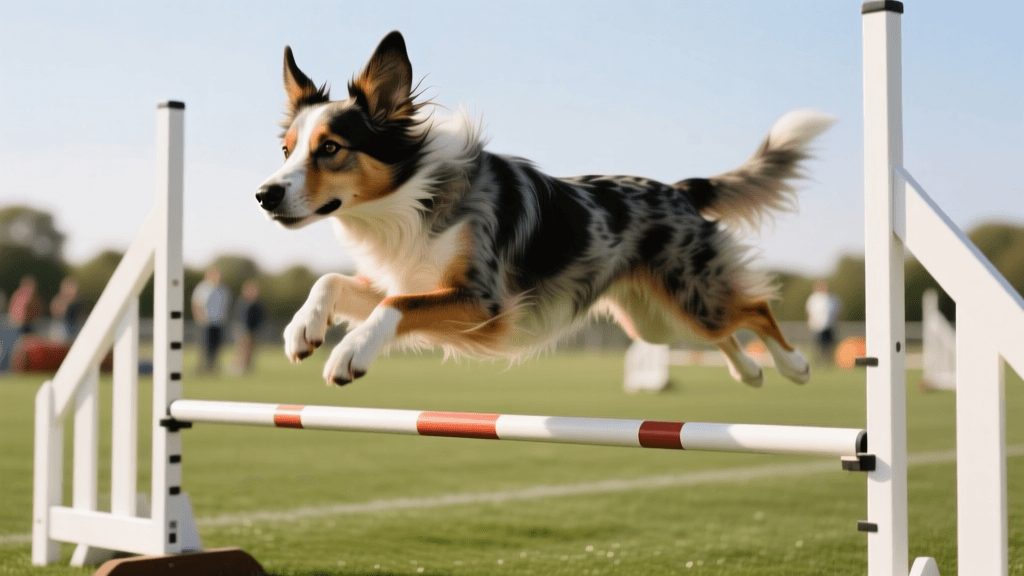
Herding breeds are highly sensitive to environmental movement and handler tension. When stressed, they often exhibit 'stalking' behaviors or attempt to control the movement of other dogs in the warm-up ring. A stressed herding dog may also 'shut down' and lie flat on the ground, a behavior often misinterpreted as relaxation but actually indicative of cognitive overload and avoidance.
Terriers (e.g., Jack Russells, Rat Terriers)
Terriers possess high prey drive and low frustration tolerance. Under stress, their arousal frequently tips into reactivity. A stressed terrier is more likely to vocalize excessively, nip at the handler's hands, or 'pop off' obstacles (refusing to make contact on the dog walk or teeter). Their stress is explosive rather than implosive.
Retrievers and Spaniels (e.g., Golden Retrievers, Cocker Spaniels)
Bred to work cooperatively with humans, these breeds often exhibit appeasement behaviors when stressed. Expect to see excessive scratching, sudden yawning, rolling over to expose the belly, or 'nosing' the handler's pockets. They are desperately trying to diffuse the perceived social tension in the ring.
Navigating the Modern 2026 Trial Environment
The sensory landscape of agility trials in 2026 presents unique psychological challenges. Indoor arenas now frequently utilize high-intensity LED lighting arrays that can cause visual glare and disorientation, particularly for dogs with light-sensitive eyes. Furthermore, the widespread adoption of advanced artificial turf surfaces, while excellent for joint health and traction, produces distinct acoustic reflections and synthetic odors that can overstimulate a dog's olfactory and auditory processing centers.
Additionally, the modern warm-up ring is a chaotic environment. The proximity of crating areas to the competition rings means that resting dogs are subjected to the continuous sound of teeters slamming and electronic timing horns blaring. According to the ASPCA, chronic exposure to unpredictable, high-decibel noises is a primary trigger for anxiety in companion animals. Handlers must proactively manage their dog's sensory diet throughout the trial day, utilizing sound-dampening crate covers and scheduling strategic 'sniffari' walks outside the venue to allow the dog's nervous system to reset.
Evidence-Based Decompression and Actionable Strategies
When you identify stress signals, the immediate goal is not to 'push through' but to actively lower your dog's cortisol levels. Cortisol, the primary stress hormone, can remain elevated in a dog's bloodstream for up to 72 hours after a highly stressful event. Running a stressed dog repeatedly over a weekend guarantees a compounding cortisol load, leading to 'agility burnout' and a negative association with the sport.
1. Implement Pattern Games
Pattern games, popularized by canine behavior experts, provide predictable, rhythmic structures that give the dog a sense of control in a chaotic environment. Games like '1-2-3 Treat' or 'Ping-Pong Recall' shift the dog's brain from the emotional center (amygdala) to the thinking center (prefrontal cortex). By engaging in a familiar, low-stakes pattern, the dog learns that they can predict the outcome of their environment, which rapidly lowers heart rate and anxiety.
2. The 'Look at That' (LAT) Protocol
If your dog is stressed by the movement of other dogs running the course, use the LAT protocol. From a safe distance outside the ring, mark and reward your dog simply for looking at the agility equipment or other dogs, then looking back at you. This changes the emotional response from 'threat/alert' to 'cue for a treat,' effectively rewiring the dog's association with the trial environment.
3. Strategic Scratch Scratches
Many handlers unknowingly pump their dogs up with high-energy chest thumping before a run. For a dog already showing subtle stress signals, this is overwhelming. Instead, utilize slow, deep-pressure massage along the dog's chest and the base of the tail. This stimulates the parasympathetic nervous system, promoting a 'rest and digest' state and bringing the dog back into a zone of optimal, focused arousal.
Conclusion: The Ethical Competitor
Ultimately, agility should be a celebration of the bond between human and dog. As the sport continues to grow in 2026, the mark of a truly elite handler is not just the speed of their dog, but their profound ability to read and respect their canine partner's psychological state. By mastering the subtle language of canine stress, you protect your dog's mental well-being, extend their competitive career, and forge a partnership built on mutual trust and clear communication. Listen to what your dog is telling you before they step up to the start line; their body language is the most honest feedback you will ever receive.
jonas-cole
All our authors care for dogs every day — read more of their work on the authors page.