2026 Guide to Force-Free Dog Nail Trimming Scratchboards
Master force-free dog nail trimming in 2026 with cooperative care scratchboards. Learn step-by-step positive reinforcement techniques for stress-free paws.
The Shift to Cooperative Care in 2026
Gone are the days when dog owners and groomers believed that pinning down a terrified, struggling dog was the only way to maintain their nails. As we move through 2026, the dog care community has overwhelmingly embraced cooperative care and force-free handling methods. This paradigm shift prioritizes the dog's emotional well-being, allowing them to actively participate in their own husbandry routines. At the forefront of this movement is the nail scratchboard, a brilliantly simple tool that transforms one of the most dreaded chores into an engaging, rewarding game.
According to the American Veterinary Society of Animal Behavior (AVSAB), force-free, reward-based training methods are not only more humane but significantly more effective for long-term behavioral health. By utilizing positive reinforcement, we eliminate the fear, anxiety, and stress (FAS) traditionally associated with nail clipping. Instead of fighting the clippers, dogs learn to offer their paws willingly, filing their own nails on a textured surface while earning high-value treats.
What is a Nail Scratchboard and How Does It Work?
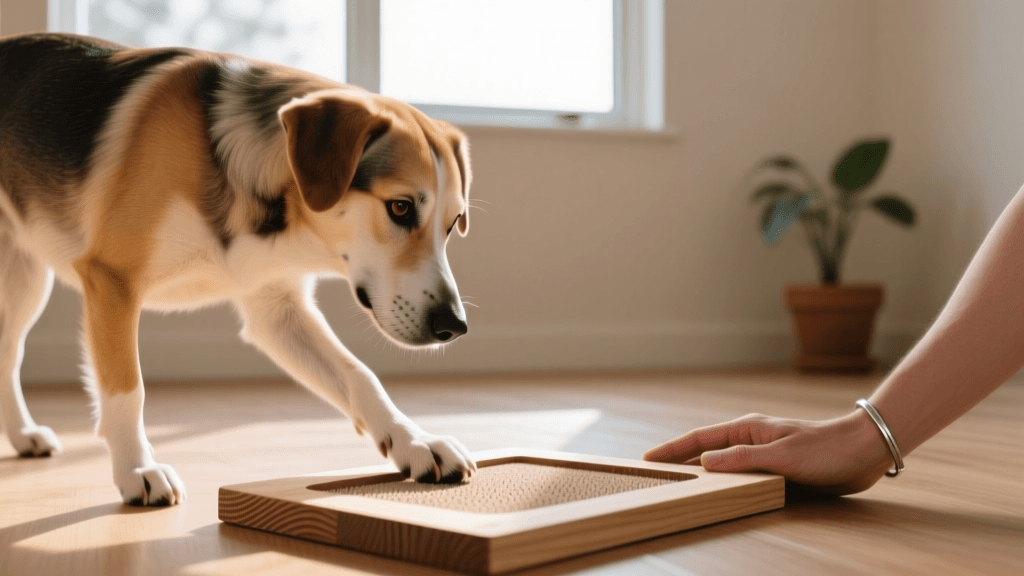
A nail scratchboard is essentially a sturdy, angled board covered in a high-grit abrasive material, such as sandpaper or a specialized composite grip tape. The concept relies on operant conditioning: the dog is rewarded for scraping their front paws down the board, which naturally files the nails. Because the dog controls the pressure and duration of the scratch, the risk of hitting the sensitive "quick" (the blood vessel inside the nail) is drastically reduced. Dogs possess an innate self-preservation instinct; if the filing gets too close to the quick, they will naturally lighten their pressure or stop scratching altogether.
The Fear Free Pets initiative heavily advocates for giving animals a sense of control during veterinary and grooming procedures. The scratchboard is the ultimate embodiment of this philosophy, granting the dog complete agency over the nail-trimming process.
Top Scratchboard Styles and Equipment for 2026
While a simple DIY board made from a plank of wood and hardware-store sandpaper works well, the pet market in 2026 offers highly engineered, ergonomic options designed for both canine comfort and human convenience. Below is a comparison of the most popular scratchboard setups currently available.
| Scratchboard Type | Material & Build | Grit Replaceable? | Best Suited For | Avg. 2026 Cost |
|---|---|---|---|---|
| Classic Flat DIY Board | Pine wood & standard 60-grit sandpaper | Yes (Manual) | Budget-conscious owners, large breeds | $10 - $15 |
| Ergonomic Angled Bamboo Board | Sustainable bamboo with a 30-degree slope | Yes (Adhesive pads) | Senior dogs, dogs with joint stiffness | $35 - $50 |
| Smart-Track Scratch Mat | Rubberized base with interlocking abrasive tiles | Yes (Snap-in tiles) | Multi-dog households, heavy scratchers | $45 - $65 |
| Integrated Lick-Mat Board | Angled board with a built-in silicone treat spreader at the top | Yes (Velcro strips) | High-anxiety dogs needing distraction | $40 - $55 |
Step-by-Step Force-Free Training Protocol
Teaching your dog to use a scratchboard requires patience, high-value rewards, and a solid understanding of shaping behavior. Never force your dog's paw onto the board. The goal is to build a positive emotional response (CER) so that the sight of the board triggers excitement rather than avoidance.
Step 1: Desensitization and Board Introduction
Begin by placing the scratchboard flat on the ground in a quiet, familiar room. Do not ask your dog to do anything. Simply drop a few high-value treats (like freeze-dried minnows or boiled chicken) near and on top of the board. Let the dog investigate at their own pace. If they step on the board to get a treat, mark the behavior with a clicker or a verbal "Yes!" and reward generously. Repeat this until the dog happily steps onto the board expecting a treat.
Step 2: Shaping the Paw Target
Once the dog is comfortable standing near or on the board, hold it at a slight angle or prop it up against a sturdy base. Wait for the dog to offer a paw touch to the board. The moment their paw makes contact with the abrasive surface, mark and reward. If your dog already knows a "paw" or "shake" cue, you can use this to your advantage by luring their paw toward the board. Gradually raise your criteria: only mark and reward when the paw touches the board with a slight downward motion.
Step 3: Capturing the Scratch
This is where the magic happens. When the dog swipes their paw down the board, immediately mark and reward. To build a continuous scratching motion, withhold the reward for a split second longer, waiting for a second, more deliberate swipe. Use a continuous marker word like "Good, good, good..." as they scratch, followed by a jackpot reward (a handful of treats) when they stop. Keep training sessions incredibly short—no more than 2 to 3 minutes—to prevent paw pad fatigue and maintain the dog's enthusiasm.
Step 4: Adding Duration with Lick Mats
For dogs who need a bit more distraction or who tend to get over-aroused during training, pairing the scratchboard with a lick mat is a game-changer. In 2026, many ergonomic scratchboards come with a built-in silicone spreader at the top edge. Smear a dog-safe enrichment recipe (such as plain Greek yogurt mixed with pumpkin puree and a dash of low-sodium bone broth) onto the spreader. As the dog licks the treat, gently present the board. The rhythmic licking lowers the dog's heart rate, while the scratching files the nails. This dual-action approach is highly recommended by force-free behaviorists for nervous dogs.
Troubleshooting Common Challenges
Even with the best positive reinforcement techniques, you may encounter a few hurdles. Here is how to navigate them without resorting to force or frustration.
- The Over-Enthusiastic Scratcher: Some dogs, particularly terriers and hounds, may attack the board with too much vigor, risking abrasion to their paw pads. If this happens, lower the value of your treats to calm their arousal level, and only reward slow, controlled swipes. You can also place a thin towel over the top edge of the board to protect their pads while they learn control.
- The Fearful Avoider: If your dog is terrified of the sound the nails make on the sandpaper, start with a much lower grit (like 40-grit) which is smoother and quieter, or place a thin piece of felt over the board for the first few sessions. Gradually remove the felt as the dog's confidence grows.
- Uneven Filing: Dogs naturally favor their dominant paw. To ensure all nails are filed evenly, practice on both the left and right sides. You can train a "switch" cue by luring the dog to the opposite side of the board, rewarding them heavily for offering the non-dominant paw.
- Hitting the Quick: While rare with scratchboards, it is possible if the dog's nails are excessively long and the quick has grown out with the nail. Always inspect the nails after a session. Look for the dark, chalky center of the nail. As soon as you see a small, dark dot or a pinkish hue appearing in the center of the filed nail, stop the session immediately. That is the quick approaching.
Integrating Scratchboards into Multi-Dog Households
Living with multiple dogs requires careful management during husbandry routines to prevent resource guarding or competitive stress. In 2026, force-free trainers emphasize the importance of "stationing" for multi-pet homes. Teach your non-working dog to go to their designated mat or bed and engage with a frozen enrichment toy (like a Kong stuffed with wet food) while the other dog works on the scratchboard. This not only prevents interference but also builds a positive association with the scratchboard routine for the waiting dog. Always rotate the dogs so that each receives one-on-one, focused attention without the pressure of an audience.
Conclusion: A Lifetime of Stress-Free Paw Care
Embracing force-free nail trimming via a scratchboard is one of the most empowering investments you can make in your dog's daily care routine. By aligning with modern, science-backed cooperative care standards, you are not just trimming nails; you are building trust, enhancing communication, and proving to your dog that their comfort matters. With the right equipment, a pocket full of high-value treats, and a commitment to positive reinforcement, the dread of nail trims will become a relic of the past. Grab your scratchboard, prepare your favorite treat spreads, and enjoy the rewarding journey of cooperative care with your best friend.
jonas-cole
All our authors care for dogs every day — read more of their work on the authors page.