2026 Guide to Cooperative Care Bucket Training for Vet Exams
Learn force-free cooperative care bucket training to reduce your dog's vet anxiety in 2026. Step-by-step positive reinforcement guide for stress-free exams.
The Shift to Force-Free Veterinary Care in 2026
Welcome to 2026, a year where the veterinary landscape has fundamentally and permanently shifted. Gone are the days when pinning down a terrified dog for a routine blood draw or vaccination was considered standard practice. Today, the American Veterinary Society of Animal Behavior (AVSAB) and leading global veterinary boards unequivocally endorse force-free, positive reinforcement methods for all animal handling. This paradigm shift recognizes that psychological trauma at the veterinary clinic doesn't just cause temporary distress; it leads to long-term behavioral deterioration, compromised immune function due to chronic cortisol spikes, and delayed medical care because owners dread the clinic visits.
For dog owners and modern veterinary professionals, the gold standard for medical handling is now cooperative care. Cooperative care empowers the dog to actively participate in their own healthcare. Among the most effective and widely adopted cooperative care techniques in 2026 is Bucket Training. This guide will walk you through the science, the step-by-step protocol, and the essential gear needed to transform your dog's veterinary exams from a battle of wills into a stress-free, positive experience.
What is Cooperative Care Bucket Training?
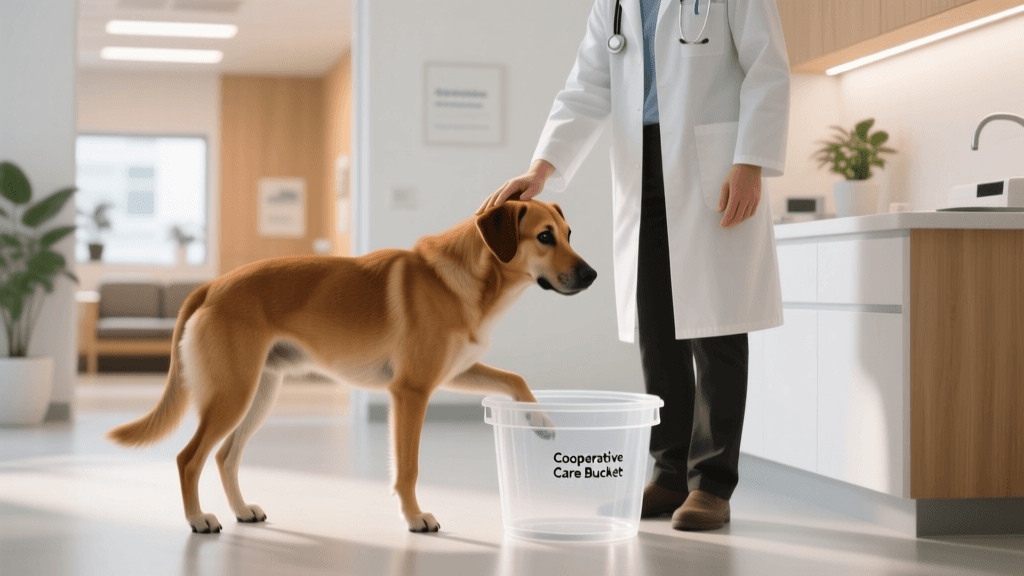
Bucket training is a target-based cooperative care technique where a dog is taught to rest their chin or paws on a specific target—usually an inverted bucket, a specialized target stick, or a designated mat—while remaining completely still. In exchange for maintaining this position, the dog receives a continuous stream of high-value reinforcement, typically in the form of food paste or lickable treats.
The true magic of bucket training lies in its built-in "opt-out" mechanism. If the dog lifts their head off the bucket, the reinforcement stops immediately, and the medical procedure pauses. This gives the dog complete agency. Counterintuitively, giving a dog the choice to say "no" dramatically increases their willingness to say "yes." When an animal knows they are not trapped, their baseline anxiety plummets, allowing them to engage their prefrontal cortex rather than reacting from a place of limbic panic.
The Neurobiology of Stress and Positive Reinforcement
To understand why force-free methods are non-negotiable in 2026, we must look at canine neurobiology. When a dog is forcibly restrained, the amygdala triggers a massive release of cortisol and adrenaline. This "fight or flight" response shuts down the brain's ability to process new information or form positive associations. The dog isn't learning that the vet is safe; they are learning that the vet is a place where they lose control of their body.
Conversely, positive reinforcement training utilizing high-value food rewards stimulates the release of dopamine and endorphins. According to the Fear Free Pets initiative, which has now become a baseline certification for modern veterinary clinics, reducing fear, anxiety, and stress (FAS) is just as critical as treating the physical ailment. By pairing a potentially uncomfortable stimulus (like a stethoscope or a gentle palpation) with a continuous dopamine drip (like licking a high-value treat paste), we actively rewire the dog's emotional response to veterinary care.
Step-by-Step Bucket Training Protocol
Implementing bucket training requires patience, consistency, and a strict adherence to force-free principles. Never force your dog's head onto the bucket. The behavior must be shaped entirely through positive reinforcement.
Phase 1: Shaping the Chin Rest
Start in a low-distraction environment at home. Place a clean, inverted plastic bucket or a specialized target disc on the floor. Hold a high-value treat near the bucket. The moment your dog investigates and their chin accidentally or intentionally brushes the target, use a marker word (like "Yes!") or a clicker, and deliver the treat.
- Repetition: Repeat this until the dog is deliberately pushing their chin onto the bucket to earn the marker and reward.
- Cue Introduction: Once the behavior is reliable, introduce a verbal cue such as "Chin" or "Target" right before they perform the action.
Phase 2: Building Duration and Distraction
Once your dog readily offers the chin rest, you must build duration. Instead of marking and treating the moment they touch the bucket, wait one second, then mark and treat. Gradually increase the time to three seconds, five seconds, and eventually up to two minutes.
To make this practical for a vet visit, transition from single treats to a continuous reinforcement tool, such as a lick mat smeared with dog-safe peanut butter or a squeezable treat tube. The dog must keep their chin on the bucket to access the food. If they lift their head, the food is pulled away. This teaches the dog that maintaining the target position is the key to unlocking the reward.
Phase 3: Introducing Veterinary Stimuli
This is the desensitization phase. While your dog is happily engaged in their bucket chin rest and eating their continuous reward, introduce mild veterinary stimuli.
- Week 1: Gently touch their shoulder, then their back, while they are on the bucket.
- Week 2: Introduce a cold stethoscope to their chest.
- Week 3: Gently lift a paw or simulate a nail trim motion.
- Week 4: Practice gentle restraint around the neck or simulate a blood draw hold (without any needles, obviously).
Crucial Rule: If the dog lifts their head off the bucket during any of these steps, stop the stimulation immediately. Do not punish the opt-out. Simply reset, wait for them to re-engage with the bucket, and try again at a lower intensity.
Essential Force-Free Gear for 2026
Having the right tools makes cooperative care significantly easier. Here are the top recommended items for your 2026 cooperative care kit:
- Target Discs or Buckets: Rubber, non-slip target caps that can be mounted on walls or placed on examination tables.
- Squeezable Treat Pastes: Products like Inaba Churu or Kong Easy Treat are ideal because they allow for continuous, slow-feeding reinforcement without the dog needing to chew and lift their head.
- Silicone Lick Mats: Suction-cup lick mats that can be stuck directly to the wall or the side of the examination table at the dog's eye level.
- Snuffle Mats: Excellent for keeping dogs engaged on the floor during waiting room periods to prevent baseline anxiety from building up before the exam.
Traditional Restraint vs. Cooperative Care
The data supporting the transition to force-free cooperative care is overwhelming. Below is a comparison of how traditional methods stack up against cooperative care in a modern veterinary setting.
| Metric | Traditional Restraint | Cooperative Care (Bucket Training) |
|---|---|---|
| Cortisol Levels | Significantly elevated, prolonged recovery | Baseline or mildly elevated, rapid recovery |
| Exam Accuracy | Compromised (tense muscles, elevated heart rate) | High (relaxed muscles, true resting heart rate) |
| Risk of Bites/Injury | High for staff and dog | Negligible when properly conditioned |
| Long-Term Impact | Worsening clinic phobia, owner non-compliance | Improved clinic affinity, proactive healthcare |
The Power of the "Opt-Out" Signal
The most common question from owners new to force-free methods is: "Won't my dog just choose to opt-out every time, meaning we never get the exam done?" The answer, backed by decades of applied behavior analysis, is a resounding no.
When an animal is given a clear, functional way to escape an uncomfortable situation, they rarely use it unless the discomfort exceeds their threshold. By honoring the opt-out signal (the dog lifting their head), you build profound trust. The dog learns that they are safe and that their boundaries will be respected. This trust actually increases their threshold for discomfort over time. A dog that knows they can stop the procedure at any moment is far more likely to endure a mildly uncomfortable palpation or a quick injection than a dog who feels trapped and must fight for survival.
Communicating With Your Veterinarian
In 2026, most progressive veterinary clinics are well-versed in cooperative care, often championed by organizations like the American Animal Hospital Association (AAHA). However, it is still your responsibility to advocate for your dog. Before your appointment, call the clinic and inform them that you are practicing cooperative care bucket training. Ask if they allow owners to administer the continuous food reinforcement during the exam, and request a Fear Free certified veterinarian or technician if available.
Bring your own familiar bucket, target mat, and high-value treats to the clinic. Familiar smells and objects provide a layer of environmental comfort that can drastically reduce the initial spike in anxiety upon entering the building. Remember, your dog looks to you for cues. If you remain calm, patient, and committed to force-free principles, your dog will mirror that emotional stability.
Conclusion
Embracing cooperative care and bucket training is one of the most profound ways you can advocate for your dog's physical and mental wellbeing. By replacing force with choice, and fear with positive reinforcement, you are not just making veterinary visits easier—you are actively protecting your dog's neurological health and strengthening the human-animal bond. Start your training today, respect your dog's opt-out signals, and watch as your canine companion transforms into a willing, confident partner in their own healthcare journey.
robin-maitland
All our authors care for dogs every day — read more of their work on the authors page.