The Canine Weight Loss Blueprint: Calculating Exact Daily Calories
Learn how to calculate your dog's exact daily caloric needs for safe weight loss, featuring RER formulas, feeding charts, and practical diet tips.
The Growing Epidemic of Canine Obesity
As devoted dog owners, we often express our love through food. However, this well-meaning affection has contributed to a severe health crisis in our pets. According to the Association for Pet Obesity Prevention (APOP), nearly 59% of dogs in the United States are classified as overweight or obese. This is not merely a cosmetic issue; excess adipose tissue is an active endocrine organ that secretes inflammatory cytokines, directly contributing to a host of chronic diseases.
Canine obesity significantly increases the risk of osteoarthritis, tracheal collapse, insulin resistance, and certain types of cancer. Furthermore, landmark research has shown that dogs maintained at an ideal body condition score (BCS) live up to two years longer than their overweight littermates. Transitioning your dog to a healthier weight requires more than simply guessing portion sizes; it demands a scientific, calculated approach to daily caloric intake and macronutrient balance.
The Hidden Dangers of Crash Dieting
Before diving into the math, it is crucial to understand why you should never put your dog on a drastic 'crash diet.' Severely restricting calories without veterinary supervision can lead to hepatic lipidosis (fatty liver disease), severe muscle wasting, and dangerous nutrient deficiencies. The goal of any canine weight loss program is to target fat loss while preserving lean muscle mass. A safe, sustainable rate of weight loss for dogs is between 1% and 2% of their total body weight per week. Achieving this requires calculating exact caloric needs based on your dog's ideal target weight, not their current overweight status.
Step 1: Calculate the Resting Energy Requirement (RER)
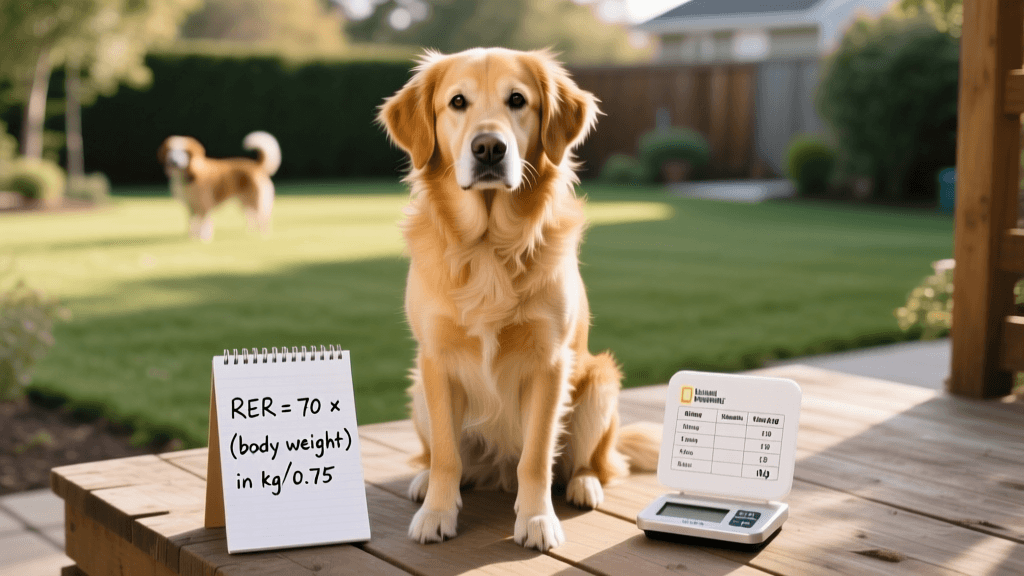
The foundation of veterinary nutrition is the Resting Energy Requirement (RER). This formula calculates the baseline calories your dog's body needs to maintain basic physiological functions at rest, such as breathing, circulation, and cellular repair. The universally accepted formula for calculating RER in dogs is:
RER = 70 x (Body Weight in kg)^0.75
To use this formula, you must first convert your dog's weight from pounds to kilograms by dividing the weight in pounds by 2.2. Let us look at a practical example. Imagine you have a Beagle who currently weighs 40 lbs, but whose ideal target weight is 30 lbs.
- Convert ideal weight to kg: 30 lbs / 2.2 = 13.6 kg
- Calculate the exponent: 13.6^0.75 = 7.08
- Multiply by 70: 70 x 7.08 = 495.6 kcal/day
The RER for this Beagle's ideal weight is roughly 496 calories per day. According to the clinical nutrition guidelines published by the Tufts Cummings School of Veterinary Medicine, using the target weight's RER is the safest starting point for designing a weight loss protocol.
Step 2: Apply the Weight Loss Multiplier
RER only accounts for resting metabolism. To account for daily activity and the thermic effect of food, we apply a multiplier. For a standard, neutered adult dog maintaining weight, the multiplier is typically 1.6. However, for safe weight loss, veterinary nutritionists recommend feeding the RER of the ideal weight without an activity multiplier, or multiplying the ideal RER by 0.8 to 1.0 depending on the dog's current activity level and metabolic adaptations.
In our Beagle example, feeding the exact RER of the ideal weight (496 kcal) or slightly less (roughly 400 to 450 kcal) will induce a steady, safe caloric deficit. Below is a quick-reference chart for common ideal target weights.
Daily Caloric Needs for Weight Loss Chart
| Ideal Target Weight (lbs) | Ideal Weight (kg) | RER (kcal/day) | Target Weight Loss Calories (kcal/day) |
|---|---|---|---|
| 15 | 6.8 | 218 | 175 - 218 |
| 25 | 11.4 | 325 | 260 - 325 |
| 40 | 18.2 | 451 | 360 - 451 |
| 60 | 27.3 | 603 | 480 - 603 |
| 80 | 36.4 | 743 | 595 - 743 |
| 100 | 45.5 | 876 | 700 - 876 |
Note: Always consult with your veterinarian before starting a weight loss plan, as underlying conditions like hypothyroidism or Cushing's disease can alter metabolic rates and require specialized medical diets.
Practical Feeding Strategies: Ditch the Measuring Cup
One of the most common mistakes owners make during a weight loss journey is using standard measuring cups. Kibble density varies wildly between brands and even between different recipes from the same manufacturer. For example, one cup of Purina Pro Plan Weight Management contains approximately 318 kcal, while one cup of Hill's Science Diet Perfect Weight contains about 315 kcal. A slight over-pour of just 10 extra kibbles a day can add up to an extra pound of body fat over a year.
Invest in a Digital Gram Scale
To achieve precision, purchase a digital kitchen scale. The Greater Goods Digital Kitchen Scale (typically priced around $15) is highly accurate down to the gram. Instead of feeding 'one cup,' check the feeding guidelines on your dog food bag for the gram weight equivalent, or calculate it based on the kcal/kg printed on the nutritional label. Weighing your dog's food in grams eliminates human error and ensures your caloric calculations remain exact.
Macronutrient Considerations
When reducing overall food volume to create a caloric deficit, the risk of essential vitamin and mineral deficiencies increases. This is why simply feeding less of a standard maintenance diet is dangerous. You must transition to a dedicated weight management formula or a prescription metabolic diet. These diets are formulated with higher protein to preserve lean muscle mass, increased fiber (often from sources like oat hulls or cellulose) to promote satiety, and fortified micronutrients to compensate for the reduced volume.
The 10% Treat Rule and Low-Calorie Alternatives
Treats are the silent saboteurs of canine weight loss. The golden rule of veterinary nutrition is that treats should never constitute more than 10% of your dog's total daily caloric intake. If your dog is on a 400-calorie weight loss diet, their treat allowance is a mere 40 calories per day. A single standard milk-bone biscuit can contain upwards of 40-50 calories, instantly maxing out their daily allowance.
To keep your dog motivated without ruining their caloric deficit, swap high-fat commercial treats for low-calorie, whole-food alternatives:
- Cucumber Slices: Roughly 2 kcal per slice. Excellent for dogs who crave a satisfying crunch.
- Green Beans (Canned, No Salt Added): Roughly 3 kcal per bean. High in fiber and water volume.
- Blueberries: Roughly 1 kcal per berry. Packed with antioxidants.
- Greenies Teenie Dental Treats: Exactly 9 kcal per treat, allowing for precise calorie tracking while supporting dental health.
Enrichment and Exercise Without Overexertion
Diet controls weight loss, but exercise preserves muscle and supports cardiovascular health. However, forcing an obese dog to go on long, high-impact runs can cause severe joint damage, cruciate ligament tears, and pad abrasions. Instead, focus on low-impact physical activity and high-engagement mental enrichment.
Mental Enrichment Tools
Mental stimulation burns just as many calories as physical exercise for a dog. Utilize puzzle toys to slow down eating and engage their natural foraging instincts. The KONG Classic (approx. $12) can be stuffed with plain, non-fat Greek yogurt and frozen, providing a long-lasting, low-calorie licking challenge. Alternatively, the Outward Hound Dog Brick Puzzle (approx. $15) forces your dog to use their nose and paws to uncover their daily kibble ration, turning a two-minute meal into a twenty-minute brain game.
Low-Impact Physical Activity
Replace high-impact fetch sessions with 'Sniffaris'—long, slow walks where the dog is allowed to stop and sniff every bush and tree. Sniffing lowers a dog's heart rate and provides immense mental fatigue. If your dog enjoys water, swimming or using an underwater treadmill at a canine rehabilitation center is the gold standard for obese dogs, as the buoyancy of the water supports their joints while providing excellent cardiovascular resistance.
Monitoring Progress and Adjusting the Plan
Weight loss is rarely a straight line. As your dog loses weight, their metabolic rate will adapt, and their caloric needs will decrease. The World Small Animal Veterinary Association (WSAVA) Global Nutrition Committee recommends weighing your dog every two to four weeks using the same scale to track progress accurately.
If your dog's weight loss stalls for more than three weeks, do not immediately slash their food intake. First, audit your household for 'calorie leaks'—ensure no family members are secretly dropping table scraps, and verify that your gram scale is calibrated correctly. If adherence is perfect and the stall persists, reduce the daily caloric intake by an additional 10% and monitor for another two weeks. By combining precise mathematical calculations, gram-level portion control, and enriching low-impact activities, you can safely guide your dog back to an ideal body condition, ultimately adding years of vibrant health to their life.
priya-sutaria
All our authors care for dogs every day — read more of their work on the authors page.