Dog Separation Anxiety vs Isolation Distress: 2026 Training Guide
Learn the key differences between canine separation anxiety and isolation distress in 2026, plus a step-by-step departure cue desensitization guide.
The Evolving Landscape of Canine Alone Time in 2026
As we navigate the evolving landscape of pet ownership in 2026, the dynamics of human-canine relationships have shifted dramatically. With hybrid work models and advanced home-automation ecosystems now fully normalized, dogs have grown accustomed to near-constant human companionship. While this bond is beautiful, it has inadvertently triggered a rise in stress-related behaviors when dogs are left alone. Understanding the psychology behind your dog's distress is the first step toward fostering independence and emotional resilience. However, not all alone-time stress is created equal. To effectively treat your dog, you must first distinguish between true separation anxiety, isolation distress, and simple understimulation.
The Psychological Divide: Separation Anxiety vs. Isolation Distress
Many pet owners use the term "separation anxiety" as a catch-all phrase for any distress exhibited when a dog is left home alone. However, veterinary behaviorists draw a strict line between true Separation Anxiety (SA) and Isolation Distress (ID). Understanding this distinction is critical for developing a successful behavioral modification plan in 2026.
True Separation Anxiety is a hyper-attachment disorder directed toward one specific individual. A dog with SA experiences a profound panic response when separated from their primary attachment figure, regardless of whether other humans or dogs are present in the home. Their brain is flooded with cortisol and norepinephrine, triggering a genuine fight-or-flight survival response. According to VCA Hospitals, this is not a behavioral choice or a display of disobedience; it is a severe psychological crisis.
Isolation Distress, on the other hand, is the fear of being alone in general. A dog with ID will be perfectly content as long as someone is present, whether that is a family member, a pet sitter, or even a familiar dog. They are not hyper-attached to one specific person; rather, they lack the coping mechanisms to self-soothe in total solitude.
Behavioral Breakdown: Identifying the Root Cause
Accurately diagnosing your dog's behavior requires careful observation, often utilizing smart home cameras to review their actions when you are not present. Use the table below to help differentiate between the three most common causes of alone-time distress.
| Behavioral Indicator | True Separation Anxiety | Isolation Distress | Boredom / Understimulation |
|---|---|---|---|
| Vocalization | Frantic crying/howling only when primary owner is gone | Whining or barking when left by anyone | Sporadic barking, usually stops after 10-15 mins |
| Destructiveness | Focused on exit points (scratching doors, window sills) | Generalized chewing or focused on owner's scent items | Focused on trash, toys, or accessible furniture |
| Elimination | Occurs despite being fully house-trained (panic-induced) | Occurs due to general panic and lack of routine | Occurs out of lack of routine or territorial marking |
| Pacing & Panting | Continuous, frantic pacing; excessive drooling | Restless wandering, settles if someone else arrives | Minimal; usually rests or seeks out entertainment |
The Science of Departure Cues and Anticipatory Anxiety
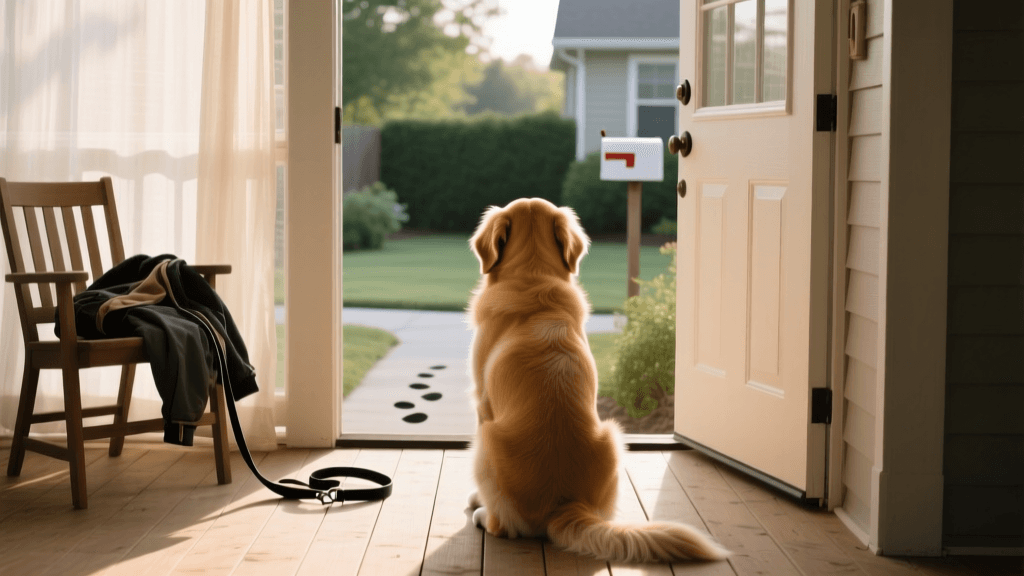
For dogs suffering from SA or ID, the panic attack does not begin when the front door closes. It begins the moment you initiate your "departure routine." Dogs are masters of associative learning. The sound of jingling keys, the squeak of a specific pair of shoes, the rustle of a coat, or the picking up of a purse are all "departure cues." Through classical conditioning, your dog has learned that these cues predict the terrifying event of your absence.
By the time you actually walk out the door, your dog's nervous system is already in a state of high arousal. To break this cycle, we must utilize a technique called Departure Cue Desensitization. The goal is to uncouple the trigger (the keys) from the outcome (you leaving), effectively rendering the trigger meaningless to your dog's nervous system.
Step-by-Step Departure Cue Desensitization Protocol
This protocol requires immense patience. You must progress at your dog's pace; if they show signs of stress (panting, lip licking, whale eye), you have moved too fast and must return to the previous step.
Phase 1: Trigger Neutralization (Weeks 1-2)
Begin by identifying your top five departure cues. Throughout the day, when you are not leaving the house, perform these actions. Pick up your keys and put them down. Open the front door, close it, and walk back to the couch. Put on your coat and sit down to watch television. Do this 10 to 15 times a day. Initially, your dog will follow you anxiously. Over time, as these cues repeatedly fail to predict your departure, your dog will stop reacting to them entirely. They will learn that the sound of keys simply means you are moving around the house.
Phase 2: Micro-Departures (Weeks 3-4)
Once your dog is completely relaxed during Phase 1, introduce micro-departures. Perform your newly desensitized routine, step outside the door, and close it behind you. Wait exactly 0.5 seconds, then re-enter. Do not greet your dog upon re-entering; ignore them until they are calm. Repeat this, gradually increasing the time outside to 1 second, then 3 seconds, then 5 seconds. The ASPCA emphasizes that keeping departures and arrivals incredibly low-key is vital for preventing emotional spikes.
Phase 3: Duration Building and Variable Reinforcement (Months 2-3)
Once you can comfortably leave for 5 minutes without triggering a stress response, begin extending the duration. Leave for 10 minutes, then 20, then 45. Introduce variable reinforcement: sometimes you leave for 5 minutes, sometimes for 30. This unpredictability prevents the dog from anticipating a specific return time, reducing the "ticking clock" anxiety that plagues many canine patients.
Pre-Departure Enrichment: Setting the Stage for Success
Before initiating a departure, provide a high-value, long-lasting enrichment item to promote dopamine release and self-soothing. In 2026, frozen KONGs filled with single-ingredient Greek yogurt, pureed pumpkin, and a dash of low-sodium bone broth remain a gold standard. Alternatively, textured lick mats secured to the wall with suction cups encourage repetitive licking, a behavior scientifically proven to lower canine heart rates. Ensure the enrichment item is only available when you are leaving, making your departure a predictor of a highly rewarding experience rather than a terrifying one.
Leveraging 2026 Smart Tech for Alone-Time Success
Technology has revolutionized how we monitor and manage canine anxiety. Modern smart cameras no longer just record video; they actively participate in behavioral modification.
- AI-Driven Behavior Monitors: Devices like the Furbo 360 Pro now feature advanced AI that can differentiate between a playful bark and an anxiety-induced howl, sending real-time alerts to your smartphone so you can intervene via two-way audio before the panic escalates.
- Automated Treat Dispensers: The Petcube Bites 3 Lite allows you to schedule randomized treat tosses throughout the day. This intermittent reinforcement keeps your dog engaged and creates positive associations with being alone.
- Synthetic Pheromone Diffusers: The Adaptil Calm Home Diffuser continuously releases synthetic dog-appeasing pheromones (DAP), which mimic the comforting signals produced by a nursing mother dog, helping to lower baseline environmental stress.
When to Seek Professional Veterinary Intervention
Behavioral modification is highly effective, but it is not always enough on its own. If your dog is engaging in self-harm (breaking teeth on crates, bloodying paws at doors), or if their baseline anxiety is too high to accept treats or learn new coping skills, you must consult a board-certified veterinary behaviorist. In 2026, the integration of pharmacological support—such as daily SSRIs like fluoxetine or situational medications like trazodone—is widely recognized as a humane and necessary tool to lower a dog's neurochemical threshold, allowing behavioral training to actually take root. Remember, seeking medication is not a failure; it is a critical component of comprehensive, compassionate canine care.
priya-sutaria
All our authors care for dogs every day — read more of their work on the authors page.