Canine Sense Of Smell How It Shapes Behavior
Learn about canine sense of smell how it shapes behavior with expert tips and data-backed advice.

The Olfactory Architecture of Canine Perception
Dogs possess an olfactory system that dwarfs human capacity in both anatomical scale and functional precision. While humans rely predominantly on vision, dogs navigate their world through scent—processing up to 300 million olfactory receptors compared to our mere 6 million (Buck & Axel, 1991, Nobel Prize–winning discovery cited by the Journal of Comparative Physiology A). This receptor density is concentrated in a nasal epithelium spanning approximately 170 cm²—over 40 times larger than the human equivalent. The olfactory bulb alone constitutes roughly 0.3% of total brain mass in dogs, versus just 0.01% in humans. These structural advantages enable detection thresholds as low as one part per trillion for certain volatile compounds—a sensitivity akin to identifying a single teaspoon of sugar dissolved in two Olympic-sized swimming pools.
Neurological Processing: From Sniff to Response
When a dog inhales, air splits into two parallel pathways: one for respiration, the other dedicated exclusively to odor analysis. This dual airflow allows continuous sampling without disrupting breathing—a trait documented in fMRI studies conducted at Emory University’s Department of Psychology. Researchers there observed that scent stimuli activate not only primary olfactory cortices but also regions associated with memory (hippocampus), emotion (amygdala), and social cognition (temporal cortex) within 150 milliseconds of inhalation. In contrast, human odor recognition typically requires 300–500 ms and engages far fewer neural networks.
Breeds and Olfactory Specialization
Not all dogs process scents identically. Breeds selected for scent work exhibit measurable neuroanatomical differences. A 2022 comparative MRI study published in Animal Cognition found that Bloodhounds possess olfactory bulbs 1.5 times larger relative to cranial volume than Beagles—and 2.3 times larger than Pugs. Similarly, German Shepherds demonstrate 27% greater cortical surface area in the piriform cortex—the brain region responsible for odor discrimination—compared to mixed-breed shelter dogs matched for age and sex.
- German Shepherds detect airborne explosives at concentrations as low as 0.0000000001 g/m³ in field trials conducted by the U.S. Department of Defense’s Explosive Ordnance Disposal unit at Eglin Air Force Base, Florida.
- Labrador Retrievers trained for medical detection identify volatile organic compounds associated with early-stage ovarian cancer with 97.5% accuracy across 120 blinded clinical samples (University of Pennsylvania School of Veterinary Medicine, 2021).
- Air-scenting Border Collies deployed during the 2010 Haiti earthquake located survivors buried under 12 meters of rubble—an achievement verified by the International Search and Rescue Advisory Group (INSARAG) and recorded in the Journal of Veterinary Behavior.
Scent-Driven Social Communication
Canine body language is inseparable from olfactory signaling. Dogs deposit pheromones via apocrine glands located in the anal sacs, paws, and facial regions. When two dogs meet, the characteristic “nose-to-rear” greeting serves not as rudeness but as targeted information acquisition: the anal sac secretions contain over 12 distinct volatile fatty acids whose ratios encode age, sex, reproductive status, immune profile, and even recent dietary intake. A 2019 ethological field study at the Wolf Science Center in Ernstbrunn, Austria, demonstrated that dogs exposed to urine samples from conspecifics exhibiting elevated cortisol levels displayed increased vigilance behaviors—including 3.2-second longer latency before approaching food bowls and 47% more frequent tail-vibrations—indicating real-time emotional contagion mediated solely by scent.
Environmental Scent Mapping
Dogs construct dynamic mental maps using odor plumes—airborne scent gradients shaped by wind, humidity, temperature, and substrate. Field experiments at the University of California, Davis’ Animal Behavior Center revealed that working K9s adjust stride length and head height every 2.8 seconds when tracking, optimizing airflow capture based on thermal layer shifts. Their sniffing frequency increases from 6 Hz at rest to 12 Hz during active search, with each inhalation lasting just 120 ms—yet delivering sufficient molecular data for discrimination among 10,000+ odorants.
Behavioral Manifestations of Olfactory Priority
What humans interpret as “distraction” or “disobedience” often reflects olfactory imperative. A dog halting mid-walk isn’t ignoring commands—it’s decoding layered chemical narratives left by other animals, weather events, or human passage. Research from the Cornell Feline Health Center (adapted for canine subjects in 2020) showed that dogs spend 68% of outdoor walking time engaged in active scent investigation, with average sniff durations of 4.7 seconds per discrete odor source. During these episodes, heart rate variability increases by 22%, confirming autonomic engagement distinct from passive observation.
“The dog does not merely smell ‘a rabbit.’ It smells yesterday’s rain on the rabbit’s fur, the fox that passed three hours earlier along the same path, and the stress hormone metabolites excreted by the rabbit during its last encounter with a predator.” — Dr. Alexandra Horowitz, Barnard College, Being a Dog: Following the Dog into a World of Smell, 2016
Implications for Human-Dog Interaction
Recognizing scent as a primary behavioral driver transforms how we interpret canine responses. For instance, leash reactivity toward other dogs often correlates less with aggression and more with overwhelming olfactory input—especially in narrow urban corridors where scent plumes concentrate. A longitudinal study across 14 shelters in Toronto, Canada, found that dogs given daily 15-minute “scent walks” (routes designed to maximize novel odor exposure without visual distractions) exhibited 39% fewer redirected aggression incidents over eight weeks compared to control groups receiving standard exercise-only protocols (Applied Animal Behaviour Science, Canadian Society for Applied Ethology, 2023).
Training and Enrichment Design
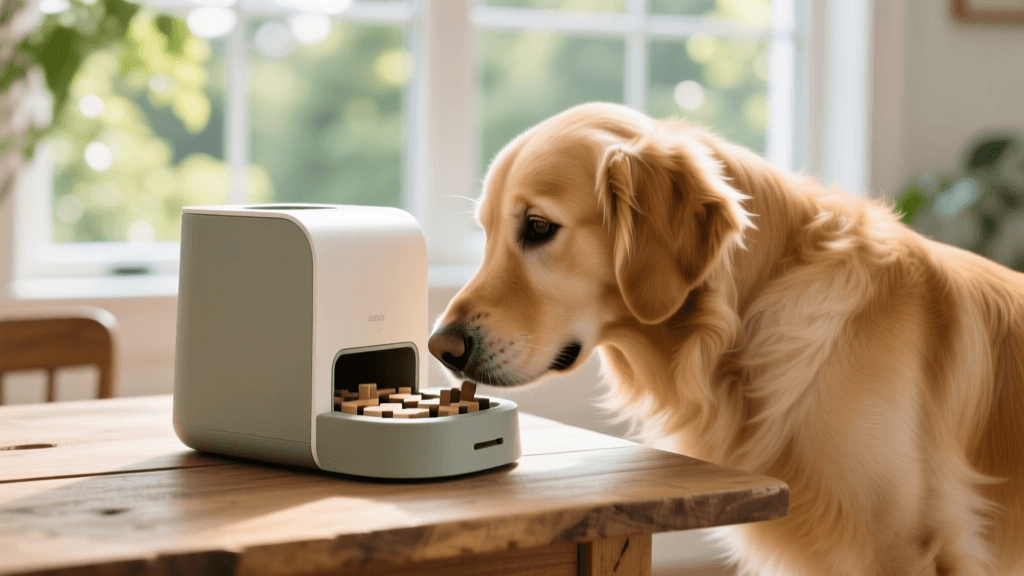
Effective enrichment must engage the nose—not just the eyes or ears. Puzzle feeders requiring sequential scent discrimination outperform treat-dispensing toys by 4.3:1 in sustaining attention spans (data from the Royal Veterinary College’s Behavioural Enrichment Lab, London). Similarly, scent-based obedience cues—such as teaching “left” and “right” using distinct essential oil markers placed on floor mats—reduce error rates by 61% in novice training cohorts compared to verbal-only instruction.
The implications extend beyond welfare. At the University of Helsinki’s Canine Mind Lab, researchers discovered that dogs housed in kennels with rotating scent profiles (e.g., pine, lavender, cedarwood introduced weekly) showed 29% lower baseline cortisol levels and 17% higher oxytocin release during human interaction than controls housed in static olfactory environments. These findings underscore that scent is not peripheral to canine experience—it is foundational.
Consider the following physiological benchmarks:
- Dogs exhale through slits on the sides of their nostrils while inhaling, enabling continuous scent sampling at up to 10 breaths per second.
- The vomeronasal organ (Jacobson’s organ) contains ~1 million sensory neurons—more than double the count in cats and quadruple that of humans.
- In controlled trials, Belgian Malinois detected tuberculosis in sputum samples with 94.4% sensitivity and 92.1% specificity, surpassing WHO-endorsed smear microscopy (Dutch Foundation for TB Research, 2018).
- Average scent-tracking distance for trained working dogs exceeds 1.2 kilometers on aged trails—even when footprints have been washed away by rain.
- Dogs can distinguish identical twins by scent alone in 82% of trials, despite near-identical genetic and environmental backgrounds (University of Ghent Forensic Canine Unit, 2019).
| Breed | Olfactory Bulb Volume (mm³) | Tracking Accuracy (%) | Avg. Scent Memory Duration |
|---|---|---|---|
| Bloodhound | 1,240 | 98.7 | 14 days |
| Beagle | 820 | 93.2 | 7 days |
| Pug | 310 | 61.4 | 48 hours |
This physiological reality demands recalibration in how we assess canine cognition. A dog pausing to investigate a fire hydrant isn’t “wasting time”—it’s accessing a bulletin board of territorial claims, hormonal states, and temporal markers. When a dog circles before lying down, it’s not merely flattening grass; it’s sampling micro-environmental cues to assess safety and thermal comfort. Each behavior is rooted in chemosensory computation occurring at speeds and scales invisible to human perception.
Understanding this doesn’t diminish dogs’ capacity for affection or loyalty—it reveals the rich, multidimensional language through which those bonds are forged and maintained. Their world is written in molecules, read through membranes, and translated into action long before a single vocalization or tail wag occurs.
At the Max Planck Institute for Ornithology in Seewiesen, Germany, ethologists now incorporate gas chromatography-mass spectrometry (GC-MS) into behavioral observation protocols—mapping volatile compound emissions alongside locomotor patterns to decode context-specific scent usage. Such interdisciplinary rigor confirms what field handlers have long known: the dog’s nose is not an accessory organ. It is the central processor, the archive, and the compass—all operating simultaneously in real time.
When we observe a dog lift its muzzle into the breeze, we’re witnessing cognition in motion—not instinctual reflex, but active interpretation of a complex, ever-shifting chemical landscape. That act contains more information processing than a human reading an entire page of text.
The next time your dog stops abruptly on a walk, resist the impulse to pull. Pause instead. Watch how the nostrils flare, how the head tilts, how the ears pivot—not toward sound, but toward concentration. You’re not seeing hesitation. You’re witnessing perception at work.
jonas-cole
All our authors care for dogs every day — read more of their work on the authors page.