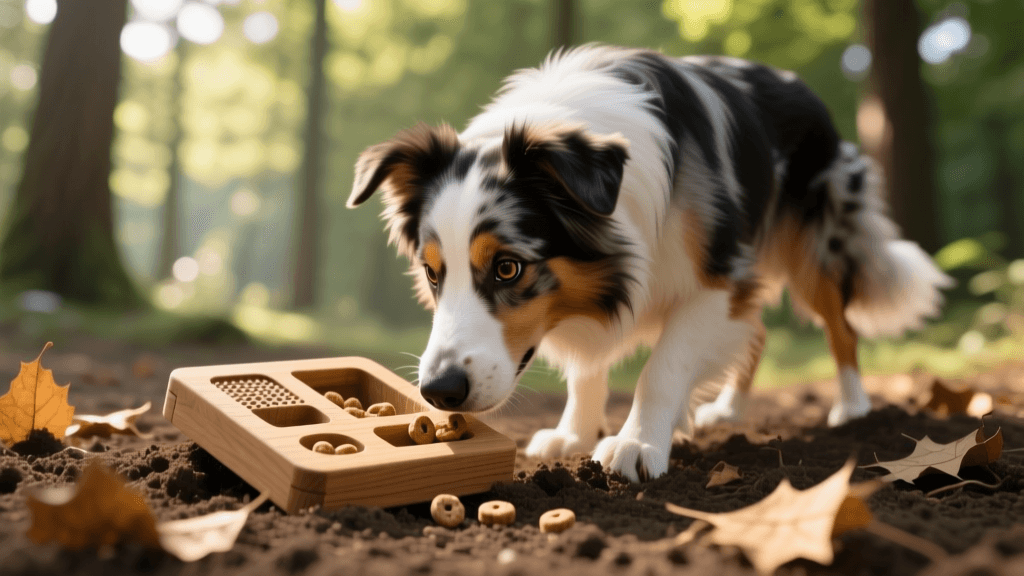
Understanding Canine Foraging: Puzzle Feeders and Scatter Feeding
Discover the psychology of canine foraging. Learn how scatter feeding and puzzle toys reduce boredom, improve behavior, and enrich your dog's daily meals.

The Psychology of the Canine Scavenger
When we think about dog nutrition, we often focus exclusively on the macronutrient profile, caloric density, and ingredient quality of the food in the bag. However, from a behavioral and psychological standpoint, how a dog eats is just as critical as what they eat. Dogs are not merely domesticated wolves; they are highly adapted, opportunistic scavengers and foragers. In the wild, canines spend up to 80% of their waking hours searching for, acquiring, and consuming food. In our modern homes, this deeply ingrained evolutionary drive is often completely ignored, leading to a host of behavioral issues.
Understanding the psychology behind canine foraging is essential for any dog owner looking to improve their pet's mental health, reduce destructive behaviors, and foster a deeper sense of contentment. By shifting our perspective from 'feeding' to 'foraging,' we can tap into our dogs' natural instincts and transform mealtime from a fleeting, two-minute event into a deeply enriching psychological experience.
The Predatory Motor Sequence and Foraging
To understand why dogs need to forage, we must look at the predatory motor sequence. This is the hardwired behavioral chain that dictates how canines interact with their environment to acquire food. The sequence consists of several distinct phases: search, stalk, chase, grab-bite, kill-bite, dissect, and consume. While domestication has heavily modified or suppressed certain parts of this sequence in specific breeds (for example, herding dogs have a heightened 'stalk and chase' but a suppressed 'kill-bite'), the 'search' and 'dissect' phases remain universally strong across almost all dog breeds.
When you place a pile of kibble in a stainless steel bowl, you are entirely bypassing the search and dissect phases. The dog simply walks up and consumes. While this is efficient for caloric intake, it leaves the dog's brain under-stimulated. Engaging the olfactory system during the 'search' phase actually triggers the release of dopamine and endorphins in the canine brain. Sniffing is a cognitively demanding task that lowers a dog's heart rate and induces a state of calm. By denying them the opportunity to search for their food, we are denying them a natural, chemical mechanism for stress relief.
The Phenomenon of Contrafreeloading
One of the most fascinating concepts in animal psychology is 'contrafreeloading.' This is the phenomenon where an animal will choose to work for its food even when identical, freely available food is sitting right next to it. Studies across multiple species, including dogs, have consistently shown that when given the choice between eating from a bowl or solving a puzzle to get the exact same kibble, dogs will overwhelmingly choose the puzzle. They want to work. They crave the cognitive challenge. According to behavioral guidelines outlined by the ASPCA General Dog Care resources, providing mental enrichment and opportunities for natural behaviors is a fundamental pillar of canine welfare, just as crucial as physical exercise and veterinary care.
The Bowl Feeding Deficit: A Recipe for Boredom
A standard bowl-fed meal takes an average dog between 30 and 90 seconds to consume. If a dog is fed twice a day, that equates to a maximum of three minutes of food-related activity out of a 24-hour day. The remaining 23 hours and 57 minutes are left unstructured. For high-energy, intelligent, or working breeds, this massive deficit in mental stimulation is a primary driver of nuisance behaviors. Chewing on baseboards, excessive barking, digging, pacing, and even certain forms of separation anxiety can often be traced back to chronic under-stimulation and unfulfilled foraging instincts.
Strategy 1: Scatter Feeding (The Zero-Cost Enrichment)
Scatter feeding is the simplest and most cost-effective way to reintroduce the 'search' phase of the predatory sequence into your dog's daily routine. Instead of placing the meal in a bowl, you scatter the kibble over a designated area, forcing the dog to use their nose to locate every single piece.
How to Implement Scatter Feeding:
- Measure the Food: Calculate your dog's daily caloric requirement. For a moderately active 30-pound dog, this might be roughly 1.5 cups of high-quality kibble per day. Divide this into two 0.75-cup portions for morning and evening meals.
- Choose the Right Terrain: Indoors, use a short-pile area rug or a dedicated snuffle mat. Avoid hard hardwood floors where kibble can bounce and slide, causing frustration. Outdoors, use a clean, fenced grassy area. Never scatter feed on gravel, mulch, or areas treated with chemical fertilizers to prevent accidental ingestion of foreign objects or toxins.
- The Toss: Toss the kibble in a wide arc over a 10x10 foot area. For beginners, start with a smaller, more concentrated area and gradually expand the radius as your dog's scent-tracking skills improve.
- Timing: A 0.75-cup scatter feed should take a dog between 10 to 15 minutes to complete, providing excellent mental fatigue.
Strategy 2: Snuffle Mats (Indoor Foraging)
If you lack a safe outdoor space or live in an apartment, a snuffle mat is an indispensable tool. These mats are constructed from hundreds of strips of fleece tied to a rubber base, mimicking the texture and depth of tall grass.
Product Recommendations and Costs:
- Premium Option: The Paw5 Wooly Snuffle Mat (approx. $45). Made from sustainable, machine-washable materials, it offers varied depths for hiding food.
- Budget Option: AWOOF Snuffle Mat (approx. $15-$20 on major retail sites). Features multiple layers and cup-like structures to increase difficulty.
- Application: Bury the kibble deep within the fleece strands. Start by leaving a few pieces visible at the top to encourage the dog, then push the rest deep into the mat. This can easily extend a 1-minute meal into a 20-minute foraging session.
Strategy 3: Puzzle Toys and Frozen Kongs
Puzzle toys engage the 'dissect' and problem-solving phases of the canine brain. They require the dog to manipulate objects with their paws and snout to extract the reward. The American Kennel Club's training resources frequently highlight puzzle toys as a primary method for building canine confidence and reducing anxiety through focused mental work.
The Classic Frozen Kong Recipe:
The Kong Classic (approx. $15 for a medium red rubber model) is the gold standard for canine enrichment. To maximize the psychological benefit, you should layer and freeze it.
- Base Layer: Plug the small hole at the bottom with a dab of xylitol-free peanut butter (e.g., Kong Stuff'n or generic natural PB). Cost: $0.15.
- Middle Layer: Fill the cavity with 0.5 cups of your dog's daily kibble. Cost: $0.40.
- Binding Agent: Pour in 1 tablespoon of plain, unsweetened pumpkin puree or plain Greek yogurt to bind the kibble together. Cost: $0.20.
- Top Layer: Cap the large hole with another smear of peanut butter or a small dog biscuit.
- Freeze: Place in the freezer for 2 to 4 hours. The freezing process turns a 5-minute toy into a 30-minute licking and chewing challenge, which is highly soothing for anxious dogs.
Interactive Board Puzzles:
For dogs that prefer mechanical challenges, board puzzles like the Outward Hound Nina Ottosson Dog Brick (approx. $18) feature sliding compartments and removable bone-shaped pegs. These require the dog to learn cause-and-effect relationships, heavily engaging the prefrontal cortex. Always supervise your dog with board puzzles to ensure they do not chew and swallow the plastic components.
Feeding Method Comparison Chart
| Feeding Method | Avg. Time Consumed | Estimated Cost | Mental Stimulation | Best Used For |
|---|---|---|---|---|
| Standard Bowl | 30 - 90 seconds | $5 - $15 (one-time) | Very Low | Strict medical diets, fast eaters needing weight control, or as a baseline. |
| Scatter Feeding | 10 - 15 minutes | $0 (uses daily food) | High (Olfactory) | Apartment dwellers, high-energy breeds, scent hounds. |
| Snuffle Mat | 15 - 25 minutes | $15 - $45 (one-time) | High (Olfactory/Tactile) | Indoor enrichment, rainy days, senior dogs with limited mobility. |
| Frozen Puzzle Toy | 20 - 40 minutes | $15 (toy) + $0.75/meal | Very High (Cognitive/Chewing) | Separation anxiety, teething puppies, crate training, heavy chewers. |
| Board Puzzles | 5 - 10 minutes | $15 - $25 (one-time) | High (Problem Solving) | Intelligent breeds (Poodles, Border Collies), building confidence. |
Transitioning Your Dog: A Step-by-Step Guide
If your dog has only ever eaten from a bowl, throwing them directly into a complex puzzle toy can lead to 'frustration giving up.' They may bark at the toy, flip it over, or simply walk away. To prevent this, use a 3-day transition plan.
- Day 1 (The Introduction): Feed 75% of their meal in their regular bowl, and scatter the remaining 25% on a rug right next to the bowl. This bridges the gap between the known (bowl) and the new (searching).
- Day 2 (Increasing Difficulty): Feed 50% in the bowl, and 50% in an easy, unfrozen Kong or lightly buried in a snuffle mat. Allow them to figure out the mechanics with minimal frustration.
- Day 3 (Full Enrichment): Remove the bowl entirely. Serve the full meal via scatter feeding, snuffle mats, or frozen puzzles. Monitor their body language; a relaxed posture and focused sniffing indicate success, while whining or pawing frantically indicates the puzzle is too hard and needs to be simplified.
Safety, Hygiene, and Resource Guarding
While foraging is immensely beneficial, it requires responsible management. First, hygiene is critical. Snuffle mats and puzzle toys harbor bacteria from saliva and food oils. Wash snuffle mats in the washing machine weekly, and place rubber toys like Kongs on the top rack of your dishwasher every few days.
Second, be mindful of resource guarding. Some dogs who are relaxed around a stationary food bowl may become defensive over a high-value, long-lasting foraging toy like a frozen Kong. If you have multiple dogs, always separate them into different rooms or crates during foraging sessions to eliminate competition and allow each dog to decompress and enjoy the activity at their own pace.
Conclusion
Understanding your dog means recognizing that they are not just passive recipients of nutrition; they are active, intelligent creatures wired to work for their survival. By replacing the mundane food bowl with scatter feeding, snuffle mats, and puzzle toys, you are not just feeding your dog—you are fulfilling a deep psychological need. The result is a calmer, more confident, and behaviorally balanced companion who is finally allowed to express their truest canine nature.
marcus-aldridge
All our authors care for dogs every day — read more of their work on the authors page.