Best Dog Puzzle Toys To Satisfy Natural Foraging Instincts
Discover how puzzle toys satisfy your dog's natural foraging instincts. Read our buyer's guide and top reviews for the best mental stimulation toys.
The Evolutionary Psychology of Canine Foraging
To truly understand your dog's behavior, you must first look back at their evolutionary history. Long before they were sleeping on our living room rugs, canines were opportunistic scavengers and cooperative hunters. In the wild, a dog's ancestors spent up to 80% of their waking hours searching for, capturing, and consuming food. Domestication has provided our pets with shelter and predictable meals, but it has not erased their hardwired biological drive to work for their food.
When we feed domestic dogs from a standard stainless steel or ceramic bowl, they typically consume their daily caloric requirement in under three minutes. This creates a massive behavioral void. The resulting boredom and pent-up energy frequently manifest as destructive chewing, excessive barking, or anxiety. According to the RSPCA, providing environmental and cognitive enrichment is absolutely vital to prevent these boredom-induced behavioral issues and promote overall psychological welfare.
The Neuroscience of the 'Seeking' Circuit
Deep within your dog's brain lies the mesolimbic dopamine system, often referred to by neuroscientists as the 'SEEKING' circuit. This neurological pathway is the primary driver of curiosity, exploration, and foraging. When your dog uses their nose to track a hidden treat or uses their paws to manipulate a sliding block, their brain releases a surge of dopamine. This neurotransmitter creates a profound feeling of euphoria, anticipation, and ultimate satisfaction.
Puzzle toys artificially activate this SEEKING circuit. They provide the psychological reward of the hunt and the satisfaction of problem-solving without the need for actual prey. By integrating these tools into your dog's daily routine, you are not just feeding them; you are fulfilling a deep-seated biological need.
Reading Your Dog's Body Language During Play
Understanding your dog means learning to read their subtle communication signals, especially when they are faced with a cognitive challenge. It is crucial to differentiate between healthy engagement and unhealthy frustration.
- Signs of Engagement: Focused sniffing, relaxed ears, deliberate pawing, soft eyes, and a gently wagging tail. Your dog is in a state of 'flow' and active problem-solving.
- Signs of Frustration: Frantic, rapid pawing, high-pitched whining, lip licking, yawning, or abruptly walking away to chew on the toy's edges. If you see these stress signals, the puzzle is too difficult, and you need to lower the cognitive load to prevent learned helplessness.
Buyer's Guide: What to Look For
Not all enrichment toys are created equal. When shopping for mental stimulation products, keep these critical factors in mind:
- Cognitive Load and Difficulty: Puzzles generally range from Level 1 (simple lifting or rolling) to Level 4 (multi-step sequential actions). Always start at Level 1 and progress slowly.
- Material Safety: Look for BPA-free, phthalate-free, and PVC-free plastics, or high-quality natural rubbers. Dogs will chew on these items, and chemical safety is paramount.
- Cleanability: Saliva and food residue breed bacteria. Prioritize toys that are top-rack dishwasher safe or easy to disassemble and wash.
- Caloric Management: Remember to subtract the calories used in puzzle toys from your dog's daily meal allowance to prevent obesity.
Top 5 Puzzle Toys Reviewed for Mental Stimulation
1. Outward Hound Nina Ottosson Dog Brick
Best For: Intermediate problem solvers and scent hounds.
Dimensions: 12 x 9 x 2 inches
Estimated Cost: $15.99
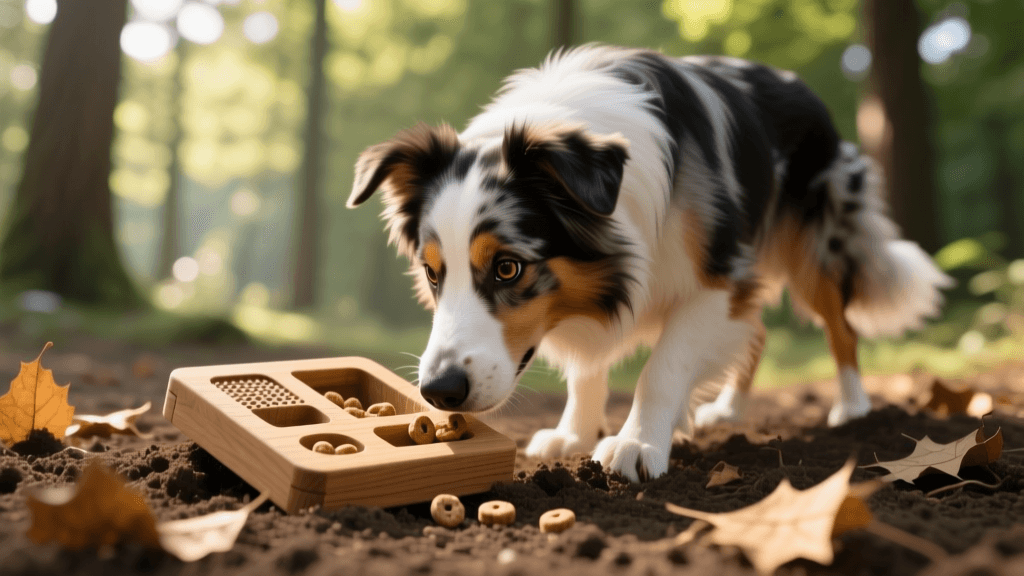
The Dog Brick is a fantastic Level 2 puzzle that requires your dog to use a combination of sniffing, pawing, and nosing. It features sliding blocks that hide treats, as well as flip-lid compartments. The removable white bone pegs add an adjustable layer of difficulty. It is made from BPA-free, phthalate-free plastic and is incredibly easy to wipe clean. However, it is not recommended for aggressive chewers who might try to crack the plastic lids.
2. KONG Classic Dog Toy (Red)
Best For: Power chewers and dogs with separation anxiety.
Dimensions: Medium size is 3.5 x 2.25 inches
Estimated Cost: $14.99
While often viewed simply as a chew toy, the KONG Classic is a foundational foraging tool when stuffed. The unpredictable bounce mimics the erratic movement of prey, triggering the chase instinct. Stuffing it with a mixture of kibble, plain yogurt, and peanut butter, then freezing it, turns it into a long-lasting licking puzzle. Licking releases endorphins in the canine brain, which naturally soothes and calms anxious dogs.
3. PAW5 Wooly Snuffle Mat
Best For: Olfactory stimulation, senior dogs, and high-energy breeds.
Dimensions: 18 x 12 inches
Estimated Cost: $44.00
The Snuffle Mat taps directly into a dog's most powerful sense: smell. Made from upcycled, machine-washable fleece, this mat mimics the experience of foraging for food in deep grass. The American Kennel Club notes that 15 minutes of intense sniffing can tire a dog out as much as a mile-long walk. It is an excellent, low-impact enrichment tool for dogs recovering from surgery or senior dogs with limited mobility.
4. West Paw Toppl
Best For: Creative freezing recipes and moderate chewers.
Dimensions: Large size is 5 x 3 inches
Estimated Cost: $24.95
Made in the USA from West Paw's proprietary Zogoflex material, the Toppl is a versatile, trap-and-treat toy. It features inner prongs that hold kibble or fruit chunks securely. The genius of the Toppl lies in its interlocking design; you can buy a small and a large Toppl and lock them together to create a sealed, spherical puzzle that requires intense rolling and batting to dispense food.
5. PetSafe Busy Buddy Kibble Nibble
Best For: Fast eaters and physical foraging.
Dimensions: 5.5 x 3.25 inches
Estimated Cost: $11.99
This is a straightforward, physical foraging toy designed to slow down meal times. It features adjustable openings at both ends, allowing you to control the size of the kibble that falls out. Your dog must roll, nudge, and chase the toy across the floor to release their dinner. It is highly effective for dogs that inhale their food, promoting better digestion and preventing bloat.
Product Comparison Chart
| Product Name | Primary Instinct Targeted | Difficulty Level | Material | Avg. Price |
|---|---|---|---|---|
| Nina Ottosson Dog Brick | Cognitive Problem Solving | Level 2 (Intermediate) | BPA-Free Plastic | $15.99 |
| KONG Classic (Red) | Chewing and Licking | Level 1 (Beginner) | Natural Rubber | $14.99 |
| PAW5 Wooly Snuffle Mat | Olfactory Foraging | Level 1 (Beginner) | Upcycled Fleece | $44.00 |
| West Paw Toppl | Manipulation and Chewing | Level 1-2 (Adjustable) | Zogoflex Rubber | $24.95 |
| PetSafe Kibble Nibble | Physical Rolling/Scavenging | Level 1 (Beginner) | Durable Plastic | $11.99 |
How to Introduce Puzzle Toys to Your Dog
Handing a dog a complex puzzle and expecting them to figure it out is a recipe for frustration. As Fear Free Pets recommends, introducing food puzzles should be a gradual, heavily rewarded process.
- Start Easy: For sliding puzzles, leave the compartments completely open and visibly filled with high-value treats like boiled chicken or freeze-dried liver. Let your dog eat them directly to build a positive association with the toy.
- Incremental Challenge: Once your dog understands that the toy holds food, cover the treats only halfway. Use an enthusiastic, encouraging tone of voice to guide them.
- Supervise Initial Sessions: Never leave a dog alone with a new puzzle toy. Some dogs will bypass the puzzle mechanics entirely and resort to destructive chewing to access the food. Supervision allows you to intervene and redirect their behavior to the correct mechanism.
- Rotate for Novelty: Dogs habituate to their environment quickly. To maintain the dopamine-driven excitement of the SEEKING circuit, rotate between 3 or 4 different puzzle toys throughout the week. Put one away for a few days before reintroducing it so it feels 'new' again.
Final Thoughts on Canine Cognition
Understanding your dog requires acknowledging that they are intelligent, working animals trapped in a modern, sedentary world. By viewing mealtime not as a chore, but as an opportunity for cognitive enrichment, you can drastically improve your dog's behavioral health. Investing in high-quality puzzle toys is an investment in your dog's psychological well-being, transforming a bored, anxious pet into a tired, satisfied, and deeply fulfilled companion.
hannah-wickes
All our authors care for dogs every day — read more of their work on the authors page.