Border Collie vs Australian Shepherd: Herding Instincts
Discover the behavioral differences between Border Collies and Australian Shepherds. Learn how their unique herding instincts impact training, costs, and daily life.
The Psychology Behind the Herding Instinct
Choosing between a Border Collie and an Australian Shepherd is a common dilemma for active individuals seeking a highly intelligent canine companion. While both breeds belong to the herding group and share a reputation for boundless energy and trainability, their underlying psychological drivers and behavioral expressions are distinctly different. Understanding these nuances is critical for prospective owners. A mismatch between a dog's innate instincts and an owner's lifestyle is a leading cause of behavioral surrender. This guide dives deep into the breed psychology, comparing the working styles of these two incredible breeds to help you make an informed, lifelong commitment.
To understand these breeds, we must first examine the predatory motor sequence. In wild canids, hunting follows a specific pattern: orient, eye, stalk, chase, grab-bite, kill-bite, and consume. Through centuries of selective breeding, humans have modified this sequence in herding dogs. According to the American Kennel Club's Herding Group standards, herding breeds are selected to exhibit exaggerated portions of this sequence while inhibiting the final, lethal bites. However, the specific slice of the sequence that is amplified varies drastically between breeds, dictating their working style and, consequently, their behavior in a domestic home.
Border Collie: The 'Strong Eye' Stalker
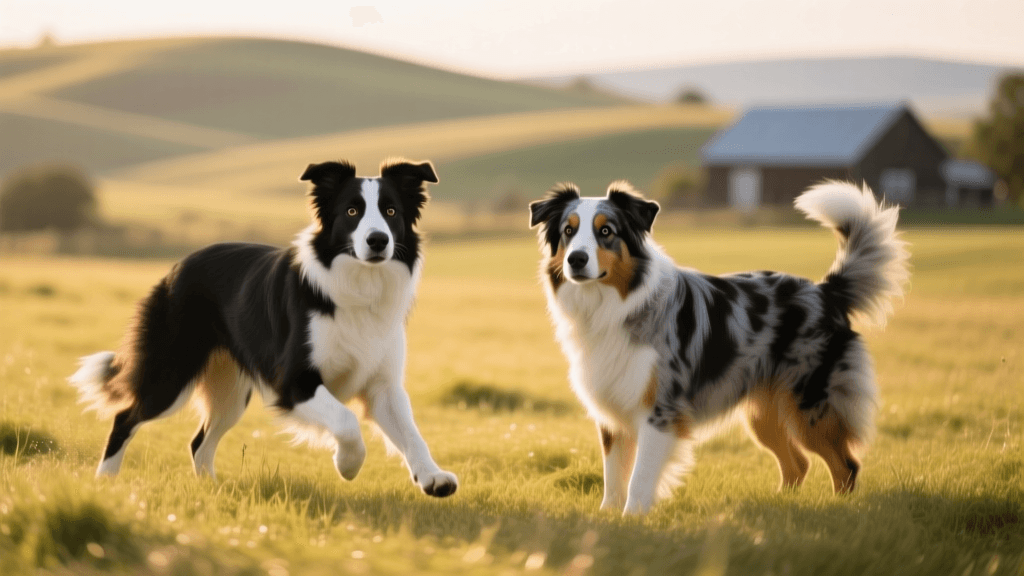
The Border Collie is globally renowned for its 'strong eye.' This refers to the dog's tendency to drop into a deep, hypnotic stalk, locking eyes with the livestock to control movement through psychological pressure. In a domestic environment, a Border Collie's unfulfilled need to stalk and control can manifest as shadow-chasing, light-fixation, or intense staring at family members. They are highly sensitive to their handler's micro-expressions and require immense mental stimulation. A simple physical walk is rarely enough; they need complex problem-solving tasks to exhaust their active minds.
When a Border Collie exhibits unwanted stalking behaviors, such as obsessively watching the family cat or fixating on moving vehicles, it is crucial to interrupt the sequence before the 'chase' phase triggers. Using a 6-foot biothane leash indoors allows owners to gently guide the dog away from the trigger and redirect them to a high-value chew or a structured training game.
Australian Shepherd: The 'Loose Eye' Heeler
Conversely, the Australian Shepherd was developed in the American West to handle unruly cattle across vast, rugged terrains. They typically possess a 'loose eye' and are known as 'heelers' or driving dogs. Instead of stalking from a distance, Aussies use their physical bodies to push and nip at the heels of livestock to force movement. This translates to a more physical, bouncy, and sometimes mouthy dog in the home. It is incredibly common for Aussies to try and 'herd' running children by nipping at their ankles.
Furthermore, Aussies often possess a stronger inherent guarding instinct compared to the more biddable, handler-focused Border Collie. They are naturally more suspicious of strangers and can be highly protective of their home and family. This psychological trait requires rigorous, early socialization to prevent reactivity. Exposing an Aussie puppy to diverse environments, sounds, and friendly strangers between 8 and 14 weeks of age is non-negotiable for a well-adjusted adult dog.
Behavioral and Lifestyle Comparison Chart
| Trait | Border Collie | Australian Shepherd |
|---|---|---|
| Working Style | Strong Eye / Stalker | Loose Eye / Heeler & Driver |
| Physical Energy | High (Endurance) | Very High (Explosive/Bouncy) |
| Mental Needs | Extreme (Complex puzzles) | High (Active obedience) |
| Guarding Instinct | Low to Moderate | Moderate to High |
| Sensitivity | Extremely High | Moderate (More resilient) |
| Avg. Monthly Enrichment Cost | $50 - $80 | $40 - $70 |
Actionable Selection and Training Advice
Timing Your Puppy Selection
The critical socialization window closes around 14 to 16 weeks of age. The American Veterinary Society of Animal Behavior (AVSAB) emphasizes that puppies must be exposed to diverse stimuli during this period. For an Australian Shepherd, this means prioritizing positive interactions with strangers to mitigate their natural guarding instincts. For a Border Collie, this means exposing them to chaotic environments to build resilience and prevent them from becoming overwhelmed by visual stimuli.
The 'Interrupt and Redirect' Protocol
When managing these intense genetic drives, punishment is rarely effective and often damages the sensitive psyche of herding breeds. Instead, behavioral experts recommend the 'Interrupt and Redirect' protocol. If your Border Collie begins to obsessively stare at a moving shadow, or your Australian Shepherd starts to stalk a toddler's heels, use a neutral interrupter cue like a gentle 'oops' or a soft kissy noise. This breaks their hyper-focus without inducing fear. Immediately redirect their energy into an incompatible behavior, such as targeting a hand or fetching a specific toy. Consistency in this protocol over 4 to 6 weeks will significantly reduce unwanted herding behaviors in the home environment.
Essential Enrichment Tools and Costs
Budgeting for a herding breed goes far beyond basic kibble. You must invest in specific tools to satisfy their genetic imperatives safely:
- Flirt Poles ($25-$35): A 36-inch wand with a 48-inch braided cord is essential for safely satisfying the Aussie's chase-and-bite sequence without encouraging hand-biting. Always keep the toy on the ground to protect their joints.
- Advanced Puzzle Toys ($15-$30): Invest in multi-step puzzles like the Outward Hound Dog Brick or heavy-duty snuffle mats to engage the Border Collie's problem-solving stalk.
- Agility and Sport Training ($150-$250): Once the dog's growth plates close (around 12-15 months), enroll in a 6-week introductory agility course. This provides structured physical exertion and deepens the handler-dog bond.
Nutritional and Physical Considerations
High-drive dogs burn significantly more calories than the average pet dog. Expect to spend $70 to $100 monthly on premium, high-protein diets formulated for active breeds. Additionally, because both breeds are prone to explosive jumping and rapid directional changes, they are at a higher risk for orthopedic injuries like cruciate ligament tears. Budgeting $40 to $60 monthly for comprehensive pet insurance is a highly recommended actionable step for prospective owners of either breed.
Understanding the Long-Term Commitment
According to the American Herding Breed Association (AHBA), the instinct to herd is deeply hardwired and cannot be entirely trained away; it can only be redirected. If you live in a quiet apartment or work long hours away from home, neither breed is a suitable choice, regardless of how much you enjoy their aesthetic. However, if you are an active individual willing to dedicate 1 to 2 hours daily to structured training, mental enrichment, and physical exercise, these breeds will reward you with an unparalleled level of loyalty and intelligence. By understanding whether you prefer the intense, calculating stare of the Border Collie or the bouncy, physical drive of the Australian Shepherd, you can select a companion whose psychological needs perfectly align with your lifestyle.
priya-sutaria
All our authors care for dogs every day — read more of their work on the authors page.