Top Puppy Breeds For Remote Workers In 2026: A WFH Guide
Discover the best puppy breeds for remote workers in 2026. Learn which low-stress, office-friendly dogs thrive in a work-from-home environment.
The Evolution of the Work-From-Home Dog in 2026
As we navigate the fully normalized hybrid and remote work models of 2026, the home office is a permanent fixture in millions of households. For remote workers, the dream of sharing a workspace with a furry companion is more achievable than ever. However, bringing a puppy into a work-from-home (WFH) environment requires a deep understanding of canine psychology and breed instincts. Not every dog is built to sleep quietly under a desk while you handle back-to-back video conferences. Choosing the right breed is the difference between a peaceful, productive workday and a chaotic schedule filled with disruptive barking and separation anxiety.
Understanding your dog's inherent drives is the core of successful human-canine cohabitation. When you work from home, your puppy learns that your presence is a constant. This creates a unique psychological dynamic where the dog must learn to self-soothe and relax independently, even when you are just a few feet away behind a closed door or a monitor. In this comprehensive guide, we break down the best puppy breeds for remote workers, focusing on low-stress temperaments, minimal barking tendencies, and the ability to thrive in a home-office setting.
The Psychology of the 'Velcro Dog' vs. The Independent Companion
When evaluating breeds for a remote work lifestyle, it is crucial to understand the spectrum of canine attachment. Many people assume they want a 'velcro dog'—a breed that sticks to their side every second of the day. While this sounds ideal for a WFH setup, it often leads to severe distress when you eventually need to leave the house, run errands, or attend an off-site meeting.
According to behavioral experts, dogs that are genetically predisposed to hyper-attachment are at a much higher risk for separation anxiety. The ASPCA notes that separation anxiety is triggered when a dog becomes overly distressed upon being left alone or separated from their primary guardian. For a remote worker, the goal is to find a breed that is deeply affectionate and enjoys your company, but also possesses the psychological independence to settle down on a dog bed and nap for hours while you focus on deep work.
Why Breed Instincts Dictate Office Harmony
A dog's breed history dictates how they interact with their environment. Breeds developed for guarding, herding, or high-endurance hunting possess instincts that directly conflict with a quiet home office. For example, herding breeds are genetically wired to react to movement and sound. In a WFH environment, the sound of a doorbell, a delivery driver, or even a sudden noise from your computer speakers can trigger an intense barking episode. Conversely, breeds developed strictly for companionship or those with low-energy 'sighthound' temperaments are far more likely to sleep through your most important Zoom presentations.
Top 5 Puppy Breeds for the Home Office in 2026
1. Cavalier King Charles Spaniel
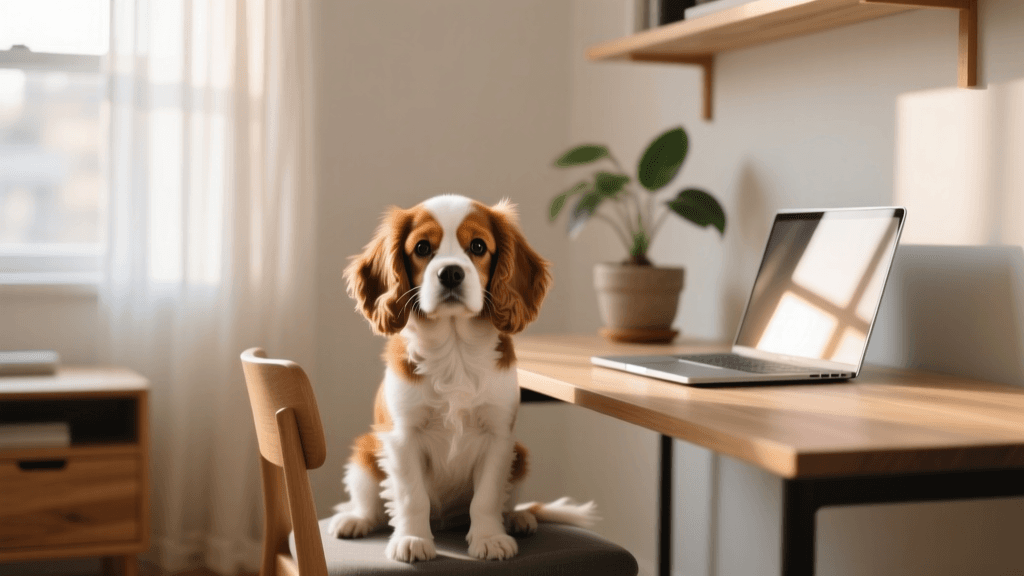
The Cavalier King Charles Spaniel is widely considered the gold standard for companion dogs. Bred exclusively to sit on the laps of royalty, their psychological need is simply to be near you. They are incredibly quiet, rarely barking without a profound reason, making them perfect for shared home-office spaces or apartment living. Cavaliers are highly adaptable; they will happily sleep on a plush bed next to your desk for hours. Their moderate energy levels mean a 30-minute morning walk and a quick evening play session are entirely sufficient to keep them happy and relaxed throughout your workday.
2. Greyhound
It may seem counterintuitive to recommend a racing breed for a desk job, but Greyhounds are famously known in the veterinary community as '45-mph couch potatoes.' Their psychology is built around short, intense bursts of energy followed by extreme lethargy. A retired racing Greyhound or a well-exercised Greyhound puppy will gladly sleep up to 18 hours a day. They are exceptionally quiet, rarely bark, and their gentle, non-intrusive nature means they will not demand constant attention while you are typing. They just want a soft, orthopedic bed in the corner of your office.
3. Basset Hound
Basset Hounds are scent hounds with a remarkably laid-back, almost stubborn, demeanor. Indoors, they are incredibly docile and prone to long naps. Their psychological drive is centered around their nose rather than guarding or herding. For a remote worker, this means you can easily keep a Basset Hound occupied for hours by utilizing enrichment tools like snuffle mats or frozen lick mats placed under your desk. They are deeply affectionate but not overly demanding, and their low-slung, heavy build means they prefer lounging on the rug over jumping on your keyboard.
4. Shih Tzu
Originally bred to keep company in Chinese palaces, the Shih Tzu is a true companion breed. Unlike terriers, which were bred to hunt and bark at vermin, the Shih Tzu's sole historical purpose was to provide calm, quiet companionship. They are highly attuned to their owner's emotions and will happily sit on your lap during a phone call or sleep in a nearby crate. They require minimal outdoor exercise, making them ideal for remote workers who live in urban environments or high-rise apartments where frequent bathroom breaks might be slightly inconvenient.
5. Whippet
Similar to the Greyhound but in a smaller, more manageable package, the Whippet is a gentle, sensitive, and profoundly quiet sighthound. They are virtually barkless indoors and form deep bonds with their owners without exhibiting the neurotic clinginess of some toy breeds. Whippets are highly sensitive to cold, so they will happily burrow under a blanket on a dog sofa in your office and stay there until you clock out. Their psychological need for a 'safe den' aligns perfectly with crate training, allowing them to feel secure while you work.
Breeds to Avoid for Zoom-Heavy Schedules
If your job requires frequent, quiet video calls, you should generally avoid high-drive working and herding breeds. The American Kennel Club emphasizes that working breeds require immense mental and physical stimulation to prevent destructive behaviors. Breeds like the Border Collie, Australian Shepherd, Belgian Malinois, and Siberian Husky are genetically programmed to work all day. In a home-office setting, they will invent their own 'jobs,' which often includes barking at the wind, herding your children, or destroying your office furniture out of sheer boredom. Guarding breeds, such as German Shepherds or Rottweilers, may also feel compelled to alert-bark at every passing car or neighborhood noise, disrupting your professional environment.
Comparison Chart: WFH Dog Breeds at a Glance
| Breed | Energy Level | Barking Tendency | WFH Suitability | Daily Exercise Need |
|---|---|---|---|---|
| Cavalier King Charles Spaniel | Low to Moderate | Very Low | Excellent | 30 - 45 Minutes |
| Greyhound | Low (Indoors) | Low | Excellent | 45 - 60 Minutes |
| Basset Hound | Low | Moderate (Howling) | Very Good | 30 Minutes |
| Shih Tzu | Low | Low to Moderate | Excellent | 20 - 30 Minutes |
| Whippet | Low (Indoors) | Very Low | Excellent | 45 Minutes |
| Border Collie (Avoid) | Extremely High | High | Poor | 2+ Hours |
Training Your WFH Puppy for Zoom Calls
Even the quietest breeds require training to understand the boundaries of a home office. The most critical skill for a WFH puppy is the 'Place' command. This involves training your dog to go to a specific mat or bed and remain there until released. Start by luring your puppy onto a raised dog cot or a specific rug with high-value treats. Gradually increase the duration they must stay on the mat while you sit at your desk. By the time they reach adulthood, the 'Place' command will act as an 'off switch,' signaling to the dog that it is time to relax while you work.
Additionally, invest in silent enrichment tools. Puzzle feeders, frozen Kongs, and snuffle mats keep your dog's brain occupied without generating noise. In 2026, smart pet cameras with treat-tossing capabilities have become incredibly advanced and reliable. Mounting a camera in your office allows you to monitor your puppy's stress levels and silently dispense a treat when they exhibit calm, settled behavior, reinforcing their quiet independence.
Preventing Separation Anxiety When You Leave the Office
The biggest risk for remote workers is that the puppy becomes entirely dependent on your constant presence. To prevent this, you must practice 'mock departures' daily. Even if you work from home 100% of the time, put your puppy in a safe playpen or crate, leave the room, and close the door for 30 to 60 minutes while you do chores or go for a solo walk. This teaches the puppy that your absence is temporary and that they are safe even when you are not in their line of sight. Providing a piece of clothing with your scent on their bed can also help soothe them during these independent periods.
Conclusion
Choosing a puppy as a remote worker is a deeply rewarding decision, provided you align the dog's genetic instincts with your professional lifestyle. By opting for companion-oriented or low-energy sighthound breeds, you ensure a harmonious environment where both you and your dog can thrive. Remember that understanding your dog's psychology is an ongoing process; with the right breed, proper boundary training, and proactive anxiety prevention, your home office will become a sanctuary of productivity and companionship.
hannah-wickes
All our authors care for dogs every day — read more of their work on the authors page.