Top Dog Breeds For Remote Workers In 2026: WFH Psychology
Discover the best dog breeds for remote workers in 2026. Learn how breed psychology, energy levels, and independence impact your work-from-home setup.
The Evolution of the WFH Dog in 2026
As we navigate the entrenched remote and hybrid work landscapes of 2026, the home office has permanently evolved from a makeshift kitchen table setup into a dedicated, optimized workspace. For millions of professionals, this environment includes a four-legged co-worker. However, sharing your square footage with a canine companion during a forty-hour work week requires more than just love; it requires a deep understanding of breed-specific psychology, instinctual drives, and behavioral thresholds.
Not every dog is built for the work-from-home (WFH) lifestyle. While some breeds view a quiet home office as an invitation to nap, others interpret the sudden stillness of their environment as a cue to patrol, bark, or demand constant interaction. Choosing the right breed—or understanding the psychological needs of your current dog—is essential for maintaining productivity and ensuring your pet remains emotionally balanced throughout the workday.
The Psychology of a Home Office Compatible Breed
When evaluating the best dog breeds for remote workers, canine behaviorists look at three primary psychological pillars: vocalization triggers, energy endurance, and independence. According to breed temperament data outlined by the American Kennel Club (AKC), a dog's historical purpose heavily dictates how they will behave in a modern, enclosed home environment.
Vocalization and the Zoom Call Factor
In 2026, virtual meetings remain a cornerstone of professional life. A dog with a high territorial instinct or a strong alert-barking drive can turn a critical client presentation into a chaotic mess. Breeds originally developed to alert farmers to intruders or to vocalize while on the hunt possess a hardwired psychological need to announce environmental changes. A delivery drone dropping a package on the porch or a neighbor walking past the window can trigger an instinctual barking sequence that is incredibly difficult to suppress without extensive behavioral conditioning.
Independence vs. 'Velcro' Syndrome
Remote workers often need to close their office doors for deep work or confidential calls. Dogs with severe 'Velcro' tendencies—breeds developed to work in constant, unbroken physical contact with their handlers—can develop acute stress when separated by a single door. The ASPCA notes that isolation distress and separation anxiety are highly prevalent in companion and herding breeds that lack the psychological independence to self-soothe. A successful WFH dog must possess the confidence to settle in an adjacent room or on a designated mat without experiencing panic.
Top Dog Breeds for Remote Workers
Based on behavioral psychology, energy expenditure requirements, and environmental adaptability, the following breeds consistently rank as the most compatible for remote professionals in 2026.
1. The Greyhound: The 45-MPH Couch Potato
Despite their racing heritage, Greyhounds are famously lethargic indoors. Psychologically, they are sprinters, not marathoners. Once they have had a brief, high-intensity morning run or a long sniffari, their nervous system down-regulates into a state of deep rest. They are exceptionally quiet, rarely barking at household noises, and they prefer to sleep curled up on a plush orthopedic bed (budget around $120 for a large, supportive memory foam mattress) in the corner of your office. Their independent yet affectionate nature means they are happy to share your space without demanding constant physical contact.
2. The Shiba Inu: The Feline-Independent Companion
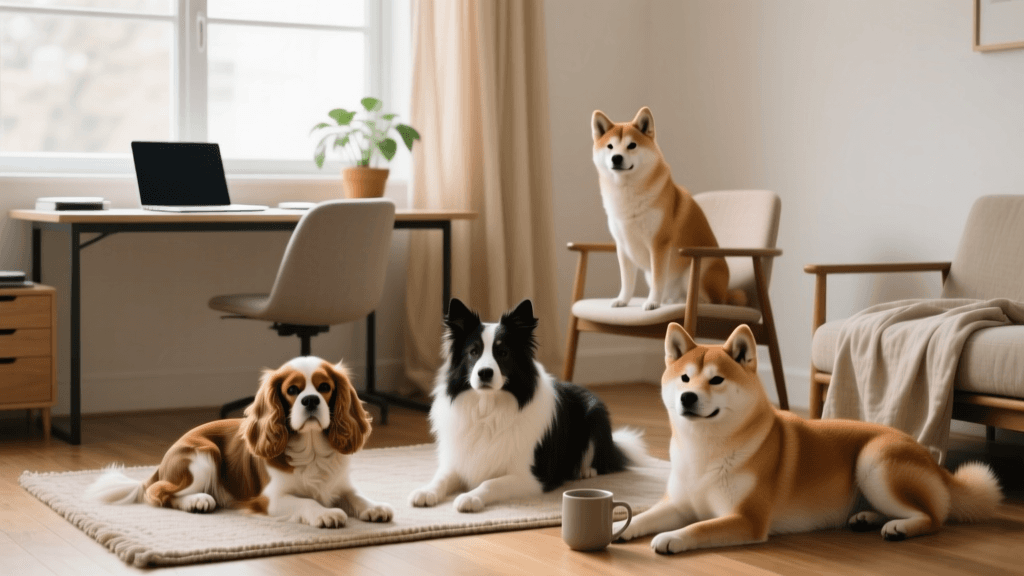
The Shiba Inu is a basal breed with a highly independent, almost cat-like psychological profile. They do not possess the eager-to-please neurochemistry of a retriever, which translates to a dog that is perfectly content entertaining itself. Shibas are fastidious, quiet, and generally aloof. They will happily observe you from their bed while you code or write reports. However, their independence means they require early, positive socialization to ensure they remain comfortable with the occasional house guest or client visit.
3. The Basset Hound: The Low-Key Co-Worker
Bred for slow, methodical scent tracking, the Basset Hound operates on a remarkably low-energy frequency indoors. Their psychological drive is centered around their nose rather than physical exertion. Providing a 2026-era smart snuffle mat or a frozen enrichment puzzle toy during your lunch break satisfies their foraging instincts, guaranteeing a solid two-hour nap while you tackle afternoon emails. They are stubborn but profoundly chill, making them immune to the stress of a fast-paced household.
4. The Standard Poodle: The Highly Trainable Intellectual
While they require significant mental stimulation, Standard Poodles possess the cognitive capacity to learn complex 'settle' commands. Unlike herding breeds that might try to manage your movements, a well-exercised Poodle can be taught to go to a specific 'place' mat and remain there for hours. Their high intelligence means they thrive when given a 'job'—such as working on a complex chew puzzle—while you work on your laptop.
Breeds That Clash with Remote Work Instincts
Understanding your dog also means recognizing when a breed's instincts are fundamentally incompatible with your lifestyle. Herding breeds, such as the Border Collie or Australian Shepherd, are psychologically driven to control movement. In a home office, this can manifest as nipping at your ankles when you stand up, barking at the robotic vacuum, or obsessively shadowing you from room to room. Similarly, Livestock Guardian Dogs like the Great Pyrenees are hardwired to bark at perceived perimeter threats, making them a liability for professionals who frequently host video conferences.
Comparison Chart: WFH Breed Compatibility
| Breed | Primary Instinct | WFH Energy Level | Vocalization Risk | Independence Score |
|---|---|---|---|---|
| Greyhound | Sprinting / Resting | Very Low (Indoors) | Low | High |
| Shiba Inu | Independent Hunting | Moderate | Low | Very High |
| Basset Hound | Scent Tracking | Low | Moderate (Bayling) | Moderate |
| Standard Poodle | Retrieving / Problem Solving | Moderate-High | Low | Moderate |
| Border Collie | Herding / Movement Control | Very High | High | Very Low |
| Great Pyrenees | Perimeter Guarding | Low | Very High | High |
Setting Up Your 2026 Home Office for Canine Success
Even the most compatible WFH breed requires environmental management to thrive. Canine psychology dictates that dogs thrive on predictability and designated spaces. Here is how to optimize your home office for your dog this year:
- The 'Place' Command and Mat Training: Invest in a high-quality, washable mat (approximately 30x40 inches for medium breeds). Spend 15 minutes daily training the 'place' command using high-value treats. This creates a psychological boundary where the dog knows it is time to settle, not play.
- Automated Enrichment: Utilize AI-driven pet cameras that dispense treats or launch interactive games when the dog has been resting for a set duration. This reinforces quiet behavior without requiring you to break your workflow.
- Acoustic Management: If you live in a noisy urban environment, use a white noise machine or a smart speaker playing classical music (specifically tracks designed for canine heart-rate regulation) to mask external triggers that might cause alert barking.
- Scheduled Decompression: The Humane Society emphasizes the importance of structured routines. Schedule a 30-minute 'sniff walk' before your first meeting. Allowing the dog to process environmental scents lowers their cortisol levels and promotes deep sleep during your core working hours.
Understanding your dog's breed-specific drives is the difference between a stressful workday and a harmonious home office. You cannot train away a dog's fundamental psychology, but you can manage their environment to set them up for success.
Conclusion
The best dog breeds for remote workers in 2026 are those whose historical instincts align with the quiet, sedentary reality of the modern home office. By prioritizing psychological independence, low vocalization drives, and manageable energy levels, you can cultivate a workspace that is both highly productive and deeply comforting. Whether you adopt a retired Greyhound or train a Standard Poodle to master the 'settle' mat, respecting your dog's behavioral needs is the ultimate key to a successful WFH partnership.
jonas-cole
All our authors care for dogs every day — read more of their work on the authors page.