Best Puppy Playtime Duration By Age And Breed
Learn about best puppy playtime duration by age and breed with expert tips and data-backed advice.
Understanding Puppy Developmental Stages
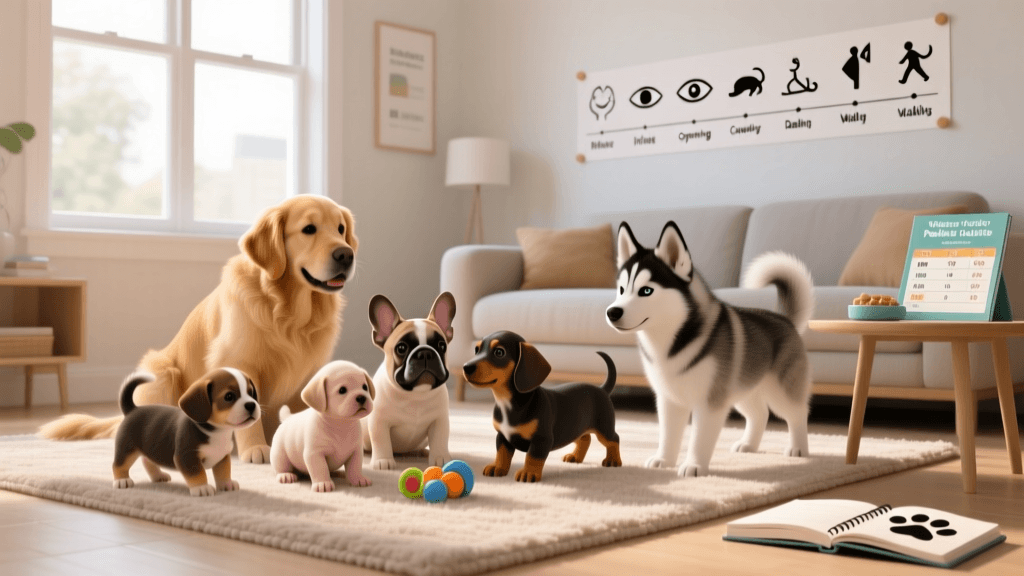
A puppy’s first 16 weeks represent the most rapid and sensitive phase of neurological, musculoskeletal, and behavioural development. During this period, neural synapses form at a rate exceeding 1 million per second, laying the foundation for lifelong learning capacity and emotional regulation. According to the American Veterinary Medical Association (AVMA, 2022), puppies experience three distinct neurodevelopmental windows: sensory (0–3 weeks), socialisation (3–14 weeks), and fear imprinting (8–11 weeks). Missing key milestones within these windows—especially between weeks 5 and 12—can result in persistent anxiety, reactivity, or impaired social cognition.
Weekly Milestones From Birth to 16 Weeks
From birth, puppies progress through tightly choreographed developmental stages. At birth, they are blind, deaf, and thermoregulation-dependent—relying entirely on maternal warmth and colostrum for passive immunity. By day 3, their umbilical cord detaches; by day 7, they begin crawling; and by day 10–14, eyes and ears open simultaneously. Between weeks 2 and 3, puppies develop righting reflexes and begin vocalising with yelps and whines. Week 4 marks the onset of exploratory locomotion, littermate play biting, and the emergence of tail wagging as a communicative signal.
Sensory Maturation Timeline
- Day 0–3: No vision or hearing; rely solely on touch and smell
- Day 10–14: Eyes fully open; ear canals open by day 17
- Week 3: Begin responding to auditory stimuli (e.g., mother’s vocalisations)
- Week 4: Visual acuity reaches ~20/200; depth perception develops
- Week 5: Full hearing sensitivity achieved (up to 40 kHz)
Optimal Playtime Duration by Age
Play is not merely recreation—it is functional neurodevelopment. Puppies require structured, low-stimulation play sessions that align precisely with their energy metabolism and attention span. A 2-week-old puppy cannot sustain more than 2–3 minutes of active interaction without risk of hypoglycaemia or thermal stress. By week 6, cumulative daily play should not exceed 45 minutes across all sessions—broken into 5–7 minute intervals. The Royal Veterinary College in London recommends that puppies under 12 weeks receive no more than 5 minutes of active play per month of age (e.g., a 3-month-old puppy: max 15 minutes per session).
Breed-Specific Considerations
Small breeds like Chihuahuas and Toy Poodles mature faster neurologically but fatigue more rapidly due to higher metabolic rates. Their optimal play window peaks at 8–10 weeks, after which overstimulation may trigger hypoglycaemic episodes. In contrast, large and giant breeds—including Great Danes and Saint Bernards—require strict activity limitation until skeletal maturity (often 18–24 months) to prevent osteochondritis dissecans. The Cummings School of Veterinary Medicine at Tufts University advises limiting high-impact play (jumping, rough wrestling) to ≤3 minutes per session for puppies weighing over 25 kg at 12 weeks.
Feeding Schedules and Energy Alignment
Nutrition directly modulates play capacity. Puppies under 8 weeks require feeding every 3–4 hours, with peak alertness occurring 45–90 minutes post-feeding. A 6-week-old Labrador Retriever consumes approximately 240 kcal/kg/day, supporting only 12–15 minutes of sustained physical play before glycogen depletion occurs. By 12 weeks, caloric needs drop to 180 kcal/kg/day, permitting longer but still segmented engagement. The World Small Animal Veterinary Association (WSAVA, 2021) specifies that meals must be timed to avoid play within 30 minutes pre- or post-feeding to prevent gastric dilatation-volvulus in predisposed breeds.
Sample Daily Schedule for an 8-Week-Old Beagle
- 7:00 AM: Breakfast + 5-minute supervised floor play
- 9:30 AM: Short outdoor sniff walk (4 minutes)
- 12:00 PM: Lunch + quiet crate rest (no play)
- 3:00 PM: Socialisation session with vaccinated puppies (6 minutes)
- 6:00 PM: Dinner + gentle handling exercises (3 minutes)
- 8:00 PM: Calming chew session (no physical exertion)
Scientifically Validated Socialisation Windows
Socialisation is not synonymous with unstructured exposure—it is targeted, positive reinforcement-based habituation. The critical period closes definitively at 14 weeks for most dogs, though some working lines (e.g., German Shepherds bred at the U.S. Air Force Working Dog Center in Lackland AFB, Texas) retain plasticity until week 16. WSAVA guidelines mandate ≥7 novel, positive experiences per week between weeks 5 and 12—including surfaces (grass, tile, gravel), sounds (vacuum, doorbell), and species (calm cats, children aged 6+). Each experience must last no longer than 90 seconds and end before signs of stress (panting, lip licking, avoidance) appear.
“Puppies exposed to fewer than 5 new stimuli per week during weeks 5–8 show 3.2× higher incidence of noise phobia by 18 months compared to those receiving ≥7 weekly exposures.” — Cornell University College of Veterinary Medicine, Canine Behavioural Epidemiology Study (2020)
Practical Implementation Framework
Successful integration of age- and breed-appropriate play requires environmental scaffolding. At the UC Davis Veterinary Medical Teaching Hospital, clinicians use a “three-tiered stimulation model”: Tier 1 (weeks 0–4) involves tactile and thermal input only; Tier 2 (weeks 5–8) introduces visual novelty and soft auditory cues; Tier 3 (weeks 9–16) adds controlled social partners and textured terrain. Each tier mandates rest periods equal to 2.5× the duration of active engagement—for example, a 4-minute play session demands 10 minutes of quiet rest.
Monitoring physiological markers ensures safety. Heart rate should remain below 220 bpm during play (measured via Doppler stethoscope); rectal temperature must stay within 38.0–39.2°C; and respiratory rate should not exceed 30 breaths/minute. A 10-week-old Cavalier King Charles Spaniel, for instance, typically exhibits 28 breaths/minute at rest—but crossing 45 breaths/minute signals overexertion.
Veterinary supervision remains essential. The ASPCA Animal Poison Control Center reports a 27% rise in puppy-related trauma incidents linked to unsupervised backyard play between 2019 and 2023—most involving falls from elevated decks or ingestion of toxic mulch. Similarly, data from the Ontario Veterinary College shows that puppies allowed off-leash play before week 12 are 4.8 times more likely to develop leash reactivity by adulthood.
Environmental design matters. Indoor play spaces should contain ≤3 novel objects at any time; outdoor sessions must occur on non-slip, shaded surfaces with ambient temperatures under 26°C. Puppies housed in urban apartments require 20% less total play volume than rural counterparts due to heightened sensory load from traffic noise and air pollution.
Consistency trumps duration. A 2022 longitudinal study at the University of Pennsylvania School of Veterinary Medicine found that puppies receiving five 3-minute play sessions daily demonstrated superior impulse control at 6 months versus those receiving two 15-minute sessions—even when total daily time was identical.
Hydration protocols are non-negotiable. Puppies lose water at 1.8× the rate of adult dogs per kilogram of body weight. Offer fresh water every 20 minutes during play, with intake measured at ≥50 mL/kg/day for puppies under 12 weeks.
Rest architecture is equally vital. Puppies aged 8–12 weeks require 18–20 hours of sleep daily—including four 2-hour naps spaced evenly across the day. Disrupting nap cycles correlates strongly with cortisol spikes and impaired memory consolidation, per research conducted at the Royal (Dick) School of Veterinary Studies in Edinburgh.
| Age | Max Session Length | Daily Total Play | Required Rest Ratio | Key Risk If Exceeded |
|---|---|---|---|---|
| 4 weeks | 2 minutes | 12 minutes | 1:5 | Hypothermia, hypoglycaemia |
| 8 weeks | 7 minutes | 45 minutes | 1:2.5 | Joint microtrauma, sleep disruption |
| 12 weeks | 15 minutes | 90 minutes | 1:2 | Overstimulation-induced fear imprinting |
Finally, individual assessment supersedes general guidelines. A puppy recovering from parvovirus vaccination at week 9 may require 40% reduced play volume for 72 hours post-injection. Always consult your veterinarian before adjusting schedules—and never substitute human-led play for species-appropriate canine-to-canine interaction during weeks 5–12.
tom-renshaw
All our authors care for dogs every day — read more of their work on the authors page.