The Beginner's Handbook To Puppy Potty Training Success
Master puppy potty training with our complete beginner's handbook. Learn exact schedules, crate sizing, and troubleshooting tips for a mess-free home.

Welcome to Your Puppy Potty Training Handbook
Bringing a new puppy home is an exhilarating experience, but it quickly meets reality when you find a puddle on your favorite rug. Potty training is consistently ranked as one of the most stressful hurdles for new dog owners. However, with a structured approach, patience, and the right tools, you can establish reliable bathroom habits in a matter of weeks. This complete beginner's handbook will walk you through the exact science, schedules, and troubleshooting methods needed for success.
The Science of Puppy Bladders
Before setting a schedule, you must understand your puppy's physical limitations. Puppies lack the sphincter muscle control and bladder capacity of adult dogs. A general veterinary rule of thumb is that a puppy can hold their bladder for roughly one hour per month of age, plus one. Therefore, a two-month-old puppy can hold it for about three hours maximum. However, this applies only to resting or crated states. Active puppies metabolize water faster and will need to go out much more frequently.
According to the American Kennel Club (AKC), consistency is the bedrock of house training. Puppies thrive on routine, and their digestive systems will quickly adapt to a predictable feeding and elimination schedule.
Essential Gear for Potty Training
Success requires the right equipment. Do not skimp on these foundational items:
- Enzymatic Cleaner: Standard household cleaners do not break down uric acid crystals. You need an enzymatic cleaner like Nature's Miracle Advanced Stain and Odor Eliminator (approx. $12 for 32oz). The protease enzymes literally digest the organic matter, preventing the puppy from returning to the same spot.
- Properly Sized Crate: A wire crate like the MidWest Homes for Pets iCrate (approx. $50-$70) with a divider panel is essential. The crate should be large enough for the puppy to stand, turn around, and lie down, but no larger. Excess space allows them to soil one corner and sleep in the other.
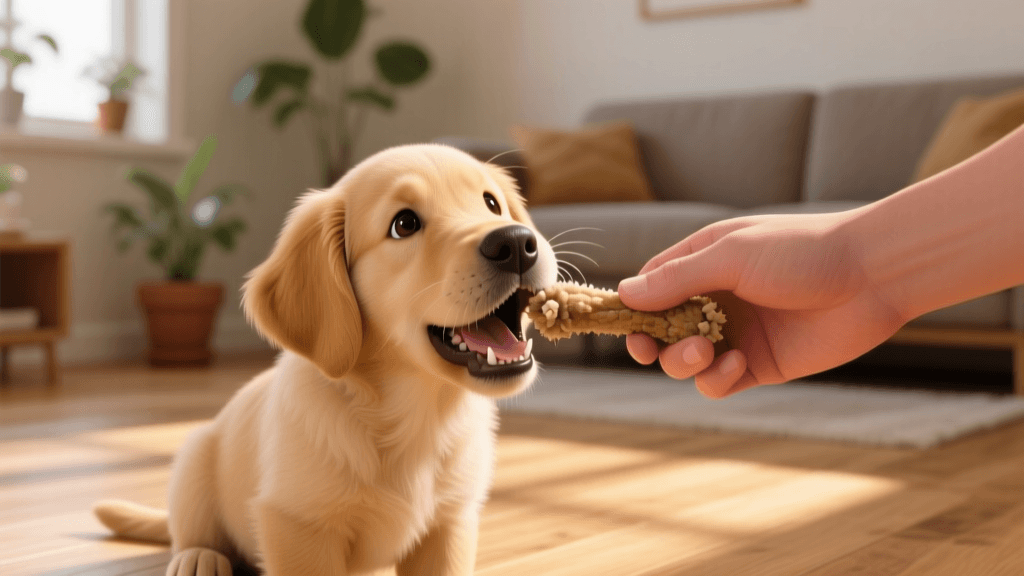
- High-Value Training Treats: Reserve a specific, ultra-tasty treat solely for potty success. Zuke's Mini Naturals (approx. $6 for 6oz) are low-calorie and soft, allowing for rapid consumption and immediate reward.
- Potty Bells: A door bell system like the Mighty Paw Smart Bell 2.0 (approx. $15) provides a clear, non-destructive way for your puppy to signal they need to go out.
The Daily Potty Training Schedule
A proactive schedule prevents accidents before they happen. Below is a sample daily blueprint for an 8-to-12-week-old puppy. Adjust the times to fit your household, but maintain the intervals.
| Time of Day | Action | Expected Outcome & Notes |
|---|---|---|
| 6:00 AM | Wake up, immediate carry outside | Urgent elimination. Do not let puppy walk; carry to prevent mid-floor accidents. |
| 6:30 AM | Breakfast & Water | Measure exactly 1/2 to 1 cup of kibble (breed dependent). Pick up water bowl 2 hours before bed. |
| 6:45 AM | Outside for Potty & Play | Puppies usually need to defecate 15-30 minutes after eating. |
| 7:30 AM | Crate Nap | Puppies need 18-20 hours of sleep. Crate enforces rest. |
| 9:30 AM | Outside for Potty | Immediate trip out upon waking from nap. |
| 12:00 PM | Lunch (if applicable) & Potty | Young puppies often require 3 meals a day. |
| 3:00 PM | Wake, Potty, Training Session | Keep training under 10 minutes to avoid overstimulation. |
| 6:00 PM | Dinner & Potty | Last meal of the day to allow digestion before sleep. |
| 8:00 PM | Water Bowl Removed | Prevents overnight bladder overload. |
| 10:00 PM | Final Potty & Bedtime | Boring, quiet trip outside. Straight into the crate. |
| 2:00 AM | Midnight Potty Break | Set an alarm. Keep lights low and interaction zero. |
The Step-by-Step Training Method
When you take your puppy outside, follow this exact protocol to build a strong neurological association between the outdoors and elimination.
1. Use the Umbilical Cord Method
When the puppy is not in the crate, they must be tethered to you via a 6-foot leash attached to your belt, or kept in a gated, puppy-proofed pen. The Humane Society of the United States emphasizes that unsupervised roaming is the primary cause of house-training regression. If you cannot watch them, they must be crated.
2. Establish a Verbal Cue
Choose a phrase like 'Go potty' or 'Do your business.' Say it in a calm, neutral tone exactly as the puppy begins to squat or lift a leg. Do not say it while they are sniffing around, or you will accidentally train them to eliminate on command indefinitely, which can be frustrating in bad weather.
3. The Two-Second Reward Rule
The moment the puppy finishes eliminating, praise them calmly and deliver a high-value treat within two seconds. If you wait until you walk back inside the house, you are rewarding them for walking through the door, not for going to the bathroom outside.
Pro Tip: Always attach the leash before opening the door to go outside. A puppy that darts out the door unsupervised can easily be spooked by a neighborhood noise, forget why they are outside, and then have an accident the moment they return indoors.
Troubleshooting Common Potty Training Issues
Submissive and Excitement Urination
If your puppy leaks small amounts of urine when you greet them or when they are reprimanded, this is not a potty training failure; it is a physiological response. Submissive urination is a canine appeasement gesture. To combat this, ignore the puppy for the first five minutes you walk through the door. Keep greetings low-key, avoid direct eye contact, and crouch sideways to appear less intimidating. Puppies typically outgrow this by 6 to 12 months of age as their confidence and bladder muscles mature.
The 'Puppy Regression' Phase
Around 4 to 6 months of age, many owners report that their previously perfect puppy suddenly starts having accidents indoors. This often coincides with teething, growth spurts, and the onset of adolescence. During this phase, revert to the strict 8-week-old schedule. Supervise them as if they are brand new to the house. According to veterinary behaviorists at VCA Animal Hospitals, consistency during regression phases is critical to prevent long-term habit formation. Do not punish the puppy; simply interrupt the behavior with a neutral 'Oops!' and immediately carry them outside to finish.
What to Do If You Catch Them in the Act
If you catch your puppy mid-squat indoors, do not yell, rub their nose in it, or hit them with a rolled-up newspaper. Punishment only teaches the puppy that eliminating in front of you is dangerous, which will result in them hiding behind sofas or under beds to do their business. Instead, clap your hands loudly once to startle them into stopping, scoop them up, and rush them outside. If they finish outside, throw a massive reward party.
Final Thoughts on Patience and Consistency
Potty training is not a linear process. There will be days of perfection followed by days of frustrating setbacks. Keep a potty journal on your refrigerator to track the times your puppy successfully eliminates. This data will help you identify their natural biological rhythms and adjust your schedule accordingly. Remember, you are teaching a young animal a complex set of rules in a foreign environment. With the structured handbook approach outlined above, enzymatic cleaners at the ready, and a pocket full of high-value treats, you and your puppy will conquer potty training together.
robin-maitland
All our authors care for dogs every day — read more of their work on the authors page.