Understanding Azawakh Behavior & Instincts in 2026
Discover the unique psychology, body language, and guarding instincts of the exotic Azawakh sighthound in our comprehensive 2026 breed guide.
The Azawakh: A Masterpiece of Sahelian Survival
As we navigate the diverse landscape of canine companionship in 2026, exotic and international breeds continue to capture the hearts of experienced dog owners seeking a deeper, more primal connection. Among the most fascinating of these is the Azawakh, a striking, long-legged sighthound originating from the harsh Sahel region of West Africa. To truly understand the Azawakh, one must look beyond their elegant, greyhound-like silhouette and delve into the primitive psychology that governs their behavior. Unlike many modern breeds that have been heavily selected for neoteny—the retention of juvenile, dependent traits—the Azawakh remains a remarkably intact, primitive working dog. Their behavior is a direct reflection of thousands of years of survival alongside the Tuareg nomads, where they served not merely as pets, but as vital protectors and providers.
The Dual Instinct: Coursing Hunter and Fierce Guardian
When most people think of sighthounds, they picture the docile, couch-potato temperament of a retired racing Greyhound or the gentle aloofness of a Whippet. The Azawakh shatters this stereotype. According to the American Kennel Club (AKC), the Azawakh possesses a unique dual instinct that is incredibly rare in the sighthound family: they are both elite coursing hunters and fierce territorial guardians.
In their native Mali and Niger, the Azawakh was tasked with chasing down gazelles and hares across unforgiving terrain, requiring explosive speed and immense prey drive. However, once the hunt was over, they returned to the nomadic camp to stand guard. This historical context explains why an Azawakh in a modern suburban home will often position themselves between their owner and an approaching stranger. They are not inherently aggressive without cause, but they possess a profound, instinctual suspicion of the unfamiliar. Understanding this guarding instinct is crucial; it is not a flaw to be trained away, but a deeply ingrained survival mechanism that requires respectful management and early, structured socialization.
Neurological Wiring: The Sighthound Visual Streak
To understand why your Azawakh reacts the way they do to environmental stimuli, you must understand their neurological hardware. Like all sighthounds, the Azawakh possesses a unique retinal structure known as the 'visual streak.' While humans and many brachycephalic (short-nosed) dogs have an 'area centralis'—a focal point of high-density ganglion cells for detailed central vision—sighthounds have a horizontal band of high-density cells stretching across the retina.
This evolutionary adaptation allows them to detect the slightest horizontal movement across a vast, panoramic horizon. In a 2026 urban or suburban environment, this means your Azawakh is neurologically hardwired to notice a squirrel darting up a tree three blocks away or a plastic bag blowing across a distant park. This intense visual reactivity is often mistaken for hyperactivity or poor focus, but it is actually the breed operating exactly as nature intended. Recognizing this visual streak helps owners understand that recall training in open, unfenced areas is a battle against millions of years of evolutionary biology.
Decoding Azawakh Body Language and Vocalizations
The Azawakh communicates through a subtle, highly expressive physical vocabulary that differs significantly from more demonstrative breeds like Golden Retrievers or German Shepherds. Because they are a primitive breed, their body language is closely tied to wolf-like pack dynamics and spatial awareness.
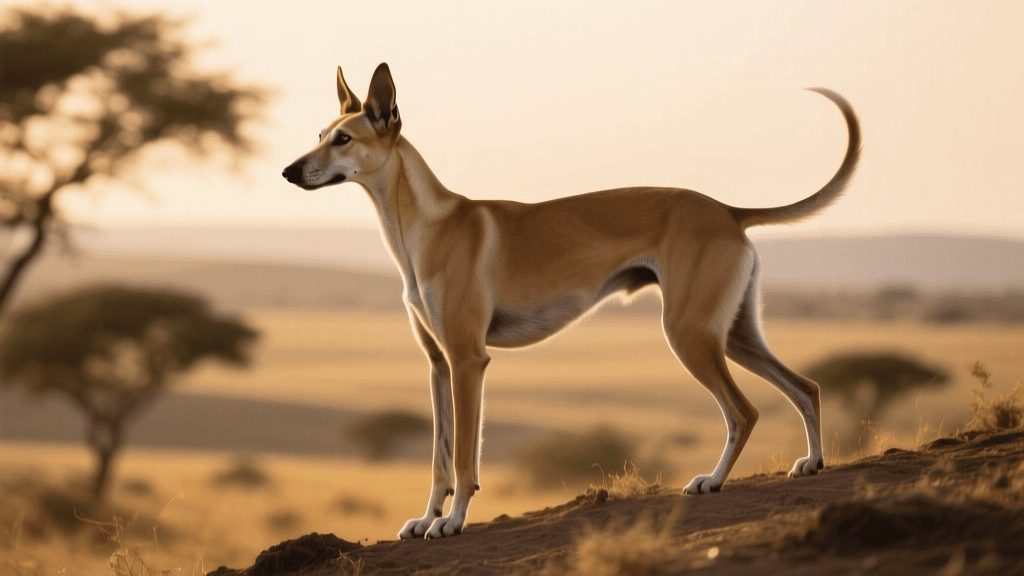
- Ear Carriage: In a relaxed state, the Azawakh's ears are dropped flat against the skull, often described as 'rose ears.' However, when their guarding instinct is triggered or they spot distant prey, the ears will rise slightly and pull back, creating an aerodynamic profile while signaling intense focus.
- Tail Posture: The tail is long, thin, and tapered. It is carried low with a slight upward curve at the tip when relaxed. When alert or moving, it may rise to a sickle shape over the back. A tightly tucked tail is a clear indicator of fear or submission, while a stiff, high tail signals territorial confidence.
- Vocalizations: The Azawakh is notably quiet in the home. They rarely bark without a profound reason. Instead of a standard bark, they utilize a deep, resonant bay or howl to alert their 'pack' to distant anomalies. This vocalization is designed to carry across the Sahara and can be startlingly loud in a modern residential neighborhood.
Comparative Sighthound Temperament Chart
To contextualize the Azawakh's unique psychological profile, it is helpful to compare them against other well-known sighthounds. The Fédération Cynologique Internationale (FCI) standard emphasizes the Azawakh's aloofness, which becomes evident when comparing breed traits:
| Breed | Primary Instinct | Guarding Tendency | Stranger Reaction | Pack Bonding Style |
|---|---|---|---|---|
| Azawakh | Hunter / Guardian | High | Aloof, Suspicious | Intense, 'Velcro' |
| Greyhound | Coursing Hunter | Very Low | Friendly, Indifferent | Affectionate, Independent |
| Saluki | Coursing Hunter | Low | Reserved, Polite | Loyal, Dignified |
| Whippet | Coursing Hunter | Low | Friendly, Playful | Highly Social, Clingy |
2026 Management: GPS Tech, Fencing, and Recall
Living with an Azawakh in 2026 requires leveraging modern technology to accommodate their ancient instincts. Because their prey drive can override years of obedience training in a fraction of a second, off-leash privileges should be strictly limited to fully enclosed, secure areas. If you are hiking in remote, legally permitted off-leash zones, a state-of-the-art GPS tracker is non-negotiable.
Leading the market in 2026 is the Fi Series 4 Smart Collar, which utilizes advanced LTE-M networks combined with satellite fallback tracking. Priced around $149 with an $8/month subscription, it offers real-time location pinging and an 'escape alert' that notifies you the moment your dog breaks a virtual geofence. Alternatively, the Tractive 6 offers multi-network roaming, which is ideal for owners who travel internationally with their exotic breeds.
Physical containment at home requires a minimum 6-foot privacy fence. Chain-link is highly discouraged, as the Azawakh's incredible agility and use of their dewclaws allow them to scale wire fences with ease. Furthermore, installing an underground L-footer wire barrier along the fence line is recommended to prevent digging, a behavior they may exhibit if they spot prey on the other side of the boundary.
Socialization: Respecting the Primitive Boundary
Socializing an Azawakh requires a paradigm shift. With modern breeds, the goal of socialization is often to create a dog that loves everyone. With a primitive guardian breed like the Azawakh, the goal is to create a dog that is neutral and safe around strangers, without forcing them into unnatural, overly gregarious interactions.
During the critical socialization window (3 to 14 weeks), expose your Azawakh puppy to a wide variety of surfaces, sounds, people, and environments. However, never force them to accept petting from strangers. Allow them to observe from a distance and reward them for calm, neutral behavior. By respecting their natural boundaries, you build a foundation of trust. An Azawakh that trusts its owner to manage the environment will be a confident, stable, and profoundly loyal companion, embodying the very best of their ancient Sahelian heritage in the modern world.
priya-sutaria
All our authors care for dogs every day — read more of their work on the authors page.