At-Home Canine Scent Work Training For Bonding And Calm In 2026
Discover how at-home canine scent work training reduces anxiety and builds trust. Explore 2026 gear, step-by-step guides, and mental health benefits.
The Neurology of the Sniff: How Olfactory Enrichment Heals
As we navigate the evolving landscape of veterinary behavioral science in 2026, one holistic wellness practice has moved from niche sport to mainstream therapeutic tool: canine scent work. While physical exercise is vital for a dog's cardiovascular health, mental stimulation through olfactory enrichment is the cornerstone of canine emotional wellbeing. A dog's olfactory system is a biological marvel, boasting up to 300 million scent receptors compared to our mere six million. But the benefits of sniffing go far beyond simple environmental processing.
When a dog engages in focused scent work, their heart rate actually decreases, and their brain releases a cascade of dopamine and endorphins. This neurological response acts as a natural anxiolytic, effectively lowering cortisol levels in stressed, reactive, or fearful dogs. By integrating structured scent games into your daily routine, you are not just entertaining your dog; you are actively regulating their nervous system and providing a profound sense of calm that physical walks alone cannot achieve.
Why Scent Work is the Ultimate Bonding Tool for 2026
Traditional obedience training often relies on a dynamic where the human commands and the dog complies. While valuable, this does not always foster deep, cooperative trust—especially in rescue dogs or dogs with a history of trauma. Scent work flips this dynamic entirely. In the scent work world, the dog is the expert. They possess the biological equipment to find the target, and the human's role is simply to facilitate, observe, and reward.
This cooperative partnership is a powerful relationship builder. When you watch your dog work a room, you learn to read their subtle body language: the flick of an ear, the change in breathing rhythm, the sudden stiffness of the tail. As you learn to trust your dog's nose and your dog learns to trust your reward timing, a profound mutual respect develops. According to the American Kennel Club's Scent Work guidelines, this sport is uniquely accessible because it allows the dog to work at their own pace, building confidence in a low-pressure environment that strengthens the human-animal bond exponentially.
Essential Scent Work Gear for the Modern Dog Owner
You do not need an expensive backyard setup to begin reaping the mental health benefits of nosework. The 2026 market offers incredible, space-saving enrichment tools designed specifically for at-home scent training.
- The Paw5 Wooly Snuffle Mat: For beginners, this handcrafted, machine-washable mat mimics the experience of foraging in tall grass. It is perfect for scattering high-value treats and encouraging the foundational 'search' drive without the complexity of essential oils.
- Nose It! Birch, Anise, and Clove Scent Kit: Once your dog masters food searches, transitioning to essential oils provides a more rigorous cognitive challenge. This kit includes pre-scented cotton swabs and training tins, adhering to official competition standards.
- Ziwi Peak Air-Dried Venison Treats: Scent work burns significant mental energy. Rewarding your dog with single-source, high-protein, low-glycemic treats ensures their digestive health remains stable while providing a high-value motivator that keeps them engaged in the search.
- Kong Wobbler or Snuffle Ball: For intermediate dogs, combining scent with physical manipulation keeps the brain engaged and prevents frustration during longer training sessions.
Reading Your Dog's Olfactory Body Language
To truly bond with your dog through scent work, you must learn to 'listen' to their nose. Dogs communicate their findings through distinct physical cues. Recognizing these cues allows you to reward them at the exact moment of discovery, which accelerates learning and builds immense trust.
- The Scent Cone Entry: When a dog catches the edge of a scent plume, you will often see a sudden head snap, a flare of the nostrils, and a change in pace. This is the 'alert' that they are in the game.
- Bracketing: As the dog moves closer to the source, they may move their head side to side, 'bracketing' the scent cone to find the highest concentration of odor.
- The Final Response: Whether trained to sit, down, or simply freeze and stare at the source, the final response is your cue to mark the behavior with a cheerful 'Yes!' and deliver the reward directly at the source of the scent.
Step-by-Step At-Home Scent Training Protocol
Follow this progressive protocol to introduce your dog to scent work, ensuring a frustration-free experience that prioritizes their mental health and your relationship.
Phase 1: The Scent Imprint
Begin in a quiet, low-distraction room. Place a single training tin containing a Birch-scented cotton swab on the floor. The moment your dog investigates the tin with their nose, mark the behavior with a clicker or a verbal 'Yes!' and deliver a high-value treat directly on top of the tin. Repeat this 10 to 15 times over a few short sessions. The goal is to teach the dog that the specific odor predicts a massive reward.
Phase 2: The Box Search
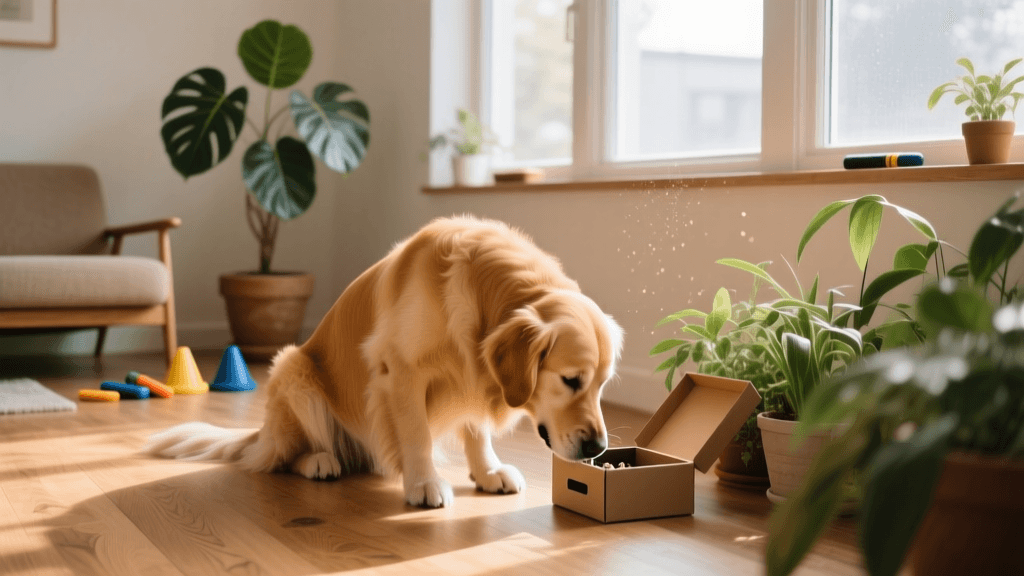
Set up three identical cardboard boxes in a line. Place the scented tin inside one box, leaving the others empty. Encourage your dog to search. When they find the correct box and indicate, reward heavily at the source. Rotate the position of the scented box to ensure the dog is using their nose, not memorizing a spatial pattern.
Phase 3: The Room Clear
Hide the scented tin at nose-level around a single room—behind a table leg, under a chair, or tucked against a baseboard. Release your dog with a cheerful 'Search!' cue. Follow them quietly, giving them space to work. When they find it, throw a 'reward party' with praise, play, and treats. This phase builds immense confidence as the dog learns to navigate complex environments using their natural abilities.
Comparison Chart: Scent Work Stages and Bonding Outcomes
Understanding the progression of scent work helps you tailor the difficulty to your dog's current mental health needs. The ASPCA's guidelines on canine enrichment emphasize that matching the challenge to the dog's skill level is critical for preventing learned helplessness and frustration.
| Training Stage | Setup Complexity | Mental Health Benefit | Bonding Outcome |
|---|---|---|---|
| Snuffle Mat Foraging | Low (Food only) | Reduces acute anxiety; promotes calm chewing and licking behaviors. | Establishes baseline trust through predictable, easy rewards. |
| Single Box Imprint | Low (Scent introduced) | Builds focus and dopamine response to specific olfactory targets. | Creates a shared language between human and dog via marker words. |
| Multiple Box Search | Medium (Discrimination) | Enhances cognitive flexibility and problem-solving stamina. | Deepens human observation skills and canine reliance on human timing. |
| Full Room Clear | High (Environmental) | Builds profound confidence in reactive dogs; exhausts excess nervous energy. | Forges a cooperative partnership where the dog leads and the human supports. |
Adapting Scent Work for Senior and Mobility-Impaired Dogs
One of the most beautiful aspects of scent work is its inclusivity. As dogs age, their vision and hearing may decline, and arthritis may limit their ability to engage in high-impact sports like agility or fetch. However, the olfactory system remains remarkably resilient well into a dog's senior years.
For senior dogs or those recovering from orthopedic surgery, scent work provides a vital lifeline to mental stimulation without risking physical injury. Keep all hides at nose-level or slightly below to prevent unnecessary neck strain or balancing challenges. Use softer, easily chewable treats like pureed meat in a lick tube or soaked kibble to accommodate aging teeth. By adapting the game to their physical limitations, you communicate to your senior dog that they are still valuable, capable, and deeply understood, which is the ultimate expression of the human-dog bond.
Nutritional Rewards and Post-Search Decompression
The cognitive load of a 15-minute scent work session is equivalent to a multi-mile run. After a successful session, it is crucial to help your dog decompress. Offer a long-lasting chew, such as a yak cheese stick or a stuffed, frozen rubber toy, in a quiet crate or pen. This post-search ritual allows their nervous system to down-regulate, processing the dopamine spike and transitioning into a state of deep, restorative rest. Pairing the mental exertion of scent work with appropriate nutritional recovery ensures your dog remains physically healthy and emotionally balanced, ready for your next cooperative adventure together.
tom-renshaw
All our authors care for dogs every day — read more of their work on the authors page.