Understanding Apartment Dog Barking: City Noise & Hallway Triggers
Discover why your apartment dog barks at hallway noises and city sirens. Learn the psychology behind urban noise reactivity and actionable training tips.
The Psychology of the Urban Canine: Why Apartments Amplify Stress
Living in an urban apartment offers incredible conveniences for pet owners, from nearby dog parks to walkable neighborhoods. However, the high-density nature of apartment living creates a unique psychological environment for dogs. To understand why your dog reacts to the city, you must first understand their sensory world. Dogs possess a hearing range of up to 65,000 Hz, compared to the human limit of roughly 20,000 Hz. This means your dog isn't just hearing the garbage truck outside; they are hearing the high-pitched squeal of its brake pads, the hum of the elevator shaft, and the muffled conversations of neighbors three floors down.
In a detached home, a dog has a yard to patrol and distance to buffer environmental stimuli. In an apartment, their territory is confined, and the boundaries are shared. Thin walls, echoing hallways, and close-proximity windows mean that a dog's territorial instincts and alarm systems are constantly being triggered by benign urban activity. Understanding the root cause of these behaviors is the first step toward helping your dog find peace in a concrete jungle.
Decoding the 'Hallway Guard' Behavior
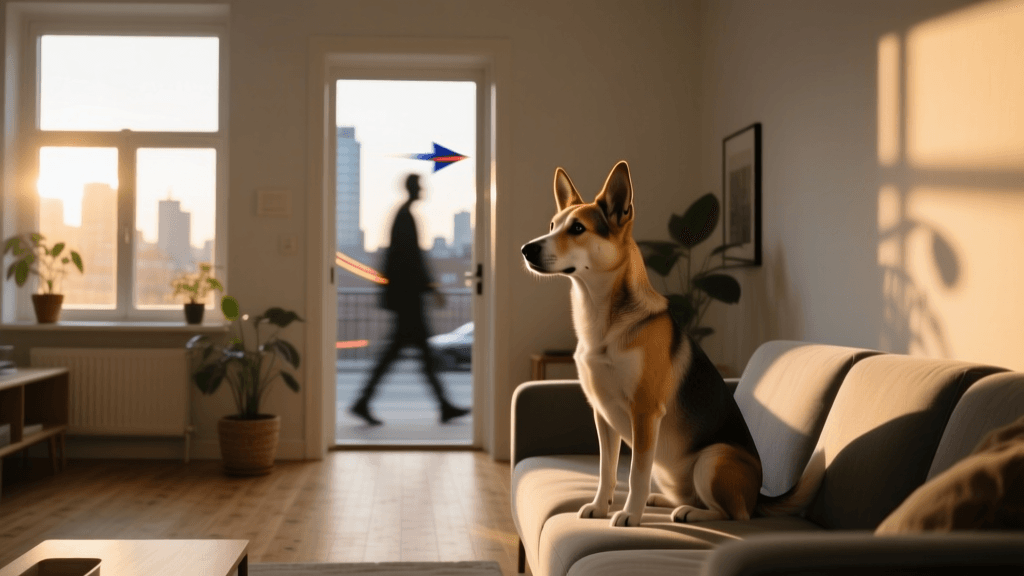
One of the most common complaints among apartment dwellers is the 'Hallway Guard' syndrome. Your dog is sleeping peacefully until a neighbor walks past your door, prompting a frantic bout of barking. From a behavioral psychology standpoint, this is rarely about genuine aggression. Instead, it is a mix of alarm barking and barrier frustration.
When a dog hears footsteps approach their door, their instinct is to alert their 'pack' (you) to a potential intruder. They bark to sound the alarm. Here is where the accidental reinforcement loop occurs: the neighbor continues walking down the hall and eventually disappears. From the dog's perspective, their barking successfully drove the intruder away. According to the ASPCA's guide on common dog behavior issues and barking, this negative reinforcement makes the behavior more likely to occur the next time footsteps approach. The dog learns that barking equals safety, making the hallway guard behavior deeply ingrained over time.
City Sirens and High-Frequency Triggers
Urban environments are filled with artificial noises that mimic canine communication or cause acoustic discomfort. Sirens, in particular, trigger a deep-seated instinctual response. When a dog howls at a police or ambulance siren, they are not necessarily in pain; they are responding to a frequency that mimics the long-distance howling of their ancestors. They are essentially 'answering' the siren to communicate with what they perceive as a distant pack member.
Conversely, the sharp, unpredictable sounds of construction work, dropping objects from upstairs neighbors, or slamming car doors can trigger genuine noise phobias. These sounds cause a spike in cortisol, leading to pacing, panting, and destructive behavior as the dog attempts to escape the confined space where the noise feels inescapable.
Trigger vs. Emotional State vs. Management Chart
To effectively manage your apartment dog's reactivity, you must correctly identify the emotion driving the behavior. Use the table below to decode your dog's triggers and apply the correct management strategy.
| Urban Trigger | Canine Emotional State | Observable Body Language | Management Strategy |
|---|---|---|---|
| Hallway Footsteps | Alarm / Barrier Frustration | Ears pinned forward, stiff posture, low growl, rushing the door | Acoustic masking near the door + 'Find It' treat scatter |
| City Sirens | Instinctual Communication / Arousal | Head tilted back, howling, pacing, ignoring commands | White noise, closed windows, redirect to a familiar trick |
| Doorbell / Knocking | Territoriality / High Arousal | Barking, spinning, jumping, scratching at the door | Desensitization to recorded sounds, place/mat training |
| Upstairs Thumping | Fear / Startle Response | Tucked tail, whale eye, hiding, trembling | Safe space creation, classical counter-conditioning |
Actionable Urban Management Strategies
Managing an apartment dog requires a combination of environmental modification and behavioral training. Here are specific, actionable steps you can take today, including product recommendations and exact measurements for optimal results.
1. Acoustic Masking at the Boundary
Do not place your white noise machine next to your dog's bed; place it at the source of the trigger. Purchase a LectroFan Classic White Noise Sound Machine (approximately $45). Place it on a console table or shelf exactly 3 to 5 feet from your apartment's entry door. Set it to a low-frequency 'brown noise' setting, which is far more effective at masking the muffled thud of footsteps and elevator dings than high-pitched white noise. Keep the volume at around 60 decibels—loud enough to blur the hallway sounds, but quiet enough that you can still hear your smoke detectors.
2. Visual Barriers for Window Reactivity
If your dog barks at pedestrians, other dogs, or city traffic from your window, you must remove the visual trigger. Avoid closing the blinds completely, as this plunges your apartment into darkness and can increase a dog's overall anxiety. Instead, apply 3M Privacy Window Film (approximately $20 per roll). Apply the film to the bottom two-thirds of the window glass. This allows natural sunlight to enter the top third of the room while completely blocking your dog's line of sight to the street below when they are standing or sitting on the floor.
3. The 'Find It' Scatter Protocol
When you hear footsteps approaching in the hallway, you have roughly 2 to 3 seconds before your dog begins to bark. Keep a jar of high-value, smelly treats (like freeze-dried minnows or small pieces of boiled chicken) near the door. The moment you hear the elevator ding or footsteps, cheerfully say 'Find it!' and scatter a handful of treats on a snuffle mat or a rug away from the door. Sniffing lowers a dog's heart rate and engages their parasympathetic nervous system. This interrupts the alarm-barking loop and replaces the emotional response from 'alert' to 'foraging'.
4. Systematic Desensitization to Door Knocks
According to the protocols outlined by the late, renowned veterinary behaviorist Dr. Sophia Yin on desensitization and counterconditioning, you must expose the dog to the trigger at a sub-threshold level. You can do this using your smartphone.
- Step 1: Record a friend knocking on your door, or download a knocking sound effect.
- Step 2: Sit with your dog in the living room. Play the sound at 5% volume—so quiet that your dog merely flicks an ear but does not bark.
- Step 3: Within 1.5 seconds of the sound playing, feed a high-value treat. The timing is critical; the treat must arrive immediately after the noise to build a classical association (Knock = Chicken).
- Step 4: Repeat this 10 times per session, twice a day. Over the course of two weeks, gradually increase the volume by 5% increments. If your dog barks, you have increased the volume too quickly. Drop it back down and proceed more slowly.
Burning Mental Energy in Small Spaces
A bored dog is a reactive dog. In a house with a yard, a dog can burn off excess energy by patrolling or playing fetch. In a 700-square-foot apartment, physical exercise is often not enough; you must provide mental enrichment to tire them out. A 15-minute session of scent work or puzzle-solving is cognitively equivalent to a 45-minute walk. Invest in a Snuffle Mat ($25) or a Kong Wobbler ($15) and feed your dog their daily kibble rations exclusively through these puzzles. A mentally fatigued dog is far less likely to care about the neighbor walking past the door.
When to Seek Professional Behavioral Help
While management and training can resolve most urban noise reactivity, some dogs suffer from severe noise phobias or separation anxiety that manifest when left alone in the apartment. If your dog exhibits chronic stress signals—such as excessive drooling, destructive chewing focused on door frames, self-mutilation, or refusal to eat when you are not home—it is time to consult a certified professional. Look for a Certified Applied Animal Behaviorist (CAAB) or a veterinary behaviorist who can work with you on a comprehensive behavior modification plan, which may include short-term anti-anxiety medications to help your dog's brain become receptive to training.
Understanding your apartment dog's behavior requires empathy for their sensory experience. By modifying your environment, utilizing strategic acoustic and visual barriers, and applying science-based counter-conditioning, you can transform your apartment from a stressful echo chamber into a peaceful sanctuary for both you and your canine companion.
beth-carrasco
All our authors care for dogs every day — read more of their work on the authors page.