Reading Agility Dog Stress Signals And Body Language 2026
Learn to read your dog's stress signals and body language in agility competitions. Expert tips for 2026 to keep your canine athlete happy and focused.
The Evolution of Canine Sports Psychology in 2026
Welcome to the 2026 agility season. Over the past few years, the sport of dog agility has evolved dramatically. Course builders are now designing faster, more complex sequences that require immense physical conditioning and split-second decision-making. However, as the physical demands of the sport have increased, so too has the necessity for handlers to deeply understand their dog's psychological state. According to the American Kennel Club, a successful agility dog must be both physically sound and mentally confident. Yet, many handlers struggle to differentiate between a dog that is 'in drive' and a dog that is quietly suffering from over-arousal or environmental stress.
Understanding your dog's body language is not just about preventing missed contacts or knocked bars; it is about safeguarding your dog's mental health. Canine sports psychology has become a cornerstone of competitive training in 2026. Handlers who can read micro-expressions, subtle shifts in weight, and changes in respiratory patterns are the ones who not only win ribbons but also maintain a lifelong, joyful partnership with their dogs. This guide will break down the physiological and behavioral indicators of stress in agility dogs, providing you with actionable strategies to manage arousal levels and create a sustainable competition routine.
The Physiology of the Agility Dog: Arousal vs. Distress
To understand stress signals, we must first look at the Yerkes-Dodson law, which dictates that performance increases with physiological or mental arousal, but only up to a certain point. When arousal levels become too high, performance decreases, and stress behaviors emerge. In the context of agility, a dog's heart rate can spike from a resting 80 beats per minute to over 160 beats per minute while waiting on the start line. This surge of adrenaline and cortisol prepares the dog's muscles for explosive speed, but it also impairs cognitive function.
When a dog crosses the threshold from optimal arousal into distress, their brain shifts from the prefrontal cortex (responsible for learning and decision-making) to the amygdala (responsible for fight-or-flight survival responses). A dog in this state cannot process complex handling cues. They may blow past tunnel entrances, fail to collect for tight jumps, or exhibit avoidance behaviors. Recognizing the exact moment your dog tips from 'eager' to 'overwhelmed' is the most critical skill a modern handler can develop.
Decoding Start Line Body Language
The start line is the crucible of agility. It is where the dog's emotional state is most visible, yet it is also where handlers are most prone to misinterpreting signals. Many handlers mistake stress-induced displacement behaviors for 'naughtiness' or 'stubbornness.' Experts at Fear Free Pets emphasize that behaviors like yawning, scratching, or sniffing the ground in a high-stakes environment are rarely signs of boredom; they are classic calming signals and indicators of internal conflict.
Below is a comprehensive breakdown of how to differentiate between high drive and distress on the start line, along with the immediate actions you should take to support your dog.
| Signal | High Drive (Optimal) | Distress (Over-Arousal) | Handler Action |
|---|---|---|---|
| Panting | Deep, rhythmic breaths, mouth relaxed | Shallow, rapid breaths, 'spatula' tongue, tight commissures | Interrupt the routine, reward calm, reset further from the first jump |
| Tail Carriage | Level with spine, relaxed, fluid wag | Tucked tightly, or stiffly flagging high and rigid | Lower criteria, play a gentle engagement game to loosen the spine |
| Eye Contact | Soft focus, checking in with handler | Whale eye (sclera showing), hard staring, dilated pupils | Break line of sight, toss a treat away to reset the dog's neck and focus |
| Vocalization | Occasional, eager, mid-pitch bark | High-pitched, continuous screaming or frantic whining | Remove from the ring immediately, initiate mat work and decompression |
| Posture | Weight shifted forward, muscles engaged but bouncy | Weight shifted back, trembling, 'whale eye' while holding a sit | Release the stay, reward movement, and rebuild start-line confidence |
Mid-Course Communication and Avoidance Behaviors
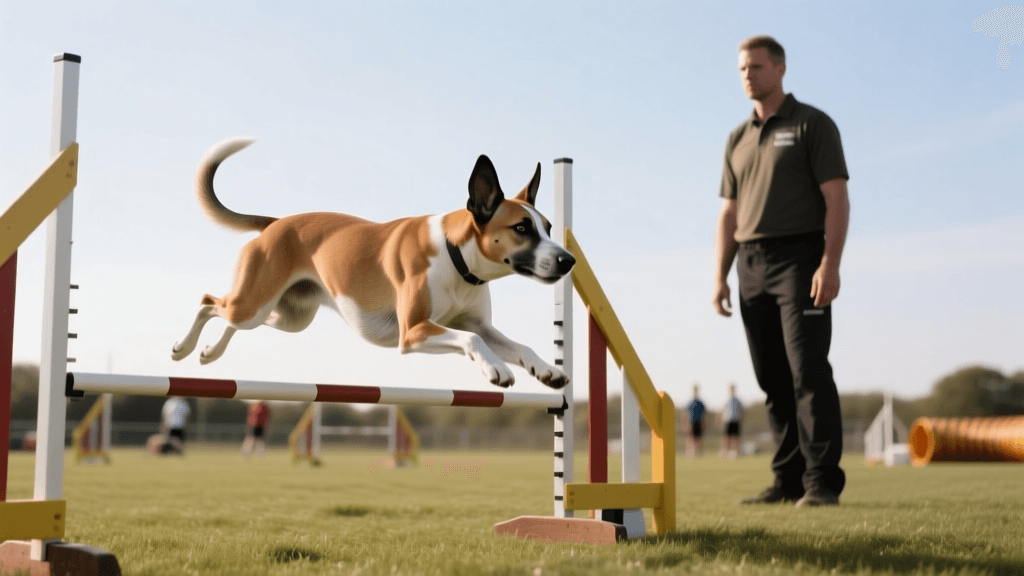
Once the dog is released, their body language continues to tell a story. A confident, happy agility dog moves with a fluid, ground-covering stride. Their ears are typically forward or relaxed, and their mouth is open in a soft 'smile.' However, when a dog is experiencing mid-course stress, their biomechanics change. You may notice 'paddling' (short, choppy strides), a lowered head, or a sudden aversion to specific obstacles.
Weave pole avoidance is one of the most common indicators of mid-course stress. If a dog repeatedly pops out of the weaves at the 8th or 10th pole, they are rarely doing it out of spite. The weaves require intense spinal flexion and extension. A dog that is physically fatigued or mentally overwhelmed will seek to escape the pressure of the obstacle. Similarly, if your dog begins to sniff the base of the A-frame or scratch at the turf near the dog walk, they are exhibiting displacement behaviors. They are essentially saying, 'The pressure is too high, and I need to self-soothe.'
When you see these signals, the American Veterinary Medical Association advises against correcting the dog. Punishing a stress response only compounds the anxiety, creating a negative association with the obstacle and the sport as a whole. Instead, simplify the course, reward the dog for offering any engagement, and end the session on a positive, low-pressure note.
Environmental Stressors in Modern 2026 Venues
The competition environment in 2026 is a sensory overload. Modern indoor arenas utilize high-lumen LED lighting, which can cause glare and visual confusion for dogs, particularly those with merle coats or light-colored eyes, who are more prone to photophobia. Furthermore, the widespread adoption of synthetic K9 Grass and rubberized flooring provides excellent traction but can create static electricity and unfamiliar acoustic feedback when a dog's nails strike the surface.
Crowd noise, the sound of electronic timers, and the presence of other high-arousal dogs can push a sensitive canine athlete past their stress threshold. To mitigate this, top competitors are now utilizing 'sensory buffering' techniques. This includes acclimating dogs to white noise machines at home, practicing under varying lighting conditions, and using calming pheromone sprays (like Adaptil) on their crate bedding and the handler's clothing to provide a familiar, soothing olfactory anchor amidst the chaos of the trial grounds.
Actionable Decompression Protocols and Gear
Managing stress is not just about what happens in the ring; it is about how you help your dog recover afterward. A robust decompression protocol is mandatory for any dog competing in agility. After a run, your dog's cortisol levels remain elevated for up to 48 hours. Active decompression helps accelerate the return to a parasympathetic (rest and digest) state.
Here is a structured, actionable decompression kit and protocol for the 2026 competitor:
- Long-Line Sniffaris (Cost: $25 - $45): Use a 15-to-20-foot Biothane long line attached to a well-fitted Y-front harness (such as the Perfect Fit Harness or Hurtta Trail Master). Biothane is ideal because it does not absorb water or dirt from the trial grounds. Take your dog to a quiet, grassy area away from the crating area and allow them to sniff uninterrupted for 15 minutes. Sniffing naturally lowers a dog's heart rate and encourages mental relaxation.
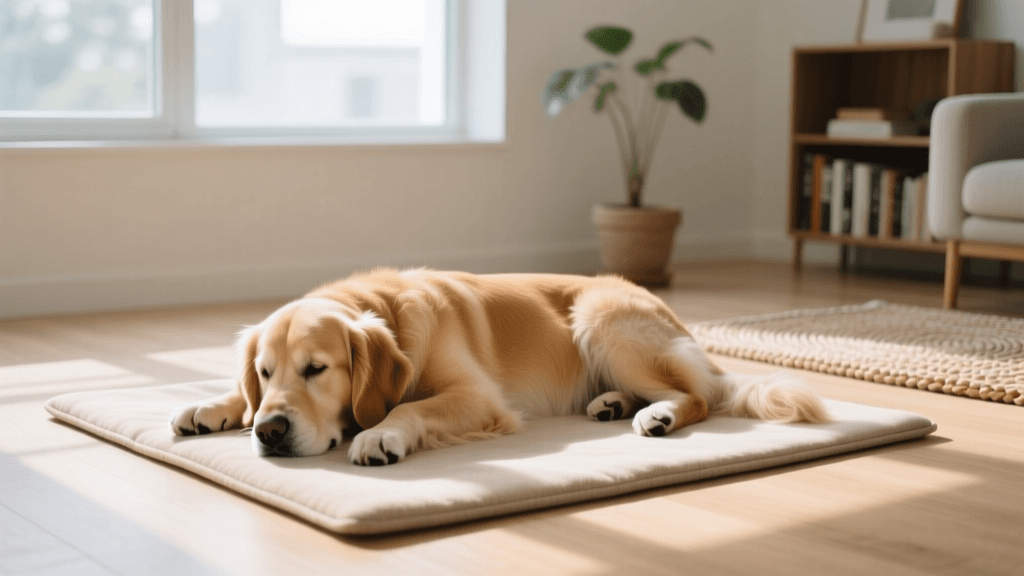
- Licking and Chewing (Cost: $15 - $30): Licking releases endorphins in the canine brain. Pack a silicone lick mat (like the Hyper Pet IQ Pad) and spread it with dog-safe peanut butter or plain Greek yogurt. Freeze it the night before the trial. Giving this to your dog in their crate after a run provides a soothing, repetitive activity that actively reduces anxiety.
- Canine Massage and TTouch (Cost: Free to $50 for tools): Learn basic Tellington TTouch techniques. Using gentle, circular motions with the pads of your fingers along your dog's back and the base of their tail can help release muscle fascia tension caused by the physical exertion of jumping and turning.
- Crate Covering (Cost: $30 - $60): Invest in a breathable, dark crate cover. Creating a 'cave' environment blocks out the visual stimulation of other dogs running and helps your dog feel secure enough to achieve deep REM sleep between runs.
Knowing When to Pivot
Ultimately, the greatest testament to your understanding of your dog is the willingness to change plans. If your dog consistently displays distress signals despite your best training, environmental management, and decompression efforts, it may be time to pivot. Not every dog enjoys the high-pressure environment of agility, even if they love the training aspects. Transitioning to lower-stress sports like scent work, trick dogging, or competitive obedience can preserve your dog's love for working with you while respecting their psychological boundaries. In 2026, the mark of a truly elite handler is not just the speed of their dog, but the depth of their empathy and the clarity of their communication.
tom-renshaw
All our authors care for dogs every day — read more of their work on the authors page.