Adaptil Calm Collar Doorbell Reactivity Protocol (2026)
Master doorbell reactivity in 2026 using the Adaptil Calm Collar and our step-by-step desensitization protocol for anxious dogs. Expert-backed guide.
The Psychology Behind Doorbell Reactivity
For many dog owners, the sound of the doorbell is an immediate trigger for chaos. Barking, lunging, and frantic pacing are common manifestations of what behavioral specialists classify as doorbell reactivity. As we navigate canine behavioral science in 2026, we understand that this reactivity is rarely about 'stubbornness' or a desire to dominate. Instead, it is a profound expression of emotional dysregulation, rooted in a combination of territorial instinct, barrier frustration, and classical conditioning.
When a dog hears the doorbell, their brain immediately anticipates a high-arousal event: a stranger entering their territory. For an anxious or reactive dog, this anticipation triggers an 'amygdala hijack,' flooding their system with cortisol and adrenaline. In this heightened state of fight-or-flight, the dog is neurologically incapable of learning or responding to basic obedience cues. To effectively manage this, we must lower the dog's baseline anxiety while systematically changing their emotional response to the trigger.
How the Adaptil Calm Collar Supports Behavioral Modification
The Adaptil Calm Collar is a cornerstone tool in modern anxiety management. It works by releasing Dog Appeasing Pheromone (DAP), a synthetic replica of the comforting pheromones produced by a mother dog while nursing her puppies. According to the American Veterinary Medical Association (AVMA), pheromone therapy can be a highly effective adjunct to behavioral modification when used correctly.
In 2026, veterinary behaviorists emphasize that the Adaptil Calm Collar is not a 'magic cure' that will instantly stop a dog from barking. Rather, it is a foundational tool designed to lower the dog's baseline stress levels, making them more receptive to learning. By providing a continuous, subtle olfactory signal of safety, the collar helps keep the dog under their reactivity threshold, which is absolutely critical for the desensitization protocol outlined below.
The 2026 Systematic Desensitization Protocol
Combining the calming effects of the Adaptil Calm Collar with a structured desensitization and counter-conditioning (DS/CC) protocol is the gold standard for treating doorbell reactivity. This process requires patience, high-value rewards, and strict adherence to sub-threshold exposure.
Phase 1: Sub-Threshold Audio Exposure
The first step is to separate the sound of the doorbell from the visual trigger of a stranger entering. Using a smartphone or smart home speaker, play a recording of your specific doorbell chime at an extremely low volume—start at just 10% to 20% of the normal volume.
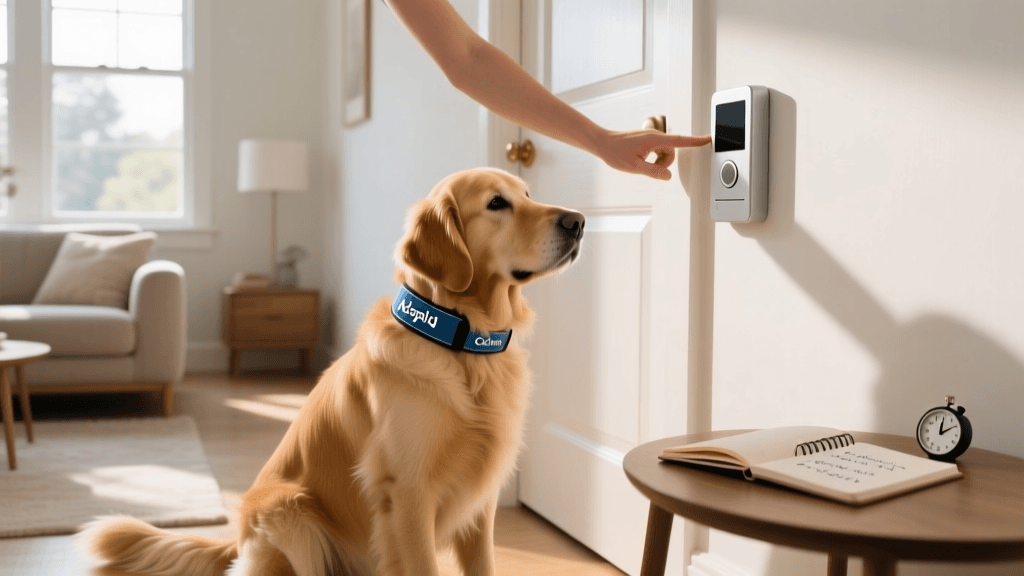
- The Setup: Have your dog on a leash or in a relaxed state in the living room, wearing their Adaptil Calm Collar.
- The Trigger: Play the low-volume doorbell sound.
- The Response: The moment the sound plays, immediately begin feeding high-value treats (such as freeze-dried beef liver or boiled chicken) for 3 to 5 seconds.
- The Goal: You want the dog to hear the sound and immediately look at you, anticipating a treat, rather than looking at the door. If the dog barks or shows signs of stress, the volume is too high. Drop the volume further and try again.
Phase 2: Spatial Desensitization and the 'Place' Command
Once your dog can hear the doorbell at full volume from your phone without reacting, you must introduce the spatial element of the trigger. The ASPCA Dog Behavior Resources strongly recommend teaching an incompatible behavior, such as going to a designated mat or bed, to replace the frantic rushing to the door.
- Train your dog to go to a 'Place' (a raised cot or specific mat) located at least 15 feet away from the front door.
- Play the doorbell sound from your phone while standing near the front door.
- Cue your dog to go to their 'Place' and reward heavily for staying there.
- Gradually increase the realism by having a family member walk up the exterior driveway while you play the sound and reward the dog for remaining on their mat.
Phase 3: Counter-Conditioning the Real Trigger
The final phase involves real-world application. Have a trusted friend or neighbor act as the 'visitor.' The visitor must be instructed to ignore the dog completely upon entering. When the real doorbell rings, cue your dog to their 'Place.' As soon as they settle, begin a continuous stream of low-calorie, high-value treats. If the dog breaks the 'Place' command or begins to bark, calmly reset them without punishment, indicating that the threshold was exceeded and the training session needs to be scaled back.
Comparing 2026 Anxiety Management Tools
While the Adaptil Calm Collar is excellent for continuous baseline support, many owners utilize a multi-modal approach. Below is a comparison of top-tier anxiety management tools available in 2026 to support your reactive dog.
| Tool | Mechanism of Action | Est. 2026 Cost | Best Use Case |
|---|---|---|---|
| Adaptil Calm Collar | Continuous synthetic pheromone release | $45 - $55 | Lowering baseline anxiety for training |
| ThunderShirt Classic | Gentle, constant swaddling pressure | $40 - $50 | Acute stress events (storms, travel) |
| Lickimat Soother | Endorphin release via repetitive licking | $12 - $15 | Pre-trigger distraction and settling |
| Snuffle Mat | Olfactory enrichment and foraging | $20 - $30 | Cognitive fatigue before guest arrival |
| Zesty Paws Calming Bites | Active ingredients like L-Theanine & Ashwagandha | $28 - $35 | Situational anxiety (administer 45 mins prior) |
Common Mistakes to Avoid
Even with the best tools and protocols, owners often inadvertently sabotage their progress. Avoid these critical errors:
- Flooding: This occurs when you force the dog to face the trigger at full intensity (e.g., forcing them to sit by the open door while a stranger pets them) hoping they will 'get used to it.' Flooding causes trauma and will severely worsen reactivity.
- Punishing the Growl: A growl is a vital communication tool indicating that your dog is uncomfortable. According to the American Kennel Club (AKC), punishing warning signs suppresses the growl but does not remove the underlying anxiety, potentially leading to a dog that bites without warning.
- Inconsistent Thresholds: Pushing the training too fast. If your dog fails three times in a row, the criteria are too high. Take a step back to the last successful phase.
When to Consult a Veterinary Behaviorist
While the Adaptil Calm Collar and systematic desensitization are highly effective for mild to moderate reactivity, severe cases may require professional intervention. If your dog exhibits self-injurious behavior, redirects aggression onto household members, or refuses to eat high-value treats even in a quiet environment, it is time to consult a board-certified veterinary behaviorist. In 2026, the integration of short-term anti-anxiety medications (such as fluoxetine or trazodone) alongside behavioral modification is widely recognized as the most humane and effective approach for severe cases, allowing the dog's brain to become chemically balanced enough to learn new coping mechanisms.
Conclusion
Managing doorbell reactivity is a marathon, not a sprint. By utilizing the Adaptil Calm Collar to establish a foundation of calm, and meticulously following a sub-threshold desensitization protocol, you can rewrite your dog's emotional response to the doorbell. Remember that every dog learns at their own pace. Celebrate the micro-victories—a moment of eye contact, a relaxed tail, or a quiet pause—and trust the science of behavioral modification to guide you toward a more peaceful home.
priya-sutaria
All our authors care for dogs every day — read more of their work on the authors page.