What Causes Zoomies in a Dog? Understanding FRAPs and
Discover what causes zoomies in a dog, when frantic running is normal versus concerning, and step-by-step strategies to manage this explosive energy safely.

What Exactly Are Dog Zoomies? Defining FRAPs
Zoomies — technically called Frenetic Random Activity Periods (FRAPs) — are sudden, explosive bursts of energy where a dog runs wildly, often in circles or figure-eights, with a seemingly manic expression. If you've ever watched your dog tear across the yard at full speed for no apparent reason, you've witnessed a FRAP.
- Duration: Typically 30 seconds to 5 minutes per episode
- Frequency: Normal range is 1–3 episodes per day, often clustered around specific triggers
- Physical markers: Tucked hindquarters, lowered head, wide eyes, open mouth, rapid directional changes
- Threshold for concern: Episodes lasting longer than 10 minutes, occurring more than 8–10 times daily, or accompanied by signs of distress (whining, panting excessively, inability to settle afterward)
According to the American Kennel Club, zoomies are a normal canine behavior seen across all breeds and ages. Puppies and young dogs experience them most frequently, but senior dogs can have them too. The key distinction for owners is understanding the difference between healthy energy release and a symptom of an underlying issue.
Why Does My Dog Get Zoomies? Root Cause Analysis
Zoomies are not random — they follow predictable patterns once you know what to look for. Here are the five primary triggers identified by veterinary behaviorists:
1. Pent-Up Energy Release (Most Common — ~60% of cases)
Dogs that don't receive adequate physical exercise or mental stimulation accumulate energy that discharges in sudden bursts. This is especially common in high-drive breeds like Border Collies, Belgian Malinois, and Australian Shepherds. A dog needing 90+ minutes of daily activity but receiving only 30 minutes is a prime candidate for evening zoomies.
2. Post-Stress Decompression (~20% of cases)
After a stressful event — a bath, a vet visit, a nail trim, or even an intense training session — dogs often release built-up cortisol and adrenaline through frantic running. This is the canine equivalent of shaking off tension. You'll commonly see this within 5–15 minutes after the stressor ends.
3. Excitement and Overstimulation (~10% of cases)
Arriving home, having guests over, or anticipating a walk can trigger zoomies. The dog's nervous system becomes overloaded with positive arousal and discharges it physically. This is particularly common in dogs under 2 years old whose impulse control is still developing.
4. Discomfort or Pain Response (~5–8% of cases)
Less commonly, zoomies can signal physical discomfort. Dogs with flea bites, skin allergies, anal gland impaction, or even early-stage arthritis may run as a response to sudden pain or itching sensations. These zoomies often appear erratic rather than joyful — the dog may stop suddenly, bite at its flank, or seem unable to get comfortable.
5. Compulsive Behavior Pattern (~2–3% of cases)
In rare cases, repetitive zoomies can develop into a compulsive disorder, particularly in dogs with anxiety or those kept in chronically under-stimulating environments. Compulsive FRAPs look different: the dog seems unable to stop, doesn't respond to redirection, and the behavior interferes with eating, sleeping, or social interaction.
Medical Rule-Out: When to See a Vet Before Training
Before implementing any behavior modification plan, it's critical to rule out medical causes. Approximately 5–10% of behavior concerns presented to veterinary behaviorists have an underlying medical component, according to data from the Merck Veterinary Manual.
| Red Flag Symptom | Possible Medical Cause | Diagnostic Test |
|---|---|---|
| Zoomies accompanied by biting at skin or flanks | Flea allergy dermatitis, skin infection, neuropathic pain | Skin scrape, allergy panel |
| Sudden onset in a previously calm adult dog | Hyperthyroidism (rare in dogs), Cushing's disease, neurological issues | Full blood panel, thyroid panel |
| Zoomies followed by disorientation or confusion | Partial seizures, vestibular disease, cognitive dysfunction (seniors) | Neurological exam, MRI if indicated |
| Scooting or biting at rear before zoomies | Anal gland impaction or infection | Physical exam, anal gland expression |
| Zoomies occurring 8+ times daily with inability to settle | Anxiety disorder, compulsive disorder, chronic pain | Behavioral assessment, pain screening |
Always consult your veterinarian before starting a behavior modification program. A thorough physical exam (typically $80–$180 depending on your region) can rule out medical causes and save you weeks of ineffective training.
Is It Normal for Dogs to Get Zoomies?
Yes — zoomies are entirely normal for the vast majority of dogs. They are a species-typical behavior observed in canids worldwide, from domestic dogs to wolves and coyotes. Puppies experience FRAPs most frequently because their nervous systems are still developing impulse control, and they accumulate energy rapidly during sleep-rest cycles.
Breed plays a role in frequency and intensity. Working and herding breeds — think Siberian Huskies, German Shepherds, and Jack Russell Terriers — tend to have more dramatic zoomies because they were selectively bred for sustained high-energy output. Brachycephalic breeds like Bulldogs and Pugs may have shorter, less intense episodes due to their respiratory limitations.
The behavior typically peaks between 6 months and 3 years of age, then gradually decreases as dogs mature. Many owners report a significant reduction in zoomies after their dog reaches full social maturity around age 3–4, though individual variation is substantial.
Immediate Management: How to Keep Your Dog Safe During Zoomies
You cannot — and should not try to — stop a zoomie once it starts. Attempting to physically restrain a dog mid-FRAP can result in redirected bites or injuries to both you and the dog. Instead, focus on environmental management:
- Clear the space: Move breakable objects, close doors to rooms with sharp furniture corners, and block access to stairs if your dog is prone to slipping on hardwood floors.
- Do not chase: Chasing reinforces the behavior by turning it into a game. Instead, stand still or sit down. Many dogs will circle back and stop on their own within 1–3 minutes.
- Use a calm verbal cue: A low, steady "that's enough" or "settle" (if previously trained) can help. Avoid high-pitched excitement, which will intensify the episode.
- Redirect after deceleration: Once your dog begins to slow, offer a sniffing activity — scatter treats on the ground or present a snuffle mat. Sniffing activates the parasympathetic nervous system and accelerates calming.
- Post-zoomie decompression: Offer a long-lasting chew (bully stick, yak cheese chew) or a frozen Kong stuffed with peanut butter. Chewing releases endorphins and helps the dog transition to rest.
Step-by-Step Training Protocol: Reducing Zoomie Frequency and Intensity
While you don't need to eliminate zoomies entirely, you can reduce their frequency, manage their timing, and teach your dog to channel that energy more appropriately. This protocol uses positive reinforcement, desensitization, and counter-conditioning — methods supported by the American Veterinary Society of Animal Behavior.
Phase 1: Build a Foundation (Weeks 1–3)
Step 1 — Audit your dog's exercise routine. Most zoomie-prone dogs are under-exercised relative to their breed's needs. Use this baseline:
| Dog Type | Minimum Daily Physical Exercise | Minimum Daily Mental Stimulation |
|---|---|---|
| Toy breeds (under 15 lb / 7 kg) | 30–45 minutes | 15–20 minutes |
| Small breeds (15–30 lb / 7–14 kg) | 45–60 minutes | 20–30 minutes |
| Medium breeds (30–60 lb / 14–27 kg) | 60–90 minutes | 30–45 minutes |
| Large working/herding breeds (60+ lb / 27+ kg) | 90–120 minutes | 45–60 minutes |
Step 2 — Identify trigger patterns. Keep a 7-day zoomie log. Note the time, what happened in the preceding 30 minutes, duration of the episode, and your dog's behavior afterward. Most owners discover 2–3 consistent triggers within the first week.
Step 3 — Teach "settle" on a mat. This is your primary counter-conditioning tool. Using a specific mat or bed, reward your dog for lying down calmly with high-value treats (freeze-dried liver, boiled chicken). Start with 3-second durations and build to 5 minutes over 2–3 weeks. This gives your dog an incompatible behavior to perform when they feel energy building.
Phase 2: Trigger Management and Redirection (Weeks 4–8)
Step 4 — Preempt known triggers. If your dog gets zoomies after baths, schedule a 15-minute structured play session (tug, fetch) before the bath to lower baseline arousal. If zoomies happen when you come home, enter calmly, ignore the dog for 2–3 minutes, then greet quietly once all four paws are on the floor.
Step 5 — Install an "energy redirect" cue. Teach your dog that when they feel the urge to run, they can grab a specific toy instead. Designate one high-value toy (a flirt pole or tug toy works well) that only comes out during predicted zoomie windows. When you see early signs — the play bow, the wide eyes, the first tentative sprint — redirect to the toy for 3–5 minutes of structured play, then transition to the settle mat.
Step 6 — Increase sniffing and foraging. Sniffing is one of the most effective natural calming activities for dogs. Replace one daily walk with a "sniffari" — a slow, leash-guided walk where the dog chooses the pace and direction, focused entirely on scent investigation. Research shows that sniffing lowers a dog's heart rate more effectively than physical exercise alone.
Phase 3: Maintenance and Generalization (Weeks 9–16)
Step 7 — Proof the settle behavior. Practice the mat-settle in increasingly distracting environments: with the TV on, with guests present, after a play session. Gradually reduce treat frequency from continuous to intermittent reinforcement (every 3rd or 5th successful settle).
Step 8 — Build a predictable daily rhythm. Dogs thrive on routine. Structure your dog's day with predictable blocks: exercise → meal → mental work → rest → exercise. Predictable rest periods teach the dog's nervous system to down-regulate naturally rather than crashing through zoomies.
Tools That Help vs. Tools to Avoid
| Category | Recommended Tools | Price Range (2026) | Tools to Avoid |
|---|---|---|---|
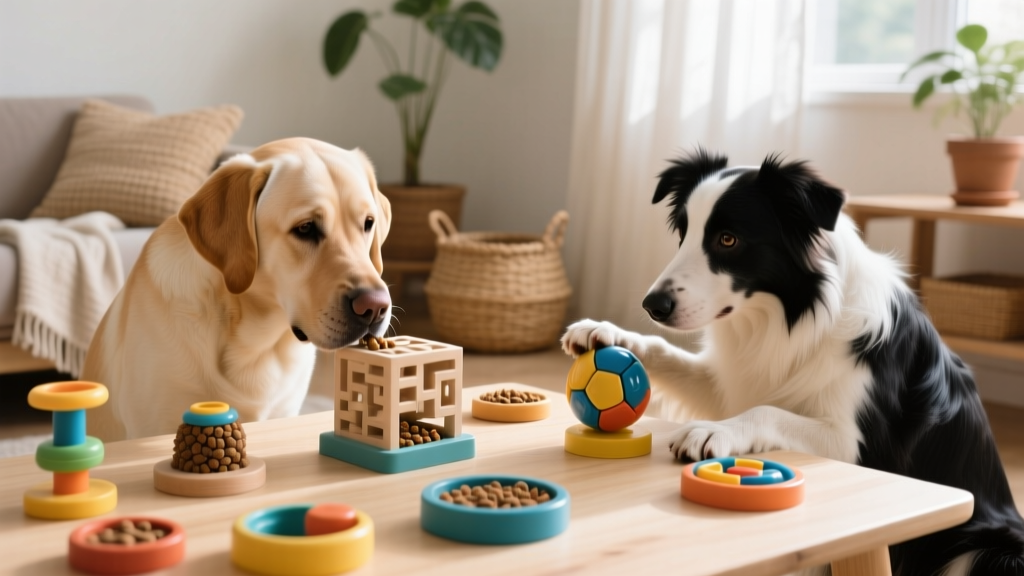
| Mental Stimulation | Kong Classic (red or black), Outward Hound Nina Ottosson Dog Brick puzzle, snuffle mats, Kibble Nibble treat ball | $8–$35 | Puzzle toys with small detachable parts for power chewers |
| Calming Aids | Adaptil Calm diffuser (pheromone-based), ThunderShirt compression vest, classical music playlists (Through a Dog's Ear) | $15–$65 | Essential oil diffusers (many oils are toxic to dogs), unregulated calming supplements without veterinary guidance |
| Physical Exercise | Flirt poles (Squishy Dog brand), iFetch ball launchers, long lines (15–30 ft / 5–9 m) for safe off-leash play, backpacks for weight-bearing walks | $15–$150 | Laser pointers (can trigger obsessive light-chasing behavior in predisposed dogs) |
| Training Equipment | Front-clip harness (Ruffwear Front Range, Kurgo Tru-Fit), treat pouch, clicker, settle mat with non-slip backing | $10–$60 | Shock collars, prong collars, choke chains, alpha rolls — these increase anxiety and can worsen zoomies |
A critical note on aversive tools: using punishment to suppress zoomies is both ineffective and potentially harmful. Shock collars and physical corrections can create fear-based associations that manifest as increased anxiety, redirected aggression, or new compulsive behaviors. The AVSAB explicitly recommends against aversive methods for all behavior modification.
Realistic Progress Timeline: How Long Does It Take?
| Timeframe | Expected Milestone | What You'll See |
|---|---|---|
| Week 1–2 | Pattern identification | You can predict when zoomies will occur with ~70% accuracy based on your log |
| Week 3–4 | Foundation behaviors installed | Dog responds to settle mat cue 60–80% of the time in low-distraction settings |
| Week 5–8 | Reduced frequency | 25–40% reduction in zoomie episodes; shorter duration when they do occur |
| Week 9–12 | Trigger management working | Predicted zoomie windows are successfully redirected 50–70% of the time |
| Week 12–16 | Generalized calm | Dog self-regulates more effectively; zoomies become occasional rather than daily events for most dogs |
| Ongoing | Maintenance | Occasional zoomies continue (they're normal!) but are manageable and safe |
Note: These timelines assume consistent daily implementation. Dogs with anxiety-based or compulsive zoomies may require 6–12 months of work, often with professional support.
How Do I Stop My Dog From Getting Zoomies?
The honest answer is that you shouldn't try to eliminate zoomies completely — they serve a legitimate physiological function. Instead, the goal is management: reducing frequency, ensuring safety, and giving your dog appropriate outlets so the energy doesn't build to explosive levels.
The three most effective strategies, based on veterinary behaviorist recommendations:
- Meet the exercise minimum for your dog's size and breed category (see the table above). Under-exercised dogs will find their own outlet, and that outlet is usually zoomies or destructive behavior.
- Provide daily mental stimulation. A 20-minute puzzle feeder session or training practice tires a dog's brain as much as a 45-minute walk tires their body. Combine both for best results.
- Maintain a consistent schedule. Dogs with predictable routines have lower baseline cortisol levels, which means less accumulated stress energy to discharge.
Should I Use Punishment to Correct Zoomies?
No. Punishment — including yelling, physical corrections, shock collars, or alpha rolls — is contraindicated for zoomies. Here's why:
- Zoomies are not disobedience. Your dog is not choosing to misbehave. They are discharging energy through a natural, instinctive pattern. Punishing a dog for zoomies is like punishing a dog for panting when hot.
- Punishment increases anxiety. Aversive corrections elevate cortisol and adrenaline — the exact neurochemicals that drive zoomies in the first place. You may suppress the visible behavior temporarily, but the underlying arousal will find another outlet, often a worse one (destructive chewing, excessive barking, aggression).
- It damages your relationship. Dogs punished during high-arousal states can develop fear associations with the owner, the environment, or the activity that triggered the zoomies.
Instead, use management (prevent the buildup), redirection (channel the energy), and reinforcement (reward calm behavior). These force-free methods are more effective and build trust rather than fear.
When Do I Need a Professional Behaviorist?
- Zoomies occur 8+ times per day consistently despite implementing the protocol above for 4+ weeks
- Your dog cannot be redirected or does not respond to their name during episodes
- Zoomies are accompanied by self-injury (running into walls, scraping skin on surfaces)
- The behavior is paired with aggression (snapping, biting) during or immediately after episodes
- Your dog shows other compulsive behaviors (shadow chasing, tail chasing, flank sucking)
- Zoomies began suddenly in an adult dog with no prior history
Who to hire: Look for a Certified Applied Animal Behaviorist (CAAB) or a Diplomate of the American College of Veterinary Behaviorists (DACVB). These professionals have graduate-level training in animal behavior and can distinguish between normal FRAPs and compulsive disorders. A general dog trainer can help with exercise plans and basic obedience but may not be qualified to assess compulsive or anxiety-based behavior. Expect to pay $150–$350 for an initial behavior consultation (1.5–2 hours) and $80–$175 per follow-up session.
Preventing Problematic Zoomies in Puppies and Newly Adopted Dogs
The best time to prevent problematic zoomie patterns is before they become entrenched. Whether you're raising a puppy or welcoming an adult rescue, these strategies set the foundation:
For Puppies (8 weeks – 6 months)
- Enforce mandatory nap times. Puppies need 18–20 hours of sleep per day. An overtired puppy is a zoomie-prone puppy. Use crate training to ensure 1–2 hour nap periods between activity sessions.
- Follow the 5-minute exercise rule. Structured exercise should be approximately 5 minutes per month of age, twice daily. A 4-month-old puppy gets ~20 minutes of structured walking per session. Free play doesn't count toward this limit.
- Introduce the settle mat early. Begin mat training at 10–12 weeks. Even 5-second settles reinforced with treats build the neural pathway for self-regulation.
- Avoid overstimulation. Limit puppy socialization sessions to 15–20 minutes, then allow decompression time in a quiet space.
For Newly Adopted Adult Dogs
- Implement a 2-week decompression period. Newly adopted dogs are often in a state of chronic stress. Keep the environment calm, limit visitors, and establish a predictable routine before expecting settled behavior.
- Assess exercise needs gradually. Start with moderate exercise and increase over 2–3 weeks. Some rescue dogs have been under-exercised for months and need to build fitness gradually to avoid injury.
- Document patterns from day one. Start your zoomie log immediately. Adopted dogs may have trigger patterns established in their previous environment that you can identify and manage proactively.
Frequently Asked Questions
Are zoomies a sign of happiness in dogs?
Often, yes. Many zoomies are triggered by positive excitement — seeing their owner, anticipating a walk, or playing with a canine friend. However, zoomies can also result from stress, discomfort, or overstimulation. Context matters: a dog zooming after a fun play session is likely happy; a dog zooming frantically after a stressful vet visit is decompressing from anxiety.
Do zoomies mean my dog isn't getting enough exercise?
Not necessarily, but it's the first thing to evaluate. Some dogs get zoomies even with adequate exercise — particularly after baths, during excitement, or as a breed-typical behavior pattern. However, if your dog has daily, intense zoomies and you're providing less than the minimum exercise for their breed category, increasing physical and mental activity is the logical first step.
Why does my dog get zoomies at night?
Nighttime zoomies usually indicate that your dog didn't get enough stimulation during the day. Dogs are crepuscular (most active at dawn and dusk), so an evening energy burst has a biological basis. If your dog consistently gets zoomies between 7–9 PM, try moving their last walk or play session to 5–6 PM so they've already discharged energy before the household winds down.
Can zoomies be dangerous?
They can be, depending on the environment. Dogs running at full speed indoors can slip on hardwood floors (risking cruciate ligament injuries), crash into furniture, or knock over children or elderly household members. Outdoors, zoomies near roads, pools, or fences carry obvious risks. Your job is to manage the environment — not to prevent the zoomie itself. Clear the space, close gates, and let the episode run its course safely.
My senior dog just started getting zoomies. Should I be worried?
A sudden onset of zoomies in a dog over 7–8 years old warrants a veterinary visit. While it could be harmless, new-onset FRAPs in seniors can signal canine cognitive dysfunction (doggy dementia), pain from arthritis, or neurological changes. Your vet will likely recommend a senior blood panel ($120–$250) and a neurological screening to rule out medical causes before addressing behavior.
How long will it take to reduce my dog's zoomies?
With consistent implementation of the protocol above, most owners see a 25–40% reduction in frequency within 4–8 weeks. Full results typically take 12–16 weeks. However, remember that the goal is management, not elimination. Occasional zoomies are normal and healthy — you're aiming for safe, infrequent episodes rather than trying to suppress a natural behavior entirely.
Dr. Hannah Wickes
All our authors care for dogs every day — read more of their work on the authors page.