Sit Down Dog: Why Your Dog Refuses to Move and How to Help
Is your dog sitting down and refusing to walk? Learn the root causes of sit down dog behavior, medical red flags, and a step-by-step force-free training protocol.

What Is a Sit Down Dog?
A "sit down dog" refers to a dog who stops, sits, or lies down during a walk and refuses to continue moving forward. This is not a single episode of pausing to sniff — it is a repeated pattern where the dog plants themselves and resists leash pressure, verbal cues, or lure attempts for 30 seconds or longer, occurring on more than half of walks over a period of at least two weeks.
Thresholds that separate normal pausing from a behavior problem:
- Normal: Dog pauses briefly (under 10 seconds) to sniff, scan, or rest, then continues willingly when cued.
- Borderline: Dog sits or stops 2–3 times per walk, requires light encouragement or a food lure to resume.
- Problem behavior: Dog refuses to move for 30+ seconds, braces against leash pressure, may flatten ears, tuck tail, or lie flat. Happens on most walks despite owner attempts to encourage movement.
Why Does My Dog Sit Down and Refuse to Walk?
Understanding the root cause is essential before attempting any training protocol. A dog who sits down and won't move is communicating something. Here are the five most common underlying causes, structured as a diagnostic tree to help you narrow down the trigger.
Root Cause Diagnostic Framework
1. Fear or Anxiety (Most Common — Estimated 40–50% of Cases)
Dogs who freeze or sit during walks often do so because something in the environment triggers a fear response. Common triggers include:
- Loud or unfamiliar sounds (construction, traffic, garbage trucks, fireworks residue)
- Unfamiliar surfaces (grates, wet pavement, bridges, shiny flooring in outdoor malls)
- Other dogs or people approaching at a distance the dog perceives as threatening
- Novel objects in the environment (flags, umbrellas, construction barriers)
Body language clues: ears pinned back, tail tucked low or between legs, whale eye (whites of eyes visible), lip licking, trembling, low posture.
2. Pain or Medical Issues (Estimated 20–25% of Cases)
A dog in discomfort may stop walking because movement hurts. This is especially common in:
- Senior dogs with osteoarthritis or degenerative joint disease
- Dogs with hip dysplasia, elbow dysplasia, or intervertebral disc disease (IVDD)
- Dogs with paw pad injuries, cracked nails, or foreign objects between toes
- Dogs with undiagnosed hypothyroidism causing lethargy and muscle weakness
3. Learned Avoidance / Negative Association (Estimated 15–20%)
If a dog has had a frightening experience on a walk — being attacked by another dog, slipping on ice, being dragged by a retractable leash — they may develop a conditioned avoidance response. The walk itself becomes a predictor of something unpleasant, and sitting down becomes a coping strategy to avoid moving toward the trigger zone.
4. Overstimulation or Sensory Overload (Estimated 5–10%)
Some dogs, particularly those from working or herding breeds (Border Collies, Australian Shepherds, Belgian Malinois), can become so overwhelmed by environmental stimuli that they shut down. This "freeze" response is a nervous system reaction, not stubbornness. The dog's brain is essentially saying: I cannot process any more input right now.
5. Lack of Early Socialization or Walk Exposure (Estimated 5–10%)
Puppies and adolescent dogs adopted from shelters or raised in low-stimulation environments may simply not have learned that walks are safe and enjoyable. For these dogs, the leash, harness, and outdoor environment are all novel and potentially alarming.
Medical Rule-Out: When to See Your Vet First
Before starting any behavior modification plan, you must rule out physical causes. Skipping this step is the single most common mistake owners make with sit down dog behavior. A dog who is in pain will not respond to counter-conditioning — they need treatment.
Veterinary Rule-Out Checklist
Schedule a veterinary exam if your dog displays any of the following alongside walk refusal:
| Red Flag Symptom | Possible Condition | Urgency |
|---|---|---|
| Limping, stiffness, or reluctance to jump into car | Osteoarthritis, hip/elbow dysplasia, cruciate ligament injury | Within 1–2 weeks |
| Vocalizing (whining, yelping) when standing or moving | IVDD, soft tissue injury, fracture | Within 24–48 hours |
| Sudden behavior change in a previously willing walker | Hypothyroidism, neurological issue, tick-borne disease | Within 1 week |
| Licking or chewing at paws excessively | Paw pad injury, interdigital cyst, foreign body, allergy | Within 48 hours |
| Weight gain, lethargy, thinning coat alongside walk refusal | Hypothyroidism, Cushing's disease | Within 1–2 weeks |
| Dragging hind legs, knuckling, or incoordination | Degenerative myelopathy, spinal cord compression | Emergency — same day |
What to expect at the vet visit: A full orthopedic exam ($60–$120), possible radiographs ($150–$400 depending on views), and bloodwork including a thyroid panel ($80–$200). Total diagnostic costs typically range from $200 to $600 depending on the complexity.
Always consult your veterinarian before assuming a behavior problem is purely psychological. Pain-driven walk refusal requires medical treatment first.
Immediate Management: Prevent Rehearsal While You Train
While you work on the underlying cause, you need a management plan to prevent your dog from rehearsing the sit-down behavior. Every time the dog sits and refuses to move — and the walk ends or the owner carries them — the behavior is reinforced. Here is how to manage the situation immediately:
Shorten the walk distance. If your dog typically freezes at the end of your block, walk only to the middle of the block and turn back. Stay within your dog's current comfort zone while you build confidence through training.
Change the route. If the behavior is location-specific (e.g., the dog always sits at a particular intersection), use a different route temporarily. This reduces the environmental trigger while you work on desensitization.
Use a front-clip harness. A front-clip harness (such as the Ruffwear Front Range, $40–$45, or the 2 Hounds Design Freedom Harness, $35–$40) gives you gentle steering control without applying pressure to the dog's neck or trachea. Avoid retractable leashes entirely — they teach dogs that pulling or bracing creates tension, which can worsen the freeze response.
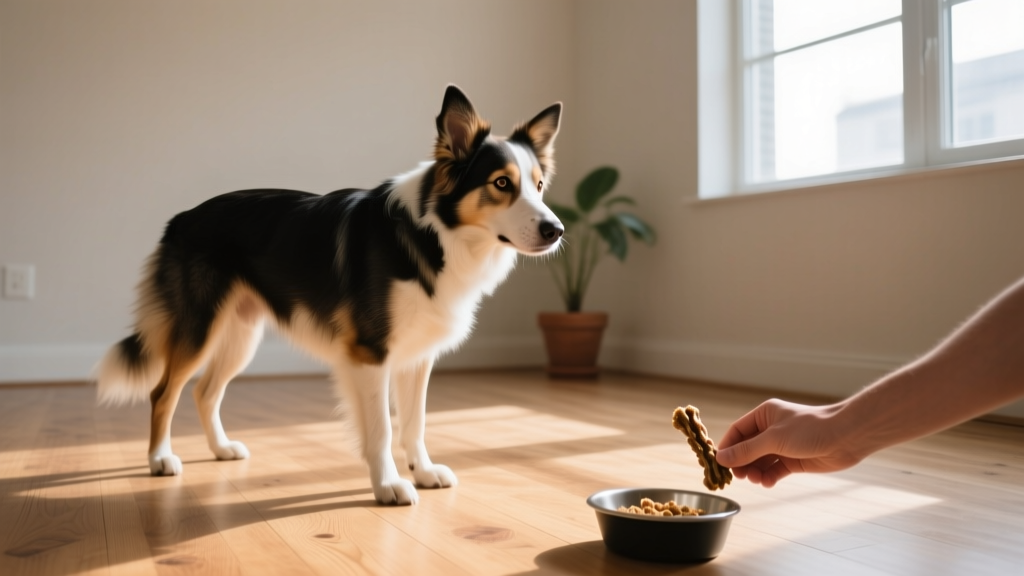
Carry high-value treats. Use real meat (boiled chicken, freeze-dried liver, or small pieces of hot dog) rather than kibble. The treat should be something your dog will work for even when mildly stressed. Keep pieces small — about the size of a pea — so you can deliver many rewards without overfeeding.
Never drag, pull, or force the dog forward. Applying leash pressure to a fearful or shut-down dog triggers an opposition reflex — the dog will brace harder. It also damages trust and can escalate to a panic response.
Step-by-Step Training Protocol to Stop Sit Down Dog Behavior
This protocol uses desensitization, counter-conditioning, and positive reinforcement. It assumes medical causes have been ruled out. Work at your dog's pace — rushing will set you back.
Phase 1: Rebuild Positive Associations with Walking Gear (Days 1–7)
Goal: Dog willingly approaches and engages with harness and leash without tension.
- Place the harness on the floor. When your dog sniffs or looks at it, mark with a clicker or the word "yes" and toss a high-value treat nearby.
- Repeat 10–15 times per session, 2–3 sessions per day.
- Progress to holding the harness open and luring the dog's head through with a treat. Reward generously.
- Clip the leash on indoors. Let the dog drag it for 5 minutes while you toss treats and play. This removes the leash as a predictor of "something scary is about to happen outside."
Phase 2: Threshold Desensitization (Days 7–21)
Goal: Dog can exit the front door and stand calmly on the doorstep or driveway without freezing.
- Open the front door. Step outside with your dog. Immediately scatter 5–10 treats on the ground within a 3-foot radius. Let the dog eat them at their own pace.
- If the dog sits and looks relaxed, mark and reward. If the dog shows stress signals (panting, trembling, ears back), shorten the distance — just open the door, treat, and close it.
- Gradually increase the distance from the door: doorstep → driveway → sidewalk → end of the yard.
- Spend 3–5 days at each distance before advancing. Do not move to the next distance until the dog is visibly relaxed (loose body, soft eyes, willing to eat treats) at the current distance.
Phase 3: Movement Engagement Games (Days 14–35)
Goal: Dog voluntarily moves forward on walks and associates movement with positive outcomes.
- Use the "Find It" game: toss a treat 2–3 feet ahead of the dog. When the dog moves to get it, say "yes" and toss another one further ahead. This creates forward momentum without leash pressure.
- Practice the "1-2-3 Walk" pattern: take one step, treat. Take two steps, treat. Take three steps, treat. Gradually increase the number of steps between treats.
- If the dog sits down during this phase, do not pull the leash. Instead, crouch beside the dog at their level, wait for them to make eye contact, mark it, and toss a treat a few feet ahead. Let the dog choose to move toward it.
Phase 4: Environmental Confidence Building (Days 28–60+)
Goal: Dog generalizes walking confidence to varied environments and stimuli.
- Walk at low-traffic times (early morning or late evening) to reduce environmental overwhelm.
- Introduce one new surface or environment per week: grass → gravel path → parking lot → quiet neighborhood street.
- Pair each new environment with scatter feeding and play (a favorite toy carried in your pocket).
- Practice "Look at That" (LAT) protocol from Leslie McDevitt's Control Unleashed program: when the dog notices a trigger (another dog, a loud truck) at a distance where they remain under threshold, mark and reward. This teaches the dog that noticing scary things predicts good outcomes rather than danger.
Tools That Help and Tools to Avoid
The right equipment supports your training; the wrong equipment can make sit down dog behavior worse or cause physical harm.
| Tool | Category | How It Helps | Price Range (2026) |
|---|---|---|---|
| Front-clip harness (Ruffwear Front Range, 2 Hounds Freedom) | ✅ Recommended | Gentle steering without neck pressure; reduces opposition reflex | $30–$50 |
| 6-foot biothane or leather leash | ✅ Recommended | Consistent length prevents accidental tension; easy to grip | $20–$45 |
| Treat pouch (Ruffwear Treat Trader or similar) | ✅ Recommended | Hands-free treat access for fast reward timing | $25–$40 |
| Snuffle mat or lick mat (used post-walk) | ✅ Recommended | Calming enrichment that lowers cortisol after stressful walks | $12–$25 |
| Calming supplements (L-theanine, Zesty Paws Calming Bites) | ⚠️ Adjunct only | May reduce baseline anxiety; consult your vet for appropriate use | $15–$30/month |
| Adaptil calming pheromone spray (applied to harness) | ⚠️ Adjunct only | Some dogs show reduced stress signals; evidence is mixed | $18–$25 |
| Shock collar / e-collar | ❌ Avoid | Suppresses behavior without addressing cause; increases fear and can trigger aggression | — |
| Prong collar / choke chain | ❌ Avoid | Pain-based; triggers opposition reflex; risks tracheal and cervical injury | — |
| Retractable leash | ❌ Avoid | Unpredictable tension; teaches dog that bracing creates pressure; poor control | — |
| Alpha rolls or physical force | ❌ Avoid | Damages trust; increases shutdown or defensive aggression; no scientific support per AVSAB position statement | — |
How Long Will It Take to Fix Sit Down Dog Behavior?
There is no universal timeline. Progress depends on the root cause, the dog's history, the consistency of training, and the individual dog's temperament. Here are realistic milestones based on clinical behavior modification experience:
| Timeframe | Expected Progress | Notes |
|---|---|---|
| Weeks 1–2 | Dog tolerates harness and leash indoors; shows comfort on doorstep | Foundation phase — do not expect full walks yet |
| Weeks 3–4 | Dog walks short distances (1–2 blocks) with treat engagement | May still freeze at specific triggers; that is normal |
| Weeks 5–8 | Dog walks moderate distances with fewer freeze episodes; recovers faster when triggered | Key phase for generalization to new routes |
| Weeks 8–16 | Dog walks confidently in familiar environments; occasional hesitation in novel areas | Continue exposure work; do not stop training |
| Months 4–6+ | Dog walks reliably in most environments; may always have specific trigger zones | Some dogs with deep fear histories will always need management at certain locations |
Important: Dogs with severe fear histories or trauma may require 6–12 months of consistent work. Dogs whose sit-down behavior was caused by a single negative experience (e.g., one dog fight on a walk) often recover faster than dogs with generalized anxiety or chronic under-socialization.
Is Sit Down Dog Behavior Normal?
Pausing during walks is completely normal — dogs explore the world through scent, and stopping to sniff is a natural, enriching behavior. However, chronic walk refusal where the dog will not resume walking despite encouragement is not typical and usually signals an underlying issue.
Context matters: a puppy on their first few walks who sits down is learning. A senior dog who suddenly stops walking after years of enthusiastic walks may be in pain. A recently adopted shelter dog who freezes on walks is likely overwhelmed and needs time. In all these cases, the behavior is understandable — but it still needs a structured response rather than waiting for it to "go away on its own."
When Do I Need a Professional Behaviorist?
Seek Professional Help If:
- Your dog's walk refusal is accompanied by aggression (growling, snapping, biting) when you attempt to move them
- The dog shows extreme fear responses: trembling, drooling, attempting to escape, or "shutting down" (becoming completely unresponsive)
- You have followed the training protocol above for 4+ weeks with no measurable progress
- The behavior is worsening despite your efforts
- You feel frustrated, overwhelmed, or are tempted to use punishment-based methods
Who to hire:
- Certified Applied Animal Behaviorist (CAAB) or DACVB (veterinary behaviorist): Best for severe fear, aggression, or cases where medication may be needed. A DACVB is a licensed veterinarian with residency training in behavior — they can prescribe anti-anxiety medication (such as fluoxetine or trazodone) alongside a behavior modification plan. Expect $250–$500 for an initial consultation.
- Certified Professional Dog Trainer (CPDT-KA or CPDT-KSA): Appropriate for moderate cases where the dog is not aggressive and fear levels are manageable. Expect $80–$150 per private session.
- IAABC-certified behavior consultant: A good middle ground for dogs with moderate anxiety who need a structured desensitization plan. Expect $100–$200 per session.
You can find certified professionals through the Certification Council for Professional Dog Trainers (CCPDT) directory or the American Veterinary Society of Animal Behavior (AVSAB).
Prevention: Setting Puppies and Newly Adopted Dogs Up for Success
Preventing sit down dog behavior is far easier than fixing it after it becomes a pattern. Whether you are bringing home a puppy or a newly adopted adult dog, these strategies build confident walkers from the start:
For puppies (8–16 weeks):
- Introduce the harness and leash indoors before the first outdoor walk. Let the puppy wear the harness during play and meal times for 10–15 minutes at a stretch.
- First outdoor experiences should be in quiet, low-traffic areas (your yard, a calm cul-de-sac). Carry the puppy to the area if needed, then let them explore on leash at their own pace.
- Keep early walks very short — 5 minutes per month of age is a general guideline (a 12-week-old puppy needs about 15 minutes of structured walking per day).
- Pair every new surface, sound, and sight with treats. The goal during the critical socialization window (up to 14–16 weeks per AVSAB puppy socialization guidelines) is to create as many positive associations as possible.
For newly adopted adult dogs:
- Allow a 3–7 day decompression period before expecting structured walks. Let the dog settle into the home, learn the routine, and build trust with you.
- Start walks in the quietest available area. Gradually expand the walking radius as the dog shows comfort.
- Use the "decompression walk" approach: long line (15–30 feet) in a safe, enclosed area where the dog can sniff and explore without directional pressure. This builds positive associations with being on leash outdoors.
- Watch for stress signals and respect them. If the dog sits and looks overwhelmed, do not force movement — create distance from the trigger and reward calm behavior.
Frequently Asked Questions
Should I use punishment to correct my dog for sitting down on walks?
No. Punishment — including leash corrections, yelling, shock collars, or physical force — suppresses the visible behavior without addressing the underlying cause. A fearful dog who is punished for freezing will not become less fearful; they will learn to suppress warning signals, which can lead to sudden aggression. The AVSAB explicitly recommends against aversive methods, citing evidence that they increase stress and damage the human-animal bond. Use positive reinforcement and counter-conditioning instead.
My dog sits down every time they see another dog on our walk. What should I do?
This is likely a fear-based freeze response triggered by the other dog. Increase distance immediately — cross the street, turn around, or step behind a visual barrier (a parked car, a hedge). At the new distance where your dog can see the other dog without freezing, reward calm behavior with high-value treats. Over time, use systematic desensitization to gradually decrease the distance at which your dog can remain relaxed. This is the core of the "Look at That" (LAT) protocol. If your dog is reacting at every distance, consult a certified behavior professional.
Is my dog being stubborn or lazy when they sit down on walks?
Dogs do not sit down on walks out of spite, stubbornness, or a desire to "win" a power struggle. These are human interpretations projected onto canine behavior. When a dog refuses to walk, they are experiencing something that makes movement feel unsafe, uncomfortable, or overwhelming. Labeling the dog as "stubborn" often leads owners to use force, which makes the problem worse. Reframing the behavior as communication — "my dog is telling me something is wrong" — leads to more effective solutions.
My senior dog used to love walks but now sits down after a few minutes. Is this just aging?
While some slowing down is normal with age, a dramatic change in walk willingness warrants a veterinary exam. Osteoarthritis affects an estimated 20% of adult dogs and over 65% of dogs over age seven, according to veterinary literature referenced in the Merck Veterinary Manual. Your vet can recommend pain management options including NSAIDs (such as carprofen or meloxicam), joint supplements (glucosamine/chondroitin, omega-3 fatty acids), physical therapy, or newer options like Adequan injections or Librela (bedinvetmab) for osteoarthritis pain. Treating the pain often restores walk enthusiasm significantly.
Can I still walk my dog while working on this training protocol?
Yes, but modify your walks to stay within your dog's comfort zone. Short, positive walks are better than long walks that end in a freeze episode. If your dog typically freezes after 5 minutes, walk for 3 minutes and end on a positive note with a treat scatter or a short play session. You can supplement physical exercise with indoor enrichment: puzzle feeders (Kong Classic, $12–$18; Outward Hound Nina Ottosson puzzles, $15–$30), scent work games, and short training sessions. Mental stimulation can be as tiring as physical exercise for many dogs.
Dr. Hannah Wickes
All our authors care for dogs every day — read more of their work on the authors page.