Resource Guarding Dog Training
Evidence-based resource guarding dog training guide covering root causes, step-by-step desensitization protocols, management tools, and when to hire a behaviorist.

If your dog stiffens, growls, snaps, or lunges when you approach their food bowl, favorite toy, or even a stolen sock, you're dealing with resource guarding. It's one of the most common behavioral issues dog owners face — and one of the most misunderstood. The good news: with consistent, force-free resource guarding dog training, most dogs show significant improvement within weeks to months.
This guide walks you through exactly what resource guarding looks like, why it happens, and a detailed step-by-step protocol based on desensitization and counter-conditioning principles endorsed by certified applied animal behaviorists. We'll also cover when medical issues might be driving the behavior, what tools actually help, and when it's time to call in a professional.
What Resource Guarding Actually Looks Like
Resource guarding is a defensive behavior where a dog uses threat displays or aggression to maintain control over a valued item, location, or person. It is not dominance, spite, or jealousy — it's a dog communicating that they feel their access to something important is under threat.
Guarding behavior exists on a continuum. Not every dog will show all signs, and escalation can happen quickly or slowly depending on the dog's history, temperament, and the context.
- Level 1 — Early Warning: Freezing, hard stare, accelerated eating, lip licking, body blocking the item
- Level 2 — Active Warning: Low growl, snarl (lip curl showing teeth), ears pinned back, whale eye (whites of eyes visible)
- Level 3 — Defensive Action: Snap (air bite with no contact), lunge toward the approaching person or animal
- Level 4 — Contact Bite: Bite with skin contact, ranging from inhibited (no puncture) to full-force
A dog can jump from Level 1 to Level 4 in under two seconds, especially if early warning signals have been punished in the past. This is why recognizing Level 1 signs is critical for safety.
Resources commonly guarded include: food bowls, high-value chews (bully sticks, rawhide), stolen items (shoes, trash), sleeping locations (beds, crates, couches), toys, and sometimes people (guarding one family member from another). According to the Merck Veterinary Manual, food-related guarding is the most prevalent form, affecting an estimated 15–20% of pet dogs to some degree.
Root Causes: Why Does My Dog Guard Resources?
Understanding the underlying driver changes how you approach training. Most resource guarding stems from one or more of these factors:
- Scarcity History (Fear-Based): Dogs from shelters, puppy mills, or multi-dog homes where food was limited or competed for often develop guarding as a survival strategy. This is the most common cause in adopted adult dogs.
- Genetic Predisposition (Temperament): Some lines within breeds carry higher anxiety or possessiveness tendencies. Herding breeds and certain terrier lines may show higher rates. This doesn't mean the behavior can't be modified — it means training may take longer.
- Inadvertent Reinforcement (Learned Behavior): If a dog growled and the person backed away, the dog learned that growling works. If items were repeatedly taken by force, the dog learned to escalate to biting. Well-meaning owners can accidentally create guarding through confrontational "dominance" exercises.
- Pain or Medical Discomfort: A dog in pain (dental disease, arthritis, gastrointestinal issues) may guard more intensely because they feel vulnerable. This is especially common in sudden-onset guarding in previously relaxed dogs.
- Understimulation / Boredom: Dogs with insufficient mental and physical enrichment may fixate on items as their only source of engagement, making those items disproportionately valuable and worth defending.
Medical Rule-Out: Check This Before Training
Before starting any behavior modification program, rule out medical causes — especially if the guarding appeared suddenly, escalated rapidly, or occurs in a dog over 7 years old. Pain is one of the most underdiagnosed contributors to aggression in dogs, according to research published in the Journal of Veterinary Behavior.
Schedule a full veterinary exam if your dog shows any of these red flags alongside guarding behavior:
- ☐ Sudden onset of guarding in a previously relaxed dog (no prior history)
- ☐ Guarding only specific body positions (e.g., only when lying down — possible orthopedic pain)
- ☐ Increased irritability around mealtimes (possible GI pain, dental disease, or nausea)
- ☐ Weight changes, excessive thirst, or coat changes (possible thyroid dysfunction — hypothyroidism is linked to behavioral changes in dogs)
- ☐ Disorientation, staring, or changes in sleep-wake cycles (possible cognitive dysfunction in senior dogs)
- ☐ Guarding that worsens despite consistent training (may indicate neurological issues or chronic pain)
What to ask your vet: Request a complete blood panel (CBC, chemistry, thyroid panel), dental exam, and orthopedic assessment. For dogs over 8, ask about cognitive dysfunction screening. Always consult your veterinarian before attributing behavioral changes to training issues alone.
Immediate Management: Stop the Rehearsal Cycle
Every time your dog rehearses guarding behavior — growling, snapping, or biting — the neural pathway strengthens. Management prevents rehearsal while you work on the underlying training protocol. Think of management as buying time and keeping everyone safe.
Environmental changes to implement today:
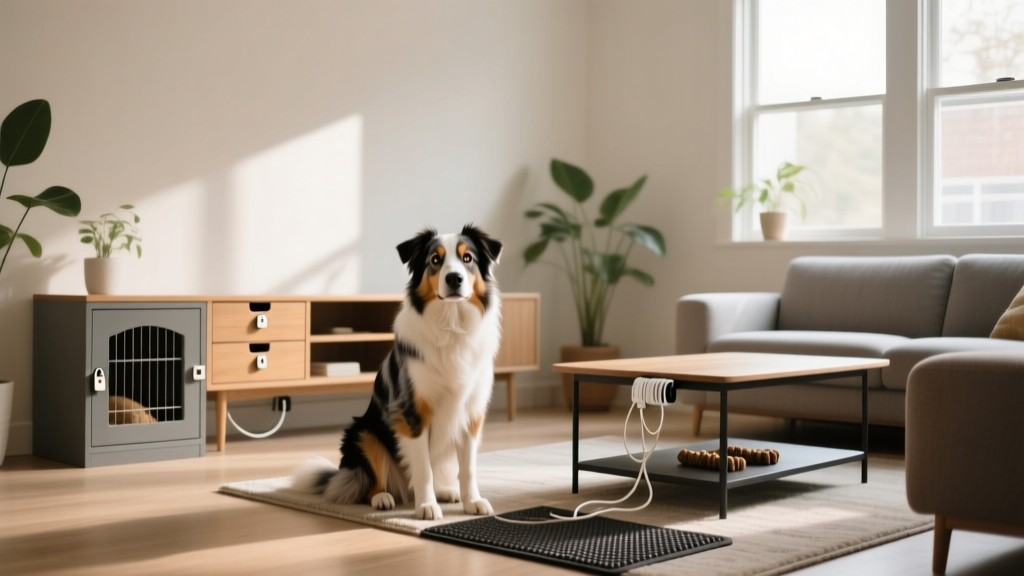
- Pick up all guardable items when not in supervised use. Shoes go in closets. Trash cans get lids. Children's toys stay behind gates.
- Feed in a closed room or crate. No approaching during meals. No other pets in the room. Put a sign on the door if you have guests or children.
- Trade-up protocol for stolen items: Never chase a dog or pry something from their mouth. Instead, offer something dramatically higher value (real chicken, cheese, freeze-dried liver) at a distance. When they drop the item to take the food, calmly pick up the item. Do not give the item back immediately — this erodes trust in the trade game.
- Use baby gates and exercise pens to create dog-free zones during high-risk times (family meals, children playing).
- Muzzle train proactively. A basket muzzle (we recommend the Baskerville Ultra or BUMAS, $25–$65) is a safety tool, not a punishment. Condition it with peanut butter and treats over 1–2 weeks before needing it.
Household rules during the training period:
- No one approaches the dog while eating — period
- Children must never be near a dog with a high-value chew
- All family members follow the same protocol (inconsistency sabotages progress)
- Log every guarding incident: date, item, distance of approach, dog's response level
Step-by-Step Resource Guarding Dog Training Protocol
This protocol uses desensitization (gradually reducing the dog's emotional reaction to your approach) and counter-conditioning (changing the emotional response from "threat" to "good things happen"). It's based on force-free, positive reinforcement methods aligned with the American Veterinary Society of Animal Behavior (AVSAB) position on humane training.
- Identify all guarded items and rank them by intensity (low, medium, high value).
- Measure the dog's "threshold distance" — the distance at which they first show tension (freezing, hard stare) when you approach while they have a medium-value item. For many dogs, this is 6–10 feet.
- Record these baselines. You'll use them to measure progress.
- Give your dog a medium-value item (a regular kibble-stuffed Kong, not a bully stick).
- Stand at a distance where your dog shows ZERO tension (typically 10–15 feet to start).
- Toss a high-value treat (small piece of chicken or cheese) toward the dog, then immediately walk away.
- Repeat 10–15 times per session, 2 sessions per day.
- The goal: your dog starts looking UP at you expectantly when you approach, because your approach predicts treats — not theft.
- Key rule: Never take the item during this phase. Your approach must always mean addition, never subtraction.
- Reduce your approach distance by 1–2 feet every 3–4 sessions — only if the dog remains relaxed (no freezing, no hard stare, continues eating normally).
- If the dog shows tension at the new distance, move back to the previous distance for 2–3 more sessions before trying again.
- Begin varying your approach angle (not always head-on) and speed (not always the same pace).
- Once you can stand 2–3 feet away with no tension, begin approaching and adding a high-value treat directly to the bowl or placing it next to the chew.
- Practice with different people (adult family members first, then supervised older children).
- Introduce the "trade" cue: offer the high-value treat, and when the dog voluntarily drops the item, say "trade" and give the treat. Then return the original item 50% of the time so the dog learns that giving things up doesn't always mean losing them.
- Practice with higher-value items (bully sticks, favorite toys).
- Practice in different rooms, different locations, with different family members.
- Continue random "approach and add" sessions 2–3 times per week indefinitely to maintain the behavior change.
- Never go back to forcibly taking items — this will undo months of progress in a single incident.
Training Tools That Help (and Ones to Avoid)
The right tools support your protocol. The wrong ones make guarding worse by increasing fear and anxiety.
| Tool | Type | How It Helps | Cost Range |
|---|---|---|---|
| Kong Classic / West Paw Toppl | ✅ Recommended | Puzzle feeders slow eating, reduce mealtime anxiety, and make food less "grab-and-guard" prone | $12–$25 |
| Snuffle Mat / Lick Mat | ✅ Recommended | Disperses food over a wide area, eliminating a single "point" to guard; licking is self-soothing | $10–$30 |
| Basket Muzzle (Baskerville Ultra) | ✅ Recommended | Safety during high-risk scenarios (vet visits, introductions). Allows panting and treat-taking | $25–$65 |
| Exercise Pen / Baby Gates | ✅ Recommended | Creates safe separation during meals and high-value chew time without isolation | $35–$80 |
| Calming Aids (Adaptil diffuser, Zesty Paws calming chews) | ✅ Supportive | May lower baseline anxiety, making the dog more receptive to training. Not a standalone fix | $20–$50 |
| Shock / E-Collar | ❌ Avoid | Punishes warning signals without addressing fear. Suppresses growling, which leads to bites without warning | — |
| Alpha Rolls / Dominance Techniques | ❌ Avoid | Increases fear and defensive aggression. AVSAB has formally advised against confrontational methods since 2008 | — |
| Prong / Choke Collars | ❌ Avoid | Pain-based correction increases stress and can redirect aggression toward the handler | — |
| "Nothing in Life Is Free" (NILIF) Forced Compliance | ❌ Avoid | Rigidly requiring sits for everything can increase anxiety in already stressed dogs. Use cues, not control | — |
Realistic Timeline: How Long Will It Take?
Resource guarding doesn't have a fixed cure date. Progress depends on the dog's history, severity, consistency of training, and whether underlying medical or anxiety issues are being addressed simultaneously. Here's what a realistic timeline looks like based on typical cases:
| Timeframe | What You Should See | If You Don't See This |
|---|---|---|
| Week 1–2 | Dog begins to look up expectantly when you approach at sub-threshold distance. Reduced tension at original threshold distance. | Check distance — you may be too close. Reduce treat size or increase value. |
| Week 3–6 | You can approach to within 3–4 feet of a medium-value item with no guarding signals. Dog may voluntarily move away from item when you approach. | Reassess for medical causes. Ensure all household members are following protocol consistently. |
| Week 6–12 | You can approach within 1–2 feet, add treats to bowl, and practice trades with medium-value items. Dog willingly drops items for high-value treats. | Consider adding a veterinary behaviorist consult. Dog may need anti-anxiety medication to facilitate learning. |
| Month 3–6 | Generalized improvement across different items, locations, and people. Occasional regression under stress is normal. | Continue maintenance sessions. If regression is severe, revisit Phase 2. |
| Ongoing | Maintenance sessions 2–3 times per week. Some dogs will always need management around their highest-value items. | This is normal. "Cured" is the wrong goal — "safely managed with strong training" is realistic. |
When to Hire a Professional Behaviorist
Not every case of resource guarding requires professional help — mild food bowl guarding in a dog that only freezes (Level 1) can often be resolved with the protocol above. But certain situations demand expert intervention.
- Your dog has bitten anyone (skin contact), especially a child
- Guarding occurs around multiple resource types (food + toys + locations + people)
- The dog guards spaces aggressively (won't let you enter a room, blocks hallways)
- You've followed the protocol for 4+ weeks with zero improvement
- The dog is over 60 lb / 27 kg and has shown Level 3+ behavior (snap or lunge) — the physical risk is substantial
- You have young children (under 10) in the home — children are disproportionately the victims of resource guarding bites due to unpredictable movement and proximity
- The guarding is accompanied by other behavioral issues (separation anxiety, leash reactivity, fear aggression)
Who to hire — and what it costs:
| Professional Type | Credentials to Look For | What They Do | Typical Cost (2026) |
|---|---|---|---|
| Veterinary Behaviorist | DACVB (Diplomate of the American College of Veterinary Behaviorists) | Full medical + behavioral assessment. Can prescribe anti-anxiety medications (fluoxetine, clomipramine, trazodone). Best for severe or medically complex cases. | $250–$500 initial consult; $100–$200 follow-ups |
| Certified Applied Animal Behaviorist | CAAB or ACAAB (Animal Behavior Society certification) | Behavioral assessment and training plans. Cannot prescribe medication but works alongside your vet. | $150–$350 initial consult |
| Certified Professional Dog Trainer | CPDT-KA or CPDT-KSA (Certification Council for Professional Dog Trainers) | Hands-on training sessions, coaching you through the protocol. Best for mild to moderate cases. | $75–$150 per session; $500–$1,200 for a package |
| IAABC Certified Behavior Consultant | CBCC-KA or CDBC (International Association of Animal Behavior Consultants) | Behavior consulting with structured modification plans. Good middle ground between trainer and behaviorist. | $100–$250 per session |
You can find credentialed professionals through the AVSAB directory, the Certification Council for Professional Dog Trainers (ccpdt.org), or the IAABC (iaabc.org). Always ask about their approach to aggression cases — if they mention "dominance," "pack leadership," or recommend e-collars, look elsewhere.
Prevention: Starting Right With Puppies and Newly Adopted Dogs
Is resource guarding normal? In a limited sense, yes — it's a natural survival behavior. Puppies from large litters where food was scarce may show early guarding tendencies, and it's not unusual for a newly adopted shelter dog to guard food during the first weeks in a new home. But "normal" doesn't mean "acceptable to live with." Prevention is far easier than remediation.
For puppies (8–16 weeks — critical socialization window):
- Hand-feed meals at least 2–3 times per week during the first month. This establishes that human hands near food = good things.
- Practice approach-and-add from day one: walk past the puppy's bowl and drop in a piece of chicken. Do this every single meal.
- Trade games: Give the puppy a toy, then offer a treat. When they drop the toy, say "trade" and give the treat. Then give the toy back. Repeat until the puppy eagerly drops items on cue.
- Never punish growling. Growling is communication. Punishing it teaches the dog to skip the warning and go straight to biting.
- Socialize around food: Have different family members and (safe, vaccinated) visiting adults practice approaching the puppy while eating.
For newly adopted adult dogs (first 30 days — decompression period):
- Feed in a quiet, closed room for the first 2 weeks minimum. Do not test the dog by approaching during meals — let them decompress.
- Introduce the trade game with low-value items first before testing with high-value chews.
- Observe and log: what items does the dog gravitate toward? What triggers tension? Build your baseline before starting formal training.
- Separate from other household pets during all meals and chew sessions for at least the first month.
- Recognize that shelter dogs may guard more intensely in the first 2–4 weeks as they adjust. This often decreases as the dog settles and learns that resources are reliable.
Frequently Asked Questions
Why does my dog resource guard?
Resource guarding is driven by the dog's perception that a valued item might be taken away. The most common causes are a history of scarcity (common in shelter and rescue dogs), genetic predisposition toward anxiety or possessiveness, inadvertent reinforcement (the dog learned that growling makes people back off), pain or medical issues, or insufficient enrichment causing items to become disproportionately valuable. Most dogs guard out of fear, not dominance.
How do I stop my dog from resource guarding?
The most effective approach combines immediate management (preventing rehearsal of the behavior) with a structured desensitization and counter-conditioning protocol. Start by identifying your dog's threshold distance, then practice approaching at sub-threshold distances while tossing high-value treats. Gradually decrease distance over weeks as the dog's emotional response shifts from "threat" to "good things happen when humans approach." Never forcibly take items — this escalates guarding. For moderate to severe cases, work with a certified professional (CPDT-KA, CAAB, or DACVB).
Is resource guarding normal dog behavior?
It's a natural survival behavior that exists in the normal canine behavioral repertoire. An estimated 15–20% of pet dogs show some degree of resource guarding. However, "natural" doesn't mean safe or acceptable in a household. Dogs that guard at Level 2 (growl) or above pose a bite risk and need structured intervention. Mild guarding (accelerated eating when approached) can often be resolved with simple approach-and-add exercises.
How long will it take to fix resource guarding?
For mild food bowl guarding with a cooperative dog, expect noticeable improvement in 3–6 weeks with daily practice. Moderate cases involving multiple items or higher-level warning signals typically take 2–4 months. Severe cases with bite history or generalized guarding may require 6+ months of professional-guided work, and some level of ongoing management is usually permanent. There is no guaranteed timeline — progress depends on consistency, the dog's history, and whether underlying medical or anxiety issues are addressed.
Should I use punishment to correct resource guarding?
No. Punishment-based corrections — including shock collars, alpha rolls, leash corrections, yelling, or forcibly taking items — consistently worsen resource guarding. The AVSAB and the American Kennel Club both recommend against aversive methods for aggression-related behaviors. Punishment suppresses warning signals (growling, freezing) without changing the underlying fear, which leads to dogs that bite without warning. Force-free methods (desensitization, counter-conditioning, positive reinforcement) have stronger evidence for long-term success and carry no risk of escalating aggression.
When do I need a professional behaviorist?
Consult a credentialed professional (veterinary behaviorist, CAAB, or experienced CPDT-KA) if: your dog has bitten someone; guarding involves multiple resource types; you have young children in the home; you've followed a structured protocol for 4+ weeks with no improvement; or the guarding is part of a broader pattern of fear or anxiety. A veterinary behaviorist (DACVB) is the best choice for severe cases because they can assess medical contributors and prescribe anti-anxiety medication if needed.
Can resource guarding be completely cured?
Many dogs reach a point where guarding behavior is no longer observable in daily life. However, under high stress, illness, or novel situations, the behavior can resurface. The most accurate framework is "safely managed and significantly improved" rather than "cured." Ongoing maintenance sessions (approach-and-add, trade practice) 2–3 times per week help sustain progress indefinitely.
Is it safe to work on resource guarding with children in the home?
Children are at higher risk for resource guarding bites because they move unpredictably, are closer to the dog's level, and may not recognize warning signals. During active training, children should be separated from the dog during all meals and chew sessions. If a child has been growled at, snapped at, or bitten, professional intervention is non-negotiable before any further child-dog interaction around resources.
Resource guarding is one of the most modifiable behavioral issues in dogs when approached with patience, consistency, and the right methods. The key is starting early, managing the environment to prevent rehearsal, and building your dog's trust that human proximity to their valued items always means something good — never something taken away. If you're feeling overwhelmed or unsafe, there's no shame in calling a professional. That's what they're there for.
Tom Renshaw
All our authors care for dogs every day — read more of their work on the authors page.